


B2B cold calling is legal in the US, the UK, the EU, Canada and Australia, but each one limits how you dial, which numbers you screen and when you call. The b2b cold calling laws that catch sales teams are the same three everywhere: machines (autodialers, recorded and AI voices), do-not-call registers that cover some business numbers, and calling hours.
Below: the rules by country with primary sources, a comparison table, a pre-call checklist and the records to keep. For the craft itself, see our complete cold calling guide.
Is B2B cold calling legal?
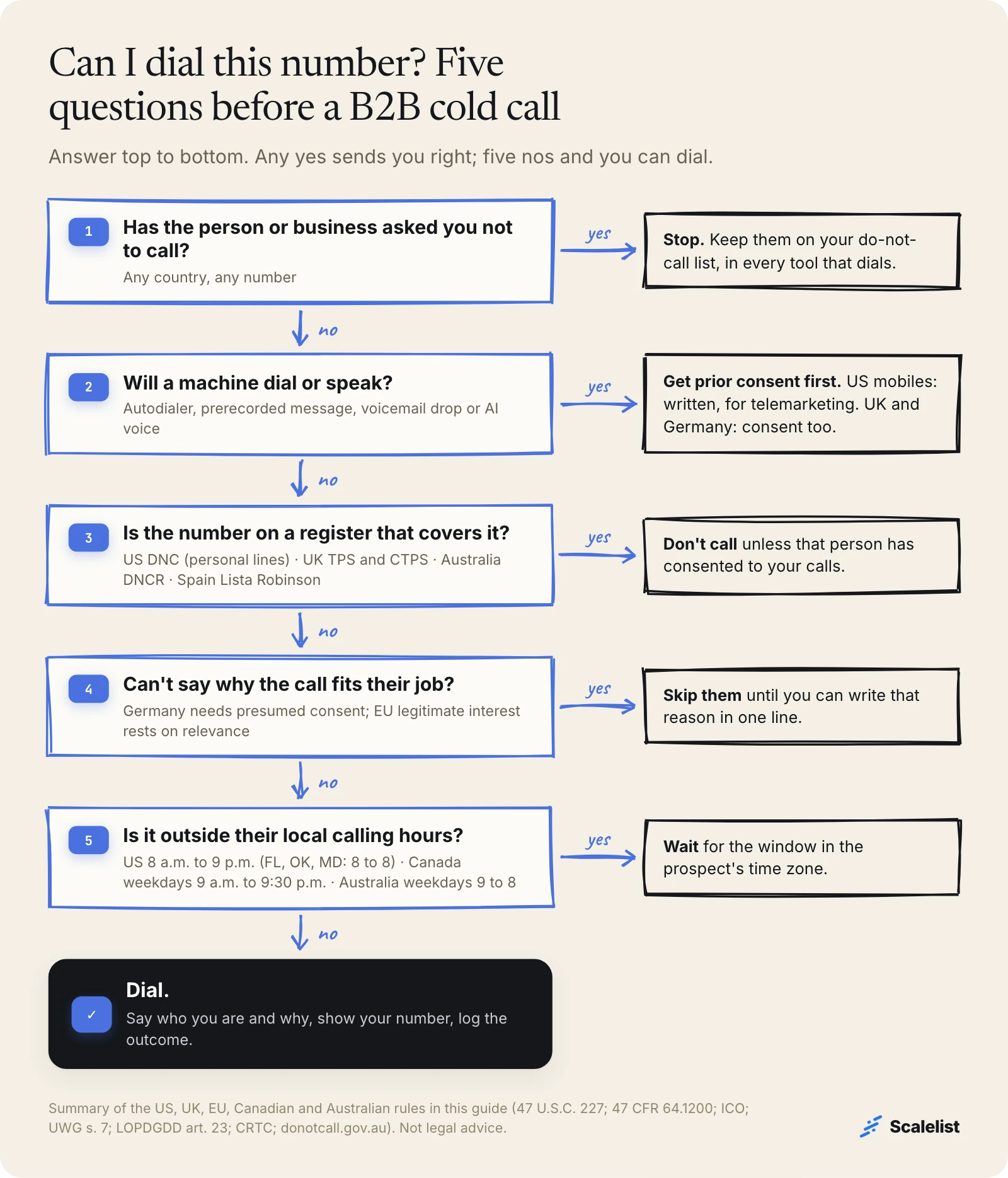
Yes. A live, hand-dialed sales call to a business is legal in the US, the UK, the EU, Canada and Australia when you screen the registers that apply, say who you are, call within local hours and stop when asked. The US, Canadian and Australian national do-not-call lists exempt or exclude most business numbers.
Two things change the answer: the number and the method. A personal mobile can be protected like a consumer line, a machine that dials or speaks usually needs prior consent, and in the UK and EU a call to a named person also processes their personal data under the GDPR. Germany adds a test: a concrete reason to believe the business wants the call.
United States: TCPA, Do Not Call and state laws
US cold calls fall under the Telephone Consumer Protection Act (TCPA) and the Federal Communications Commission (FCC) rules under it, the Federal Trade Commission’s (FTC) Telemarketing Sales Rule (TSR), and state laws. The type of number decides most of it.
TCPA cold calling: mobiles, landlines and autodialers
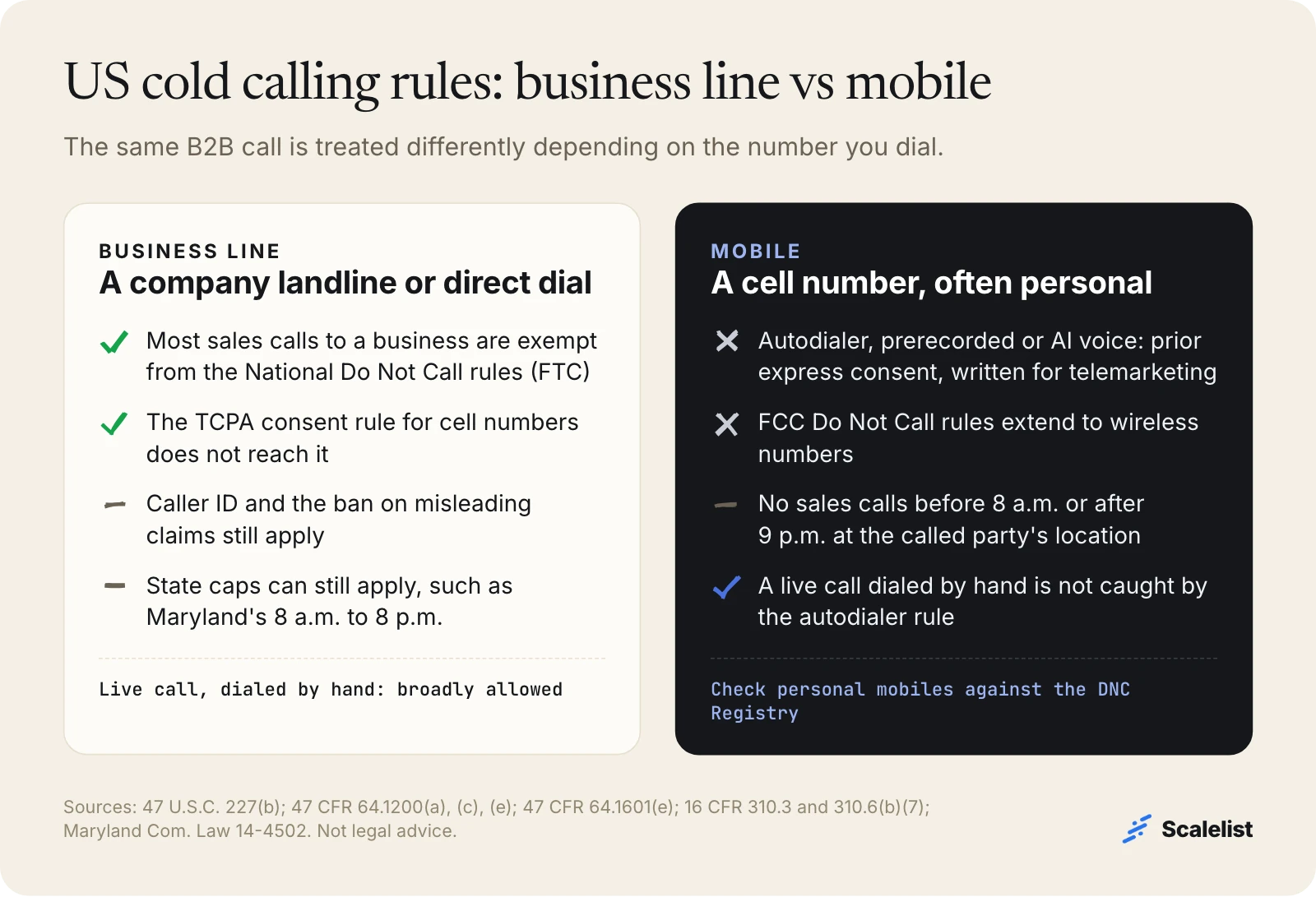
The TCPA’s consent rule protects cell numbers, not consumers. Calls to a cell number made with an automatic telephone dialing system (ATDS) or an artificial or prerecorded voice need prior express consent (47 U.S.C. 227), written for telemarketing (47 CFR 64.1200). The buyer’s job title does not matter.
Autodialers. Since Facebook v. Duguid (2021), a device is an ATDS only if it can store or produce numbers using a random or sequential number generator (opinion). Ask your vendor how its power dialer or parallel dialer places calls, and have counsel confirm before it dials mobiles.
AI voices and voicemail drops. The FCC confirmed in February 2024 that AI-generated voices count as artificial voices under the TCPA (FCC 24-17). Treat AI voice agents and prerecorded voicemail drops as consent-only features on US mobiles.
Business landlines. A live call to a company’s landline or direct dial sits outside the cell-number consent rule and, in most cases, outside the Do Not Call rules. Which one connects better: direct dial vs mobile.
Do Not Call list for B2B: the exemption and its limits
Most B2B cold calls are exempt from the National Do Not Call Registry: the TSR exempts calls to businesses (16 CFR 310.6), and FTC guidance says most sales calls to a business are exempt (FTC). The exemption has three limits:
- No misrepresentation. The TSR’s bans on misrepresenting material facts and on false or misleading statements still apply (16 CFR 310.3).
- Office and cleaning supplies sold to businesses are not exempt.
- Personal mobiles are the grey area. FCC Do Not Call rules protect residential subscribers, wireless numbers included, so protection follows the personal nature of the number, not your purpose.
Penalties. Someone who gets more than one violating call in 12 months can sue for up to 500 USD per call, trebled if willful. The FTC’s guidance (edited September 2025) cites fines of up to 53,088 USD per violation, and each call may count.
Calling hours and caller ID
Federal rules bar telephone solicitations to residential subscribers, wireless numbers included, before 8 a.m. or after 9 p.m. at the called party’s location. Plan your blocks with our data on the best times to cold call.
Anyone who telemarkets, B2B included, must transmit caller ID and must not block it, and the number shown must accept do-not-call requests during business hours (47 CFR 64.1601).
State laws: Florida, Oklahoma and Maryland
State telemarketing laws, often called mini-TCPAs, go further than the federal rules. These three share an 8 a.m. to 8 p.m. window and a cap of three calls per 24 hours on the same subject:
| State | Hours and frequency | Automated dialing | How B2B is treated |
|---|---|---|---|
| Florida | 8 a.m. to 8 p.m.; 3 calls per 24 hours | Written consent for “selection and dialing” systems (consumer calls) | Caps cover calls selling consumer goods or services; the B2B exemption does not lift them |
| Oklahoma | 8 a.m. to 8 p.m.; 3 calls per 24 hours | Written consent for “selection or dialing” systems | Exempt only in narrow cases, such as 3 years under one name plus 50% repeat sales |
| Maryland | 8 a.m. to 8 p.m.; 3 calls per 24 hours | Written consent for “selection or dialing” systems | Consent rule skips B2B sellers with 3 years under one name; the hours rule has no B2B carve-out |
Maryland’s Stop the Spam Calls Act (in force since 1 January 2024) presumes that a call to a Maryland area code reaches a resident or someone with a place of business there (Com. Law 14-4503). Florida and Oklahoma allow private suits for 500 USD per violation, trebled if willful.
With other states in play, the simplest national policy is 8 a.m. to 8 p.m. in the prospect’s time zone.
Recording is a separate law. California bars recording a confidential communication without the consent of all parties (Penal Code 632). If your dialer records, say so up front.
United Kingdom: TPS, CTPS and PECR
In the UK, live B2B marketing calls are allowed on an opt-out basis under the Privacy and Electronic Communications Regulations (PECR). The Information Commissioner’s Office (ICO) spells out what that means for business calls (ICO B2B guidance):
- Screen both registers. Check the Corporate Telephone Preference Service (CTPS), the Telephone Preference Service (TPS) and your own do-not-call list before live calls.
- Sole traders and mobiles can be on the TPS. Sole traders and some partnerships are treated like individuals. A new registration takes effect after 28 days (ICO live calls).
- Say who is calling and display a number people can call back.
- Automated calls need specific consent, including from businesses.
- UK GDPR applies to the named person you call.
The Data (Use and Access) Act 2025 counts attempted calls as calls, not only answered ones (ICO summary). The ICO says the Act lets it fine up to £17.5 million or 4% of global turnover under PECR (ICO statement). More on UK business mobiles.
EU: cold calling and the GDPR, plus national rules
In the EU, a B2B cold call needs a legal basis under the General Data Protection Regulation (GDPR) and must follow the called country’s own calling rules. A named person’s number is personal data, even at work.
The GDPR part is the same everywhere. Recital 47 says direct marketing “may be regarded as carried out for a legitimate interest”, after a balancing test, and the right to object to it is unconditional (EDPB Guidelines 1/2024). Fines reach 20 million EUR or 4% of annual turnover, whichever is higher (EDPB Guidelines 04/2022). More in B2B contact data and the GDPR.
The calling rules are national. Three examples:
- Germany is the strictest for B2B: phone advertising to a business needs at least presumed consent (mutmaßliche Einwilligung), a concrete reason to believe it wants the call. Consumers need prior express consent, and automated calling machines need it from everyone (UWG section 7). The fine of up to 300,000 EUR covers consumer calls (UWG section 20). More: German business mobiles.
- France has required consumer consent since 11 August 2026 and repealed the Bloctel list (Code de la consommation). For professionals, the CNIL accepts legitimate interest when the offer relates to the person’s job, with a free, easy way to object (CNIL).
- Spain allows unwanted commercial calls only with consent or another GDPR legal basis, and automated calls need prior consent (Ley 11/2022, art. 66). Before direct marketing, you must check the exclusion lists (LOPDGDD, art. 23); the regulator names the Lista Robinson as the common one (AEPD).
Other member states set their own rules; check each one before the first dial.
Canada: National DNCL and the Telemarketing Rules
In Canada, calls to businesses are exempt from the National Do Not Call List (DNCL), but the CRTC’s other telemarketing rules still apply. Of its three rule sets (the Telemarketing Rules, the Automatic Dialing-Announcing Device or ADAD Rules, and the National DNCL Rules), only the last exempts B2B calls (National DNCL exemptions).
- Business numbers are out of scope, including personal numbers also used for business (who can still call you).
- Register anyway. Organizations must register with the National DNCL Operator even when all their calls are exempt; only non-exempt callers must also subscribe (telemarketer FAQ).
- Keep an internal do-not-call list. Add a number within 14 days of the request and keep it for three years.
- Identify yourself at the start of the call, and follow the ADAD Rules if a machine dials or speaks.
- Calling hours: 9:00 a.m. to 9:30 p.m. on weekdays and 10:00 a.m. to 6:00 p.m. on weekends (CRTC).
- Calls from abroad count. The rules apply wherever the call originates.
The CRTC can impose penalties of up to C$1,500 per violation for individuals and C$15,000 for corporations (consumer FAQ). On the data side, PIPEDA, Canada’s federal privacy law, does not apply to business contact information used only to reach someone about their work (PIPEDA, s. 4.01).
Australia: Do Not Call Register and the Industry Standard
In Australia, business numbers cannot be on the Do Not Call Register, but the telemarketing Industry Standard covers every sales call, B2B included.
- The Register. Business numbers are not eligible. A number used for both business and personal purposes can be registered if it is used mostly for private purposes (Register FAQs), so an owner-operator’s mobile may be on it.
- The Industry Standard 2017 applies to all voice calls to Australian numbers that promote goods or services, even from callers exempt from the Register (Industry Standard).
- Hours: 9 a.m. to 8 p.m. on weekdays, 9 a.m. to 5 p.m. on Saturdays, no calls on Sundays or national public holidays.
As published by the Register, courts can impose up to A$2.22 million per day of contravention, and Industry Standard breaches carry up to A$250,000 each (compliance and breaches). More on Australian business mobiles.
B2B cold calling laws by country: the table
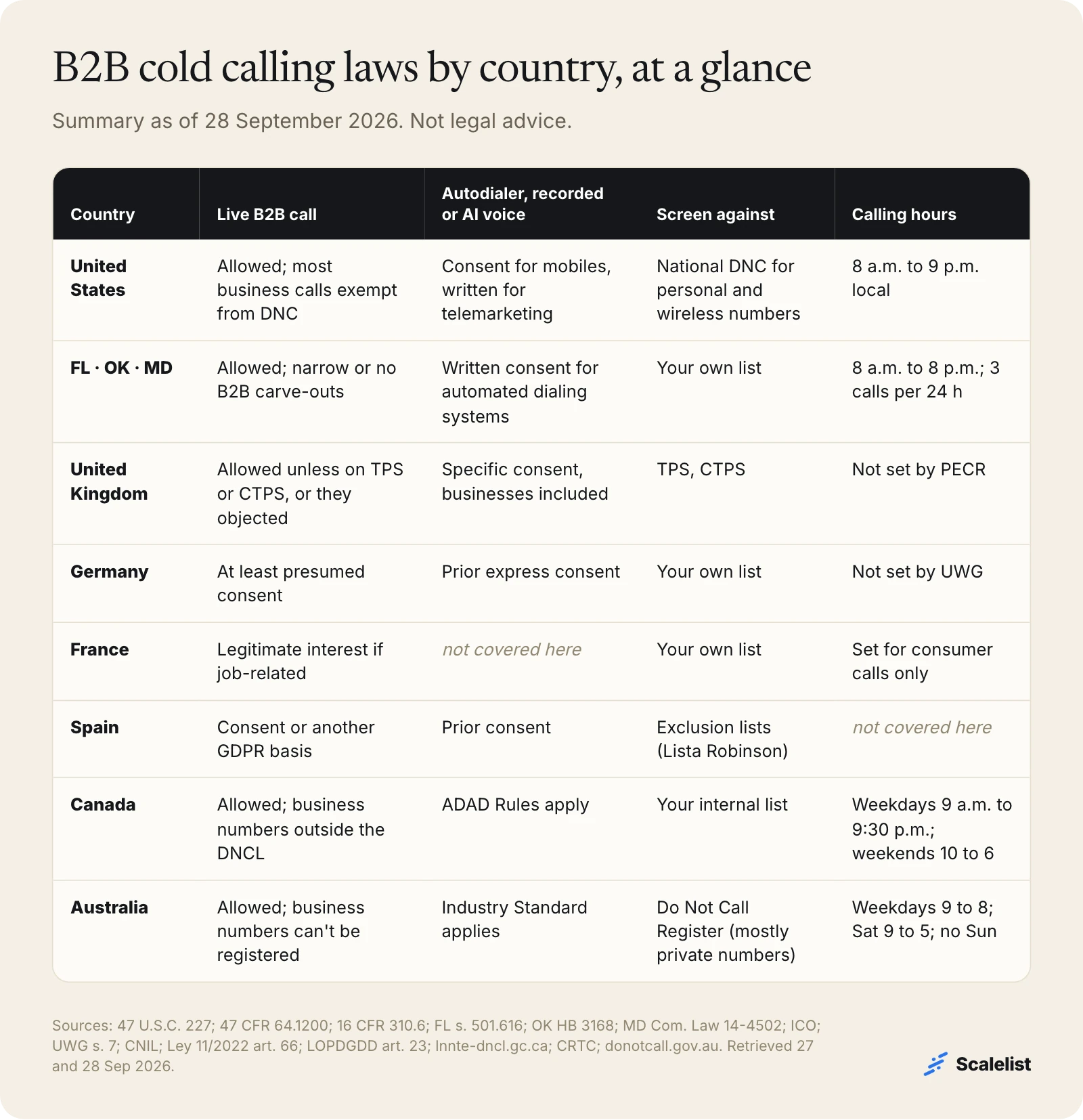
B2B cold calling laws differ most on machines, registers and hours; the live call itself is broadly allowed in every country here.
| Country | Live B2B call | Autodialer, recorded or AI voice | Screen against | Calling hours |
|---|---|---|---|---|
| United States | Allowed; most exempt from DNC | Consent for mobiles, written for telemarketing | DNC for personal and wireless numbers | 8 a.m. to 9 p.m. local |
| Florida, Oklahoma, Maryland | Allowed; narrow or no B2B carve-outs | Written consent for automated dialing | Your own list | 8 a.m. to 8 p.m.; 3 calls per 24 hours |
| United Kingdom | Allowed unless on TPS or CTPS, or objected | Specific consent, businesses included | TPS, CTPS | Not set by PECR |
| Germany | At least presumed consent | Prior express consent | Your own list | Not set by UWG |
| France | Legitimate interest if job-related | Not covered in this guide | Your own list | Set for consumer calls only |
| Spain | Consent or another GDPR basis | Prior consent | Exclusion lists (Lista Robinson) | Not covered in this guide |
| Canada | Allowed; business numbers outside the DNCL | ADAD Rules apply | Your internal list | Weekdays 9 a.m. to 9:30 p.m., weekends 10 a.m. to 6 p.m. |
| Australia | Allowed; business numbers can’t be registered | Industry Standard applies | Do Not Call Register (mostly private numbers) | Weekdays 9 a.m. to 8 p.m., Saturday 9 a.m. to 5 p.m., no Sundays |
Common compliance mistakes on B2B calls
Three habits put B2B teams outside these rules without anyone noticing.
Treating “B2B” as a blanket exemption
It is not one. UK sole traders can be on the TPS, US personal mobiles can be on the Registry, and Maryland’s hours cap has no B2B carve-out.
Dialing in your own time zone
The window is the prospect’s local time. A 9 a.m. start in New York reaches Los Angeles at 6 a.m., two hours before the federal window opens.
Honoring opt-outs in one tool only
A prospect who says stop to one rep, then gets a teammate’s call, has a complaint. Keep one do-not-call list that every dialer, sequencer and CRM reads.
A B2B cold calling compliance checklist
Eight checks before each calling block cover the rules above in every country in this guide.
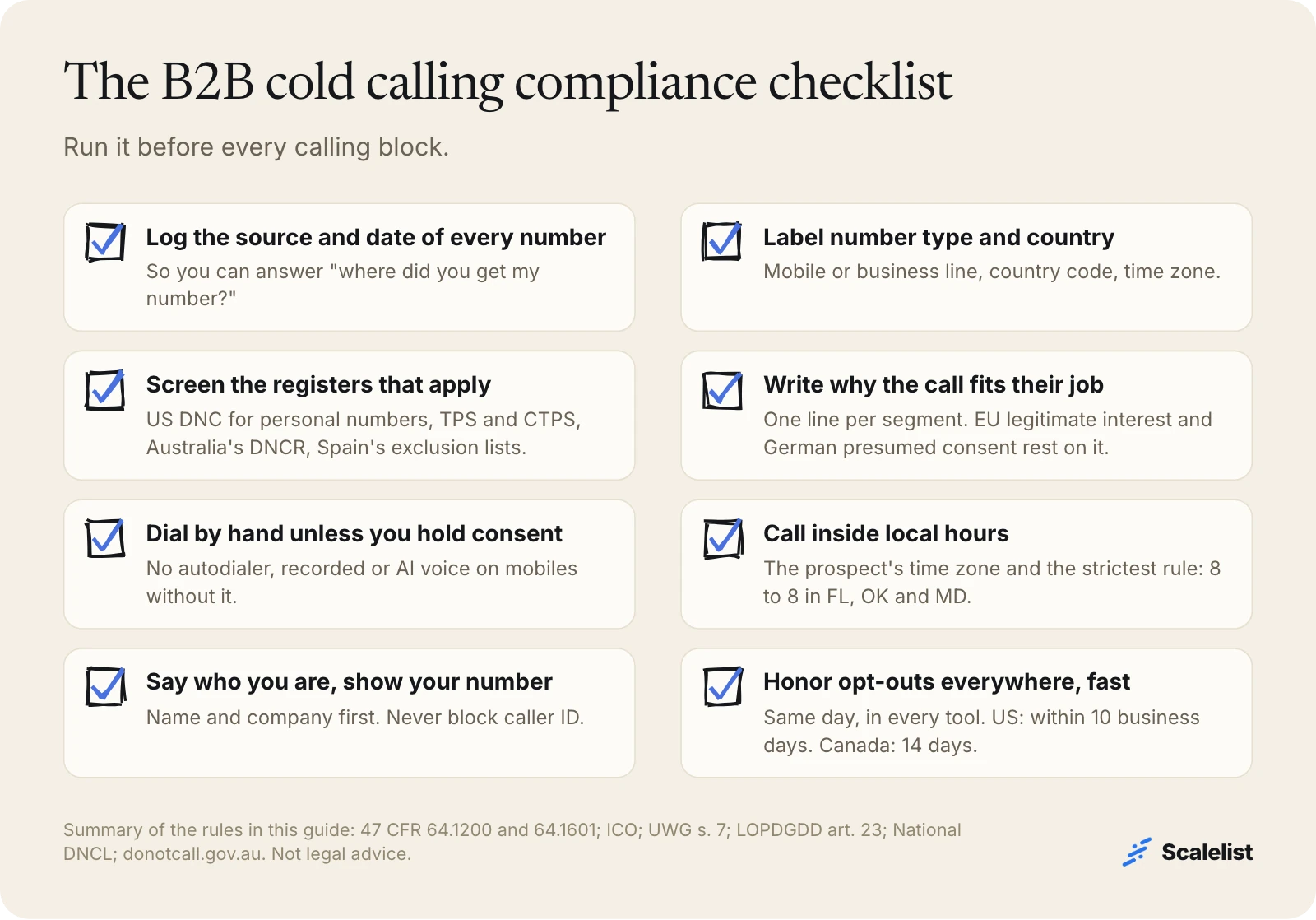
Two sentences do most of the compliance work on a live call: who you are and why you are calling, then what happens when they say stop.
If she asks you to stop: Understood. I'm taking your number off our list today, in every tool we use. Thanks for telling me.
More first lines that earn the next 30 seconds: cold call openers.
When you choose cold calling software, look for call windows set by the prospect’s time zone, one do-not-call list every user reads, caller ID you control and a dial mode you can explain to counsel.
Record keeping: what to log and for how long
Keep records that prove four things: where each number came from, that you screened it, how and when you called, and that you honored every opt-out. A few time limits are set in law.
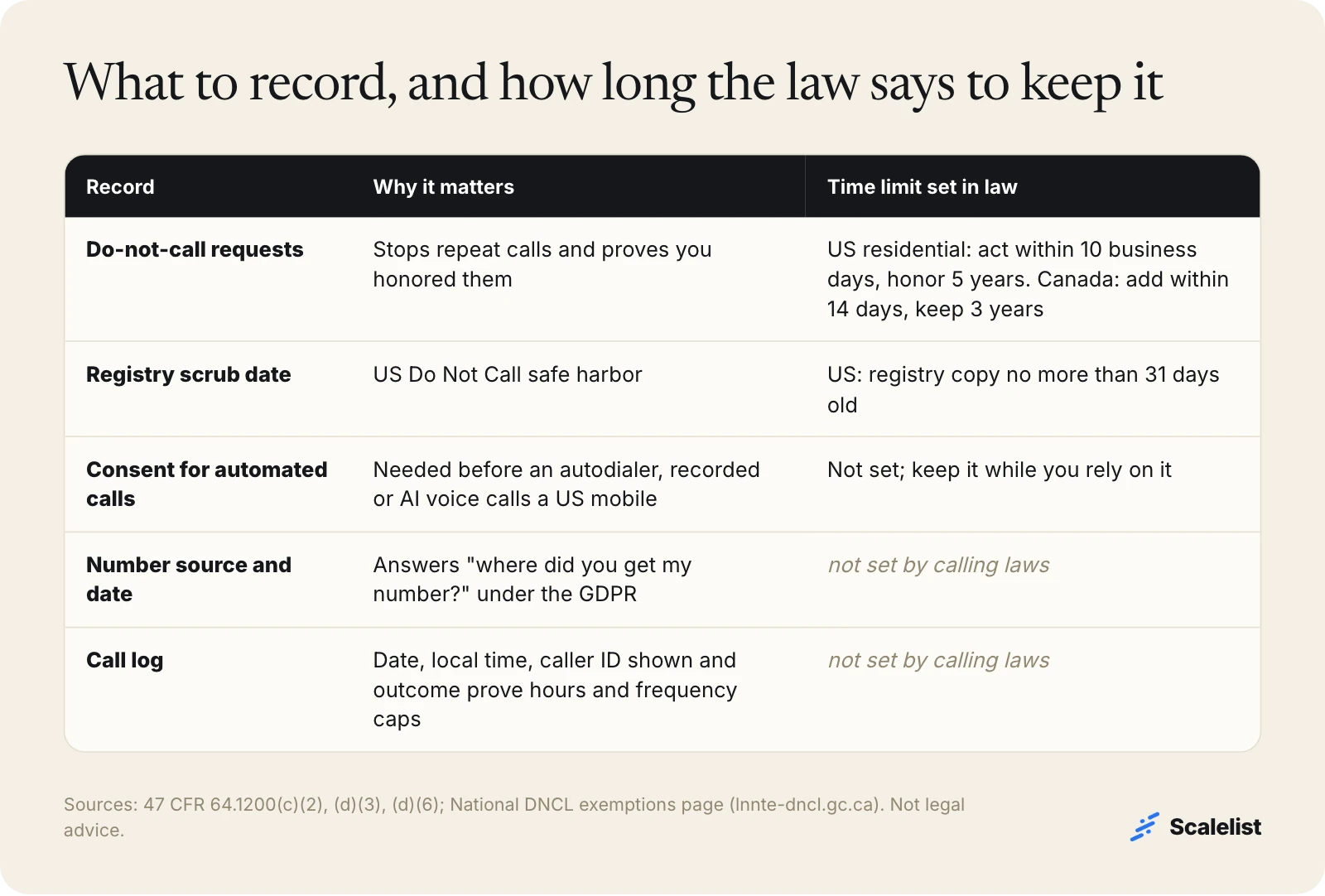
The US limits come from the FCC’s Do Not Call rules for residential subscribers (47 CFR 64.1200); the Canadian ones from the National DNCL rules above. If a machine dials or speaks, also keep who consented, when, how and to what.
Set it up once, in your CRM or dialer. For Dana Whitfield, Head of Operations at Northwind Fabrication in Columbus, Ohio, the record would show: mobile +1 555 0142, its source and date, Eastern time, internal list clear, dialed by hand, connected at 10:14 a.m.
How data sourcing fits
Calling laws apply when you dial, but where the number came from matters under data protection law, especially in the UK and EU.
- UK and EU: the GDPR covers the contact record itself. You need a legal basis to hold it, the person can object at any time, and you should be able to say where the number came from in one sentence.
- US: the TCPA and Do Not Call rules turn on the number type and how you dial, not on where you got the number.
Before you buy numbers, ask the provider for a Data Processing Agreement, a sub-processor list and an opt-out for the people in its data. More in our guide to finding a prospect’s mobile number legally.
Get verified mobiles for your call list from a provider with a DPA and a published sub-processor list, 20 credits per mobile found.
Find your first mobileFAQ
Is B2B cold calling legal in the US?
Yes. Under US federal and state B2B cold calling laws, a live, hand-dialed sales call to a business is legal, and most such calls are exempt from the National Do Not Call Registry. Autodialed, prerecorded or AI-voice calls to a mobile need prior express written consent, personal mobiles can be registered, and some states stop calls at 8 p.m. Not legal advice.
Does the Do Not Call list apply to B2B calls?
Mostly not. The FTC exempts most sales calls to businesses, and Canada’s and Australia’s national lists do not cover business numbers. The exceptions: US personal and wireless numbers can be registered, office and cleaning supply sales are not exempt, and the UK’s CTPS covers corporate numbers. Keep your own do-not-call list everywhere.
Does the TCPA apply to B2B cold calls?
Yes, for mobiles. The TCPA consent rule protects cell numbers whatever the recipient’s job, so autodialed, prerecorded or AI-voice calls to a buyer’s mobile need prior express consent, written for telemarketing. A live call dialed by hand is not caught by that rule, but Do Not Call, calling-hour and caller ID rules still apply. Not legal advice.
Is cold calling allowed under the GDPR?
It can be. Under cold calling GDPR rules, direct marketing can rest on legitimate interest after a balancing test, and the person can always object. Consent for live calls is a national rule: Germany requires at least presumed consent for B2B calls, France’s CNIL accepts legitimate interest for job-related offers, and Spain requires checking exclusion lists first.
What are the legal hours for B2B cold calls?
It depends on where the prospect is. US: 8 a.m. to 9 p.m. at the called party’s location, and 8 a.m. to 8 p.m. in Florida, Oklahoma and Maryland. Canada: 9 a.m. to 9:30 p.m. on weekdays, 10 a.m. to 6 p.m. on weekends. Australia: 9 a.m. to 8 p.m. on weekdays, 9 a.m. to 5 p.m. on Saturdays. The UK’s PECR sets none.
Do I need consent to use a power dialer?
Not always. In the US, consent is needed when the device counts as an autodialer (it can generate numbers randomly or sequentially) or when the call plays a recorded or AI voice to a mobile. A dialer that only speeds up live calls from your own list may not need it; have counsel confirm. The UK and Germany require consent for automated calls.
Sources
- 47 U.S.C. 227 (TCPA), Cornell LII
- 47 CFR 64.1200 and 47 CFR 64.1601, Cornell LII
- Facebook, Inc. v. Duguid, No. 19-511 (2021)
- FCC Declaratory Ruling FCC 24-17 (2024)
- 16 CFR 310.3 and 16 CFR 310.6, Cornell LII
- FTC: Q&A for telemarketers and sellers about DNC provisions
- Florida Statutes: s. 501.059, s. 501.603, s. 501.604, s. 501.616
- Oklahoma HB 3168 (2022)
- Maryland Code: Com. Law 14-4501, 14-4502, 14-4503, Pub. Util. 8-205, Chapter 414 of 2023
- California Penal Code 632
- ICO: Business-to-business marketing, Rules on live direct marketing calls, DUAA changes to PECR, DUAA commencement statement
- EDPB: Guidelines 1/2024 on legitimate interest, Guidelines 04/2022 on fines
- UWG section 7 and UWG section 20
- Légifrance: Code de la consommation (version from 11 Aug 2026) and CNIL: prospection commerciale par téléphone
- BOE: Ley 11/2022 General de Telecomunicaciones and Ley Orgánica 3/2018 (LOPDGDD); AEPD: ¿Qué es la Lista Robinson?
- National DNCL (Canada): Exemptions, FAQ for telemarketers, Who can still call you, FAQ for consumers
- CRTC news release on telemarketing penalties (2019)
- PIPEDA (S.C. 2000, c. 5)
- Do Not Call Register (Australia): FAQs for consumers, Industry standards, Compliance and breaches


