


B2B data costs about 2 to 13 cents per work email and about 10 cents to 1.16 USD per mobile number at the entry prices vendors publish, as of September 2026. Enterprise platforms such as ZoomInfo publish no prices at all; Vendr, a software buying platform, reports a median ZoomInfo contract of 33,500 USD a year.
Those are sticker prices. What you really pay per usable contact also depends on seats, how many contacts the vendor actually finds, whether a miss is charged, and how many found contacts turn out correct. Below: the published prices, the formula, and two worked examples you can redo with your own numbers.
How much does B2B data cost?
B2B data cost is the price you pay for one contact data point: usually a work email, a mobile number or a full contact record. At the entry plans vendors publish, an email costs about 2 to 13 cents and a mobile number about 10 cents to 1.16 USD, with quote-only platforms such as ZoomInfo and Cognism sold on annual contracts instead.
The better number is cost per usable contact: everything you spend in a month, divided by the contacts your team can actually reach. Two vendors with the same sticker price can differ by several times on that number, because of seats, hit rates and charges on misses.
What B2B data costs per email and per mobile
This table converts each vendor’s cheapest monthly plan into a price per email and per mobile number. The math is the plan price divided by its credits, times the credits the vendor charges for each item.
| Vendor | Entry plan (monthly billing) | Per email | Per mobile | Charged on a miss |
|---|---|---|---|---|
| Scalelist | 29 USD, 500 credits | 5.8 cents | 1.16 USD (20 credits) | No |
| Apollo.io | 65 USD per seat, 2,500 credits | 2.6 cents | 20.8 cents (8 credits) | No, for Apollo’s own data |
| Lusha | 49.90 USD, 400 credits | 12.5 cents | 62.4 cents (5 credits) | Partly (API: 1 credit minimum) |
| Prospeo | 49 USD per user, 2,000 credits | 2.5 cents | 24.5 cents (10 credits) | No |
| Findymail | 49 USD, 1,000 credits | 4.9 cents | 49 cents (10 credits) | No |
| FullEnrich | 29 USD, 500 credits | 5.8 cents | 58 cents (10 credits) | No |
| Lead Magic | 99 USD, 5,000 credits | 2.0 cents | 9.9 cents (5 credits) | No |
| Hunter | 49 USD, 2,000 credits | 2.5 cents | not sold | No |
| UpLead | 99 USD, 170 credits | 58.2 cents per contact, email and mobile | included | Only on Valid or Accept All results |
| ZoomInfo | not published | not published | not published | not published |
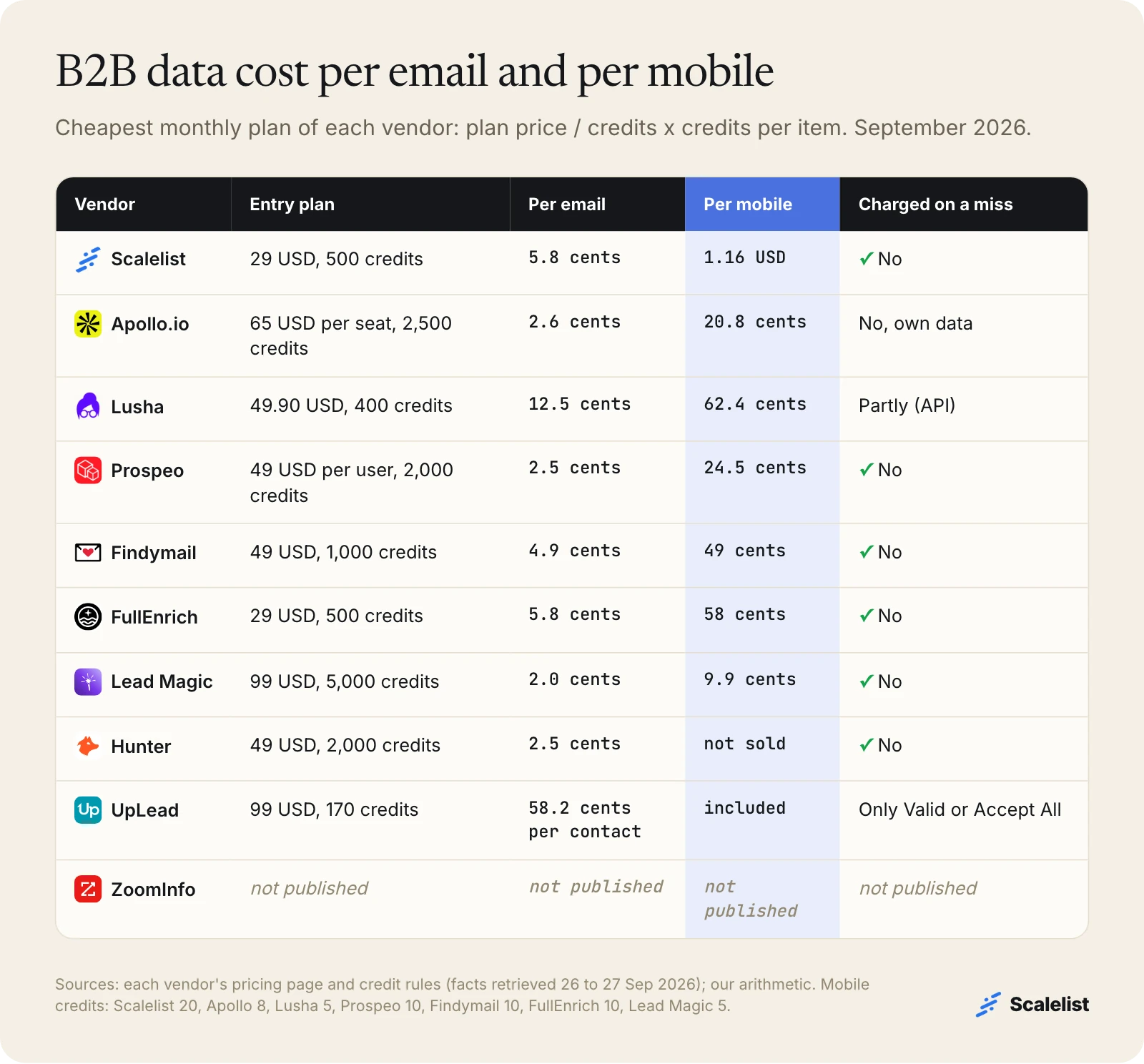
Two things stand out. Scalelist has the highest list price per mobile in this table, and larger plans shrink every vendor’s unit price: Scalelist’s mobile falls to about 0.65 USD on its 20,000-credit plan. For per-plan detail, see our Apollo pricing and Prospeo pricing breakdowns.
From sticker price to cost per usable contact
Cost per usable contact is total spend divided by the contacts you can actually reach, and it moves through four layers.
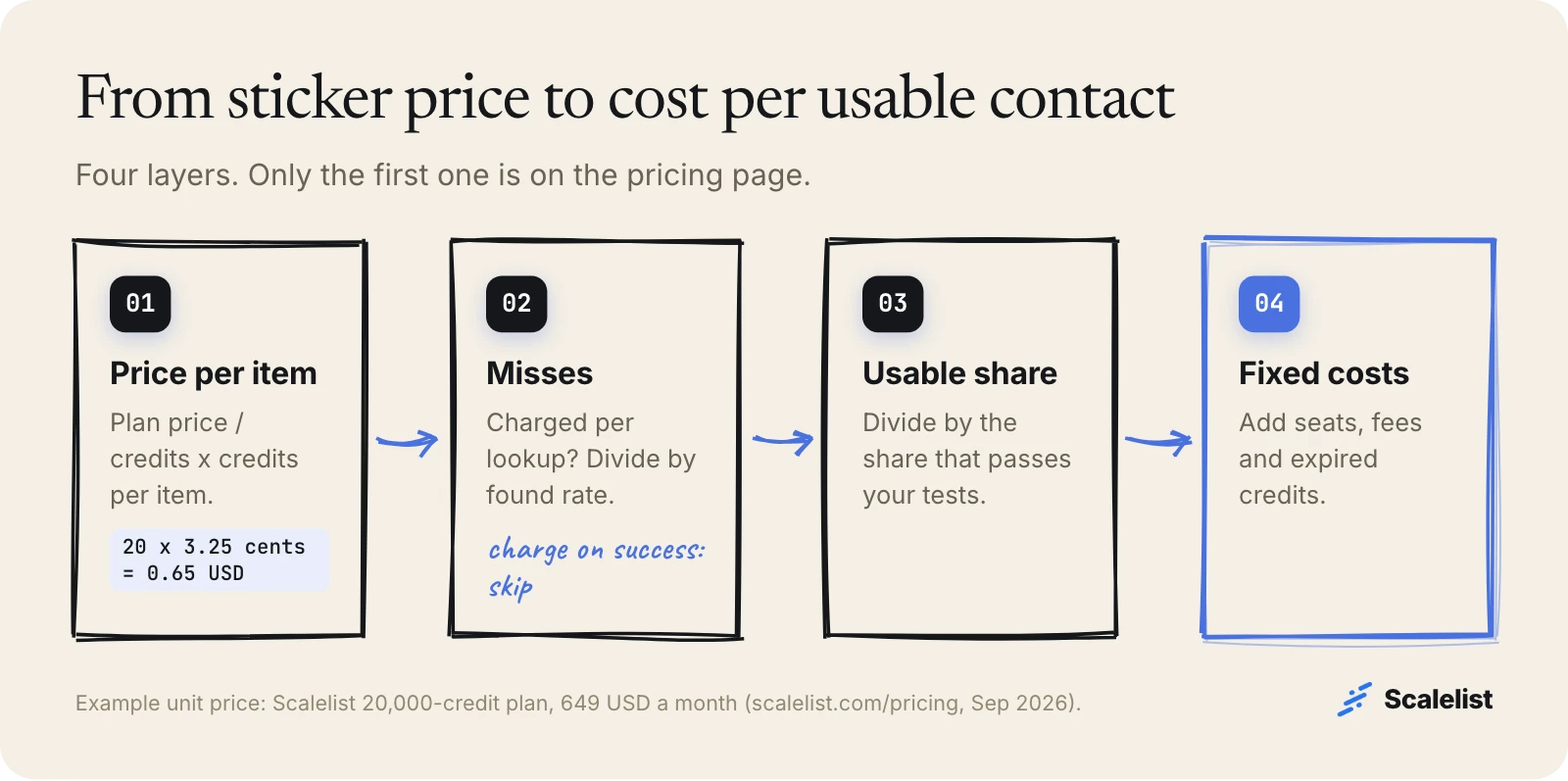
- Price per item. Plan price divided by credits, times the credits per email or mobile.
- Misses. If the vendor charges per lookup, divide by its found rate. If it charges only when something is found, skip this step.
- Usable share. Divide by the share of found contacts that pass your bounce test or reach the right person on a call.
- Fixed costs. Add seats, platform fees and credits that expire unused, spread over the contacts you get.
You measure layers 2 and 3 on your own list. Our step-by-step method to test a B2B data provider shows how, with a 200-contact sample.
Worked examples with real published plans
Both examples use each vendor’s published monthly prices and the found rates from our own B2B data provider comparison, the same test behind our ranking of the best B2B data providers. That benchmark ran the same founder list per region through 8 providers and measured found rates, not correctness, so treat the results as an illustration of the math, not a forecast for your list.
Example 1: a founder emailing 300 US contacts a month
Maya Chen runs a 4-person software company in Austin, Texas. She emails 300 new US prospects a month and needs only work emails.
| Vendor and plan | Monthly bill | Emails found (benchmark rate) | Cost per found email |
|---|---|---|---|
| Icypeas Basic, 1,000 credits | 19 USD + VAT | 228 (76%) | 8.3 cents |
| Scalelist, 500 credits | 29 USD | 276 (92%) | 10.5 cents |
| Findymail Basic, 1,000 credits | 49 USD | 261 (87%) | 18.8 cents |
| Hunter Starter, 2,000 credits | 49 USD | 171 (57%) | 28.7 cents |
At 300 contacts a month, the smallest plan size matters more than the price per credit. Hunter’s credit (2.5 cents) costs less than half of Scalelist’s (5.8 cents), yet Maya pays for 2,000 Hunter credits and uses under 200 of them.
Example 2: a 5-rep team calling 1,000 contacts a month
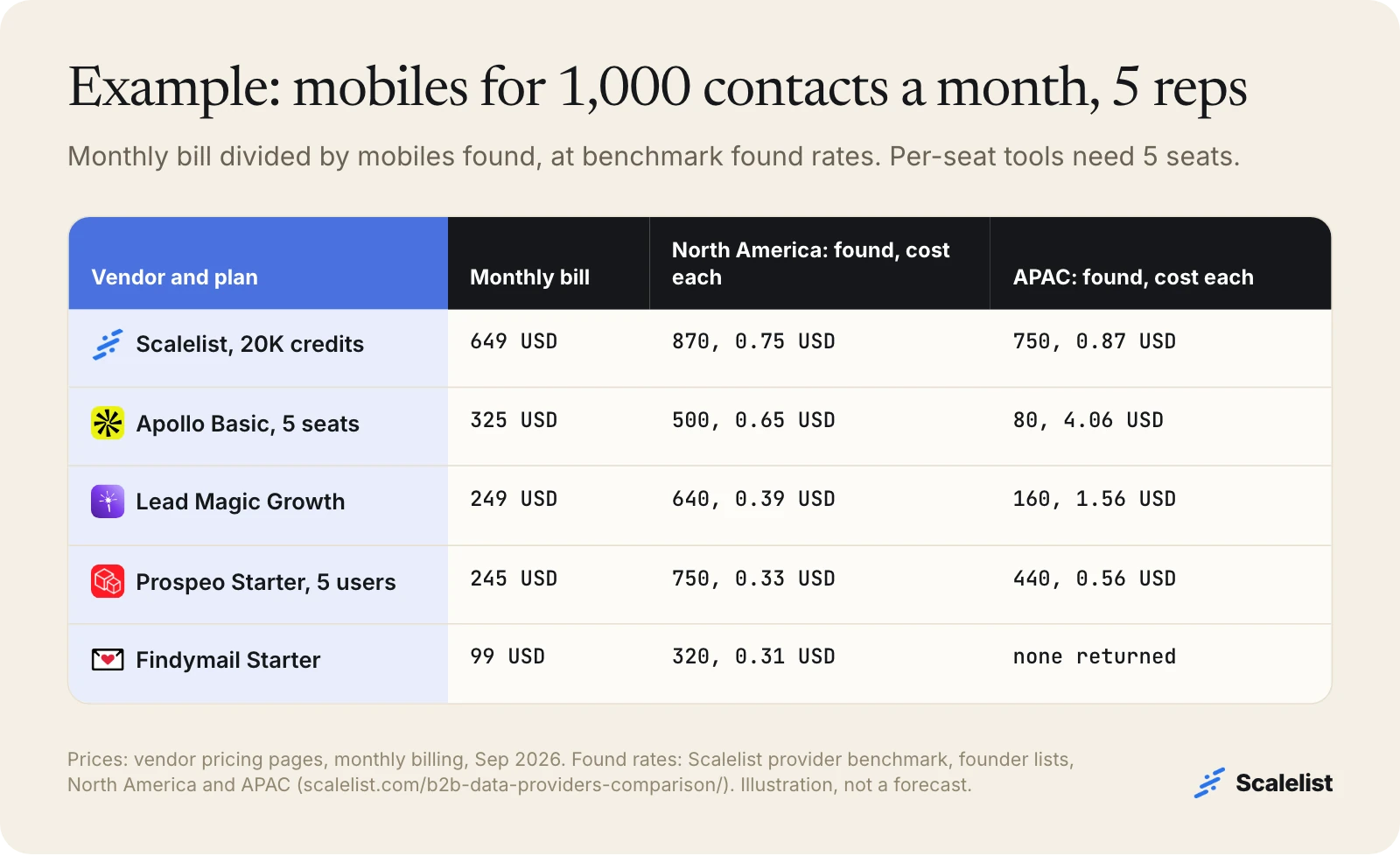
Northwind Staffing in Columbus, Ohio, has 5 SDRs who each pull their own numbers, so per-seat tools need 5 seats. They need mobile numbers for 1,000 new contacts a month, in North America or in APAC.
| Vendor and plan | Monthly bill | North America: mobiles found, cost each | APAC: mobiles found, cost each |
|---|---|---|---|
| Scalelist, 20,000 credits | 649 USD | 870, 0.75 USD | 750, 0.87 USD |
| Apollo Basic, 5 seats | 325 USD | 500, 0.65 USD | 80, 4.06 USD |
| Lead Magic Growth, 5 seats | 249 USD | 640, 0.39 USD | 160, 1.56 USD |
| Prospeo Starter, 5 users | 245 USD | 750, 0.33 USD | 440, 0.56 USD |
| Findymail Starter | 99 USD | 320, 0.31 USD | none returned |
In North America, Scalelist costs the most per found mobile, and it finds the most: 870 of 1,000, against 320 to 750 for the others. In APAC the ranking changes. Apollo finds 80 mobiles, so each one costs 4.06 USD; Prospeo is the cheapest per found mobile at 0.56 USD, and Scalelist finds the most, 750.
If one ops person pulls every number instead of 5 reps, per-seat tools get cheaper. One Apollo Professional seat at 99 USD covers the 4,000 credits needed, which is about 0.20 USD per found mobile in North America.
What does ZoomInfo cost?
ZoomInfo cost is not published: every paid plan is a custom-quoted annual contract with a minimum number of seats. Vendr reports a median of 33,500 USD a year across 1,573 purchases, in a range of 7,213 to 155,820 USD.
ZoomInfo charges 1 credit per exported record, so your cost per record is your contract divided by your exports.
| Exports a year | Cost per record at the Vendr median |
|---|---|
| 10,000 | 3.35 USD |
| 50,000 | 0.67 USD |
Two rules push the real number up: monthly credits cannot be rolled over, and if two users export the same record, ZoomInfo charges two credits. Our ZoomInfo pricing guide covers the plans and contract terms.
Hidden costs that change your cost per contact
Most of the gap between sticker price and real B2B data cost comes from terms, not from the price per credit.
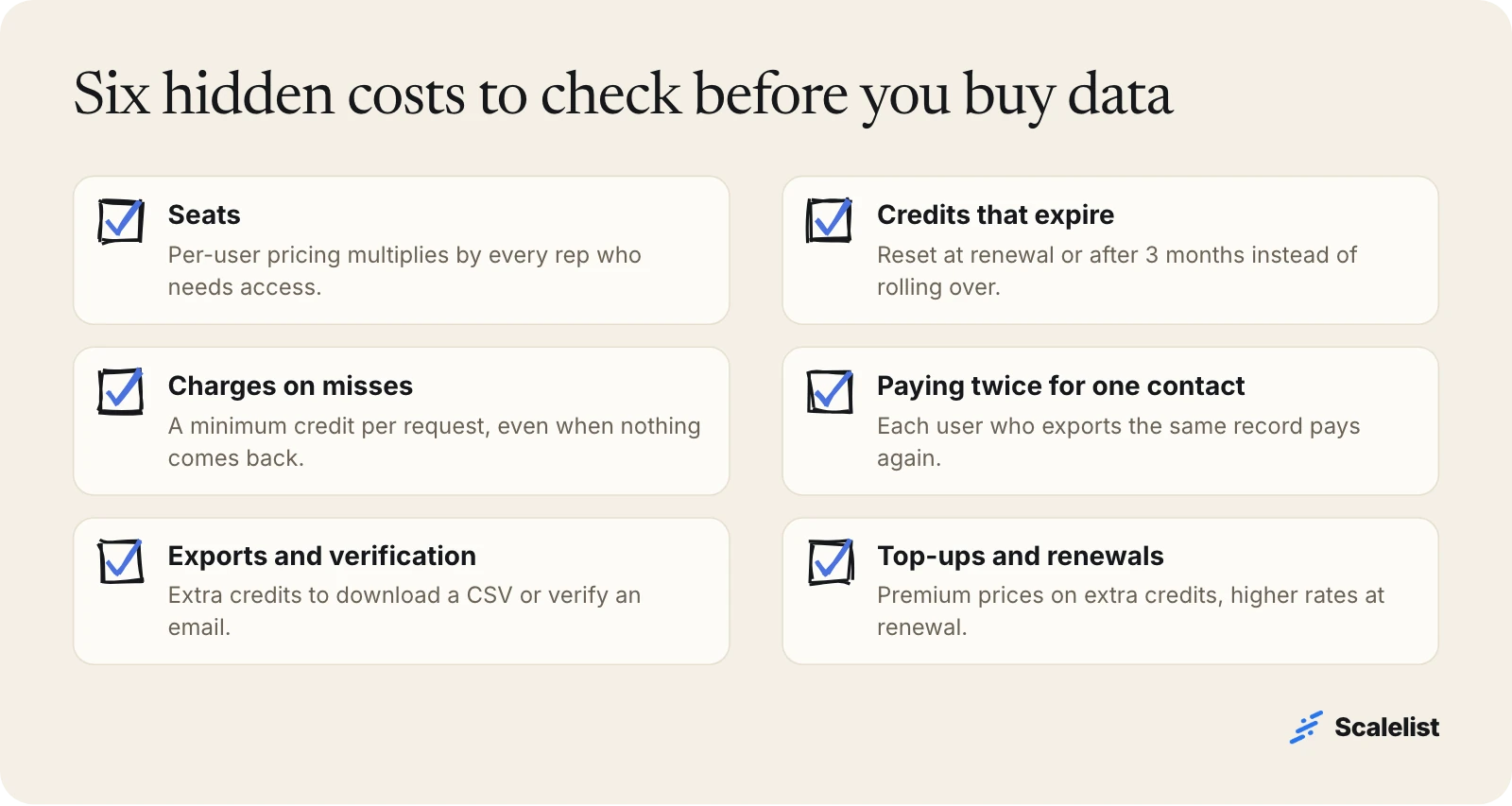
- Seats. Apollo and Prospeo price per user; Cognism packages list 5 seats included; ZoomInfo sets a seat minimum.
- Credits that expire. Prospeo credits expire at renewal. Lusha resets unused credits at the end of an annual cycle. FullEnrich monthly credits last 3 months.
- Charges on misses. Lusha’s API uses at least 1 credit per request even when nothing comes back.
- Paying twice for one contact. ZoomInfo charges each user who exports the same record; Prospeo re-enriches the same record within 90 days at no charge.
- Exports and verification. Lusha charges 1 credit per 25 rows for a CSV export; Hunter charges 0.5 credit per email verified.
- Top-ups. Clay charges a 30% premium on credit top-ups.
For how each billing model works, from seats to pay-per-success credits, read our guide to B2B data pricing models.
Cost per lead vs cost per contact
Cost per lead and cost per contact measure different things. Cost per contact is what you pay for one found email or mobile. Cost per lead is what a channel costs divided by the leads it produces, and data is only one line in it.
A quick way to see the gap: in my own calling sessions, one meeting took about 50 dials (894 dials, 18 meetings, July to September 2026). Even if every dial went to a different mobile at 0.649 USD, the data behind one meeting costs at most about 32 USD. Rep time costs far more, which is why a wrong number is expensive: it burns the dial, not just the credit.
How to lower your B2B data cost
You lower B2B data cost by buying less, and by buying only what gets used.
Size the list before you pay for it
Count the matching people first, then pull only the segment you will work this month.
Buy mobiles only for the people you will call
A mobile usually costs 5 to 20 times an email in credits. Reveal it for your call list, not your whole database.
Prefer charge-on-success and monthly terms
If a miss costs nothing, your price per found contact is fixed. Start monthly and move to annual only after a test.
Re-check data before you re-buy it
Contact data goes stale as people change jobs. Our guide to B2B data decay shows how to measure your own decay rate before you pay to refresh a list.
What to look for in a B2B data tool, on cost
- A published price per email and per mobile, or enough to work it out.
- Written charge-on-success rules: “misses are free”, not “credits may be refunded”.
- No seat minimum, or seats that match how your team actually works.
- Credits that roll over while you are subscribed.
- Found rates on your own list, in every region you sell into.
How Scalelist prices contact data
Scalelist, an AI lead finder, charges in credits with no seats: 1 credit per lead or email found, 20 per mobile found, and nothing when nothing is found. Every email comes back labelled Valid or Risky.
| Credits a month | Price a month | Per email found | Per mobile found |
|---|---|---|---|
| 500 | 29 USD | 5.80 cents | 1.16 USD |
| 1,000 | 49 USD | 4.90 cents | 0.98 USD |
| 5,000 | 199 USD | 3.98 cents | 0.80 USD |
| 20,000 | 649 USD | 3.25 cents | 0.65 USD |
It is rarely the cheapest price per credit, and on email-only volume it is not. It fits teams that call: it found mobile numbers for 87% of our North America benchmark list and 75% in APAC, and a miss costs 0.
Unused credits roll over up to 2x the monthly plan while you are subscribed, yearly billing gives 2 months free, and custom plans start above 20,000 credits a month. Full details are on the pricing page, and the Mobile Finder is where most of those credits go.
Find out what a usable mobile costs on your own list: 20 free credits, no credit card.
Get 20 credits to test itFAQ
How much does B2B data cost per contact?
About 2 to 13 cents per work email and about 10 cents to 1.16 USD per mobile number at the entry plans vendors published in September 2026. Full contact records from quote-only vendors are priced by contract. Larger plans lower the unit price: Scalelist’s mobile falls from 1.16 USD on the 500-credit plan to about 0.65 USD on the 20,000-credit plan.
How much does ZoomInfo cost?
ZoomInfo does not publish prices. Paid plans are custom-quoted annual contracts with a minimum number of seats. Vendr, a third-party buying platform, reports a median of 33,500 USD a year across 1,573 purchases. ZoomInfo charges 1 credit per exported record, so at that median a record costs 3.35 USD at 10,000 exports a year and 0.67 USD at 50,000.
What is a good cost per lead for B2B data?
There is no single benchmark, because cost per lead depends on your channel and your definition of a lead. For the data part, compute cost per usable contact: monthly spend divided by contacts that pass your bounce test or reach the right person. Then compare vendors on that number, measured on your own list, rather than on price per credit.
Why are mobile numbers more expensive than emails?
Vendors charge 5 to 20 credits for a mobile against 1 for an email: Lusha and Lead Magic 5, Apollo 8, Prospeo 10, Scalelist 20. Vendors price mobiles higher because they are worth more to a caller: Nooks found mobile numbers have a 45% higher connect rate than non-mobile numbers across nearly 3 million dials (2025). Compare the price per found mobile in cents, not the credit count.
Is per-seat or per-credit B2B data cheaper?
It depends on your team shape. Per-seat pricing is cheapest when one or two people pull a lot of data. Credit pricing with no seats is cheapest when many reps each pull a little. In our 5-rep example, five Apollo seats cost 325 USD a month before any data is found; one seat costs 65 USD.
Do you pay for B2B data that is not found?
At most vendors that publish prices, no. Scalelist, Hunter, Findymail, FullEnrich, Lead Magic and Prospeo charge only when they find something. Lusha’s API uses at least 1 credit per request even when nothing comes back, and ZoomInfo does not publish its rule. Check the wording on the pricing page, then confirm it in your own test.
How can I check B2B data cost before committing?
Run a small test on your own list. Take 200 contacts per region, run them through each vendor in the same week, log every credit charged, then run a bounce test and a phone connect test. Divide spend by usable contacts. Start on monthly plans or trials and sign an annual contract only after you have that number.
Sources
- Apollo.io pricing
- Lusha pricing and how Lusha credits are counted
- Prospeo pricing
- Findymail pricing
- FullEnrich pricing
- Lead Magic pricing
- Hunter pricing
- Icypeas pricing
- UpLead pricing
- Cognism pricing
- ZoomInfo: how much does ZoomInfo cost and overview of credits
- Vendr: ZoomInfo marketplace data
- Clay pricing
- Nooks Insights: Here’s Who Picks Up The Most (2025)


