


A cold call script for a specific industry keeps the same structure as any good cold call. It changes three things: who you call, the problem you name, and the words you use for it. Below are four full scripts, for plant managers at manufacturers, staffing agency owners, MSP owners and healthcare operations leaders.
Each comes with the prospect’s likely replies, the objection you will hear most in that industry, and a Lead Finder sentence you can copy to build the call list.
What changes in a cold call script for a specific industry?
A cold call script for a specific industry uses the same 5 beats as any cold call: right person, who you are, one reason, one question, a next step. What changes is the buyer’s title, the problem they would name first and the words they use for it. A plant manager hears “unplanned downtime”; an MSP owner hears “after-hours tickets”.
Everything else stays the same: say it’s a cold call, ask for 30 seconds, ask one question, offer two specific times. If you want the base versions first, start with our 12 cold calling scripts, then come back here to adapt them.
How to use these industry scripts
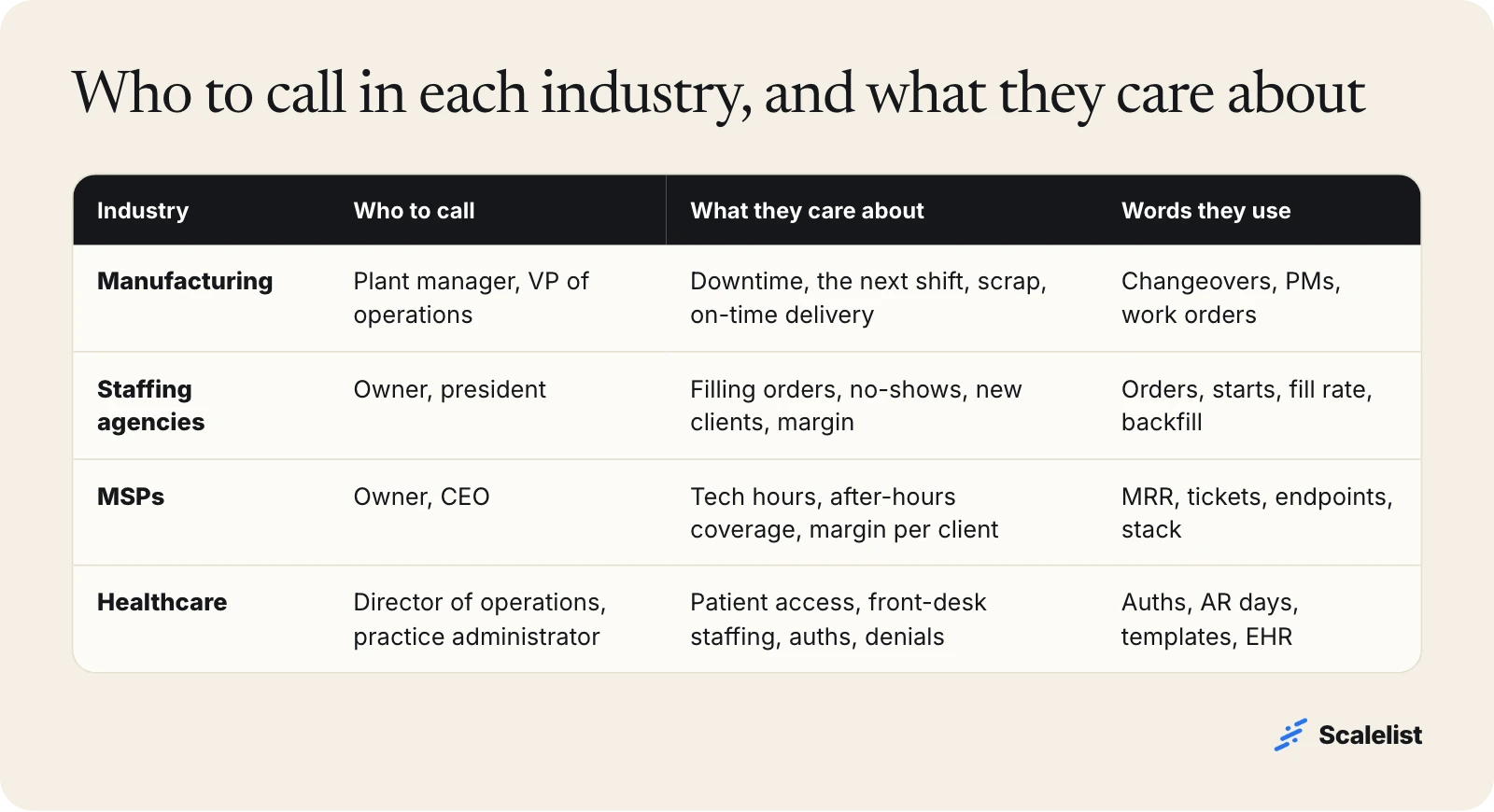
Use these scripts by keeping the buyer’s problem and swapping the seller’s product for yours. Each one uses a fictional seller whose product fits the industry, so you can see how the reason and the question change.
- Pick one problem you actually solve. Each section lists what that buyer cares about. Use only the one your product changes.
- Find one fact per account. A job post, a new site, a new client, a system change. It turns a cold reason into a specific one.
- Keep the jargon light. Use two or three of their words, correctly. One wrong term ends the call faster than none.
- Plan the industry objection. Each script ends with the pushback you’ll hear most and a reply.
For more first lines to test on these buyers, see our cold call opening lines. When nobody picks up, our industry voicemail scripts follow the same angles.
How many decision makers you can call in each industry
Each of these four markets is big enough for years of calling. The largest, manufacturing, has nearly 200,000 decision makers at US companies with 51 to 500 employees. The smallest, staffing and recruiting, has over 33,000 at firms with 11 to 200.
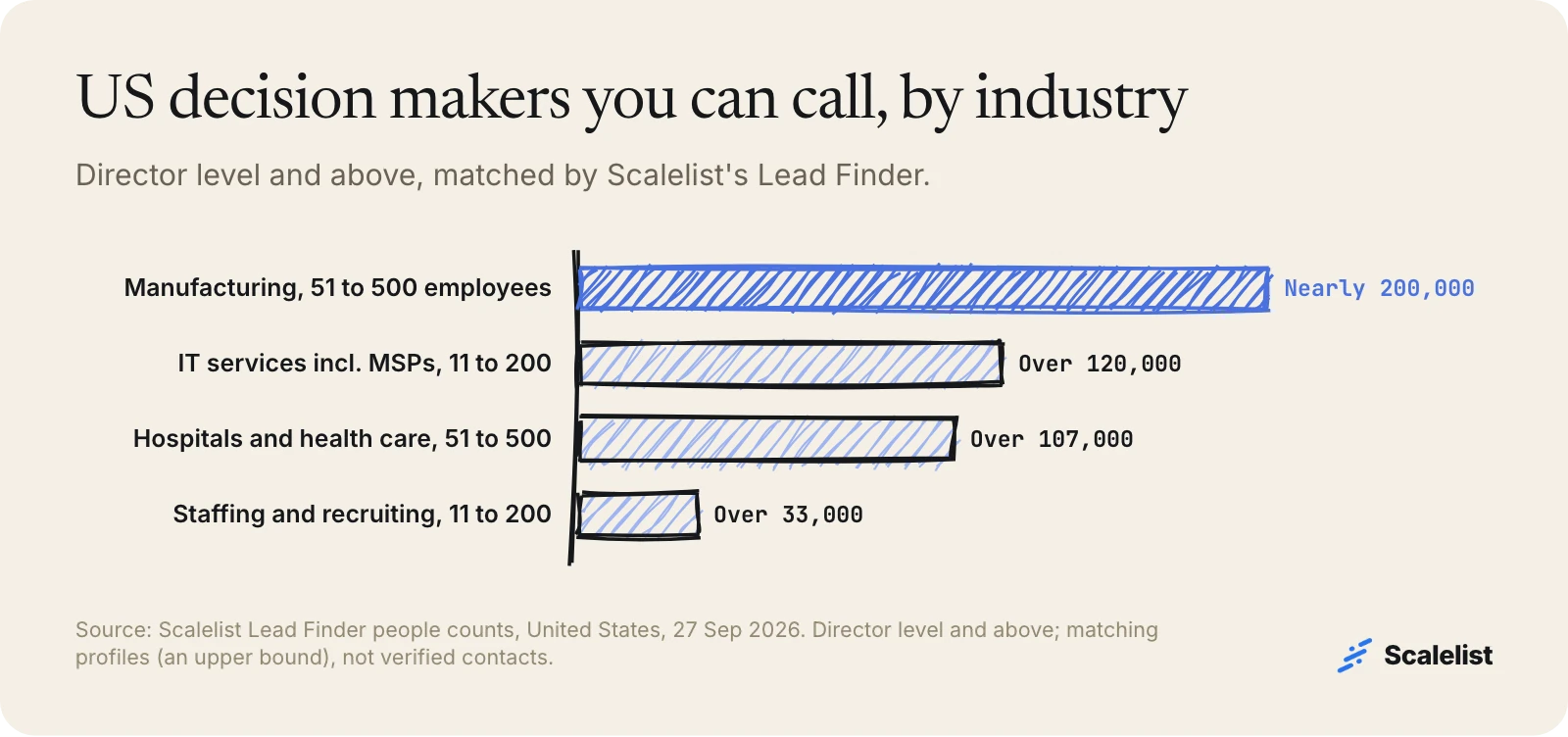
IT services companies (a category that includes MSPs) with 11 to 200 employees account for over 120,000, and hospitals and health care organizations with 51 to 500 for over 107,000.
Counts are profiles at director level and above, matched by Scalelist’s Lead Finder in the United States on 27 September 2026. They are matching profiles, not verified contacts, and your own sentence will return a narrower number.
Cold call script for manufacturing: plant managers
A cold call script for manufacturing should sound like the plant floor: downtime, the next shift, scrap and on-time delivery. Plant managers at mid-size manufacturers own those numbers, answer to the owner or a VP, and have little patience for anything that sounds like a brochure.
Who to call at a manufacturer
- Titles: plant manager, operations manager, VP of operations. At smaller plants, the general manager or owner.
- Company size: 51 to 500 employees. Big enough to run shifts, small enough that the plant manager has a real say.
- What they care about: unplanned downtime, open operator and maintenance positions, overtime, scrap and rework, on-time delivery, customer audits.
- Words they use: downtime, changeovers, second shift, PMs (preventive maintenance), work orders, throughput.
- Where they are: on the floor most of the day, which is why a mobile beats the desk line.
The plant manager script
The seller is Chris Dalton from Ridgeline, a fictional maintenance software company. The prospect is Mike Brennan, plant manager at Harlan Precision, a 180-person machining shop in Toledo, Ohio.
Mike: Yeah, who's this?
You: It's [Chris Dalton] with [Ridgeline]. We've never spoken, so this is a cold call. Thirty seconds, then you tell me if it's worth a minute?
Mike: Make it quick, I'm headed to the floor.
You: I call plant managers at [machine shops around Toledo] about [unplanned downtime]. The one I hear most: [a machine sits waiting on a part nobody logged, and second shift finds out first]. Does that happen at Harlan?
Mike: [Couple times a month, yeah.]
You: How do you track [maintenance requests] today: [a system], or [paper and a whiteboard]?
Mike: [Whiteboard, mostly.]
You: A lot of the shops I call start there. Worth 20 minutes to see how [a shop your size] runs it from a phone? [Tuesday at 1] or [Thursday at 2:30]?
If he says "We tried software. The guys won't use it.": I hear that a lot. What did they push back on: typing it in, or too many fields? If it's typing, I'll show you [the photo-and-voice request], and you tell me in 20 minutes if your guys would use it.
- The problem is described the way a plant manager lives it: a machine down, second shift finding out.
- The question is about how the floor runs today, not about software.
- “Headed to the floor” is a real time limit. Respect it: one reason, one question, one ask.
Build the manufacturing call list
Lead Finder shows what it understood and how many people match before you spend a credit. Our manufacturing lead generation playbook covers the email side and account research for this market.
Cold call script for staffing agencies: owners
A cold call script for a staffing agency owner should talk about orders, starts and clients, because that is how owners keep score. At firms of 11 to 200 people, the owner often still sells, recruits and signs off on every tool.
Who to call at a staffing agency
- Titles: owner, president, CEO. At larger firms, the VP of operations or a branch manager.
- Company size: 11 to 200 employees. The owner is still close to the desk.
- What they care about: filling orders fast, first-day no-shows and early turnover, winning new clients, not depending on one big account, bill rates and margin, recruiter productivity.
- Words they use: orders, fill rate, starts, no-shows, backfill, bill rate, spread, submittals.
- Watch the timing: light-industrial branches are busiest when shifts start, so avoid calling at the top of the morning.
The staffing owner script
The seller is Lauren Kim from Callpoint, a fictional candidate texting and confirmation tool. The prospect is Greg Walsh, owner of Pinnacle Workforce, a light-industrial staffing firm with three branches around Grand Rapids, Michigan.
Greg: Speaking.
You: It's [Lauren Kim] from [Callpoint]. Cold call, so I'll keep it short. Can I tell you why I called in 30 seconds?
Greg: Go ahead.
You: I work with [light-industrial staffing owners]. What they bring up most isn't finding candidates, it's [first-day no-shows costing them the client]. Is that on your radar at Pinnacle, or have you got it handled?
Greg: [It's always an issue. We text them the night before.]
You: Makes sense. Who does the texting, your recruiters from their own phones?
Greg: [Yeah, mostly.]
You: That's the part we take off their plate: [confirmations and "running late" replies land in one inbox the branch can see]. Worth 15 minutes on [Thursday at 11] to see if it fits how your recruiters work?
If he says "Our ATS already does texting.": Good. Does it flag who hasn't confirmed before the shift, so the branch can backfill in time? If yes, you're set and I'll get off the phone. If not, that's the 15 minutes.
- “Costing them the client, not the placement” is how owners think about a no-show: the account is at risk.
- The question about who does the texting uncovers the manual work without criticizing anyone.
- The objection reply gives him a clean way to say no, which makes a yes more believable.
Build the staffing call list
If you run a staffing agency and want scripts for calling hiring managers instead, read our guide to how staffing agencies win clients.
Cold call script for MSPs: owners
An MSP cold calling script should talk about technician hours and margin. A managed service provider (MSP) sells IT support by the month and lives on how efficiently its techs work. MSP owners also buy tools for a living, so they hear vendor pitches often and can spot a generic one fast.
Who to call at an MSP
- Titles: owner, CEO, founder. At larger MSPs, the service manager or the operations lead.
- Company size: 11 to 200 employees. At the smaller end, the owner may still work tickets.
- What they care about: technician time and hiring, after-hours coverage, margin per client and per endpoint, client security and cyber insurance renewals, growing monthly recurring revenue without adding headcount at the same pace.
- Words they use: MRR, tickets, techs, endpoints, stack, RMM and PSA (their core tools), QBRs.
- What they don’t want: a pitch that treats them like an end client. They resell, so talk about their margin and their team.
The MSP owner script
The seller is Marcus Reed from Lantern, a fictional white-label after-hours help desk. The prospect is Dave Kowalski, owner of Brightpath IT, a 22-person MSP in Charlotte, North Carolina.
Dave: Yes.
You: It's [Marcus Reed] at [Lantern]. This is a cold call, and I know MSP owners get plenty of those, so I'll be straight with you. Can I have 30 seconds?
Dave: [Thirty seconds.]
You: We run [white-label after-hours help desk] for MSPs. One question: when a client calls Brightpath at 11 p.m., who picks up?
Dave: [Honestly, me or whoever's on call.]
You: And how many of those nights turn into a full ticket for your on-call tech?
Dave: [A few times a week.]
You: Then it's worth 20 minutes to put [what on-call costs you in tech hours] next to [a flat monthly rate]. I'm not asking you to switch anything. [Tuesday at 4] or [Wednesday at 10]?
If he says "We already have an on-call rotation.": Good, then you know what it costs. The question is whether your best tech should be doing password resets at midnight. Would it hurt to see the numbers side by side?
- Admitting MSP owners get a lot of calls earns a few seconds of goodwill.
- The 11 p.m. question makes the problem concrete in one sentence.
- The ask compares costs; it doesn’t ask him to change anything yet.
Build the MSP call list
Running an MSP and calling businesses to win clients? Our guide to how MSPs find new clients is written for your side of the call.
Cold call script for healthcare: operations leaders
A healthcare cold calling script should talk to operations leaders about patient access, staffing and payer delays, and never about patients themselves. Directors of operations and practice administrators at clinic groups, surgery centers and specialty practices run the schedule, the front desk and the vendors around it.
Who to call in healthcare
- Titles: director of operations, practice administrator, VP of operations, revenue cycle director.
- Company size: 51 to 500 employees: clinic groups, ambulatory surgery centers, specialty practices, home health agencies.
- What they care about: patient access and open slots, no-shows and cancellations, front-desk and medical assistant turnover, prior authorizations, claim denials, clinician time lost to paperwork.
- Words they use: patient access, auths, denials, AR days, templates (the schedule), throughput, the EHR.
- Hard rule: never mention a patient, or ask for patient details, on a cold call or a voicemail. Anything that touches patient data goes through IT and compliance review.
The healthcare operations script
The seller is Rachel Stein from Authwise, a fictional prior authorization software company. The prospect is Linda Morales, director of operations at Valley Orthopedic Group, six clinics and a surgery center in Sacramento, California.
Linda: Yes, who's calling?
You: It's [Rachel Stein] from [Authwise]. This is a cold call about [prior authorizations], nothing to do with patients. Do you have 30 seconds, or is [after clinic hours] better?
Linda: Go ahead, quickly.
You: I work with [orthopedic groups your size]. The operations leaders I talk to say [imaging and surgery auths] are what back up the schedule. Roughly how long is an auth taking your team right now?
Linda: [Depends on the payer. A week, sometimes two.]
You: And who's chasing them: the front desk, or dedicated staff?
Linda: [Two people, full time.]
You: Then 20 minutes is worth it to see how other groups track [every auth by payer in one queue] next to their EHR. No patient data on this call or in my follow-up. [Wednesday at 12:30] or [Thursday at 4:30]?
If she says "Anything new has to go through IT and compliance.": Makes sense. I'll send [our security documentation and a sample business associate agreement] with the invite, so IT can review before we talk. Who should I copy?
- “Nothing to do with patients” answers the first worry before she has to ask.
- Offering a call after clinic hours shows you know how her day runs.
- The IT and compliance reply turns a blocker into the next step and a second contact.
Build the healthcare call list
For longer buying cycles and committees at larger systems, read how to sell to hospitals.
Build a call list for your industry from one sentence: direct mobiles at 20 credits each, nothing for a miss.
Get 20 credits to test itWhat changes from industry to industry, line by line
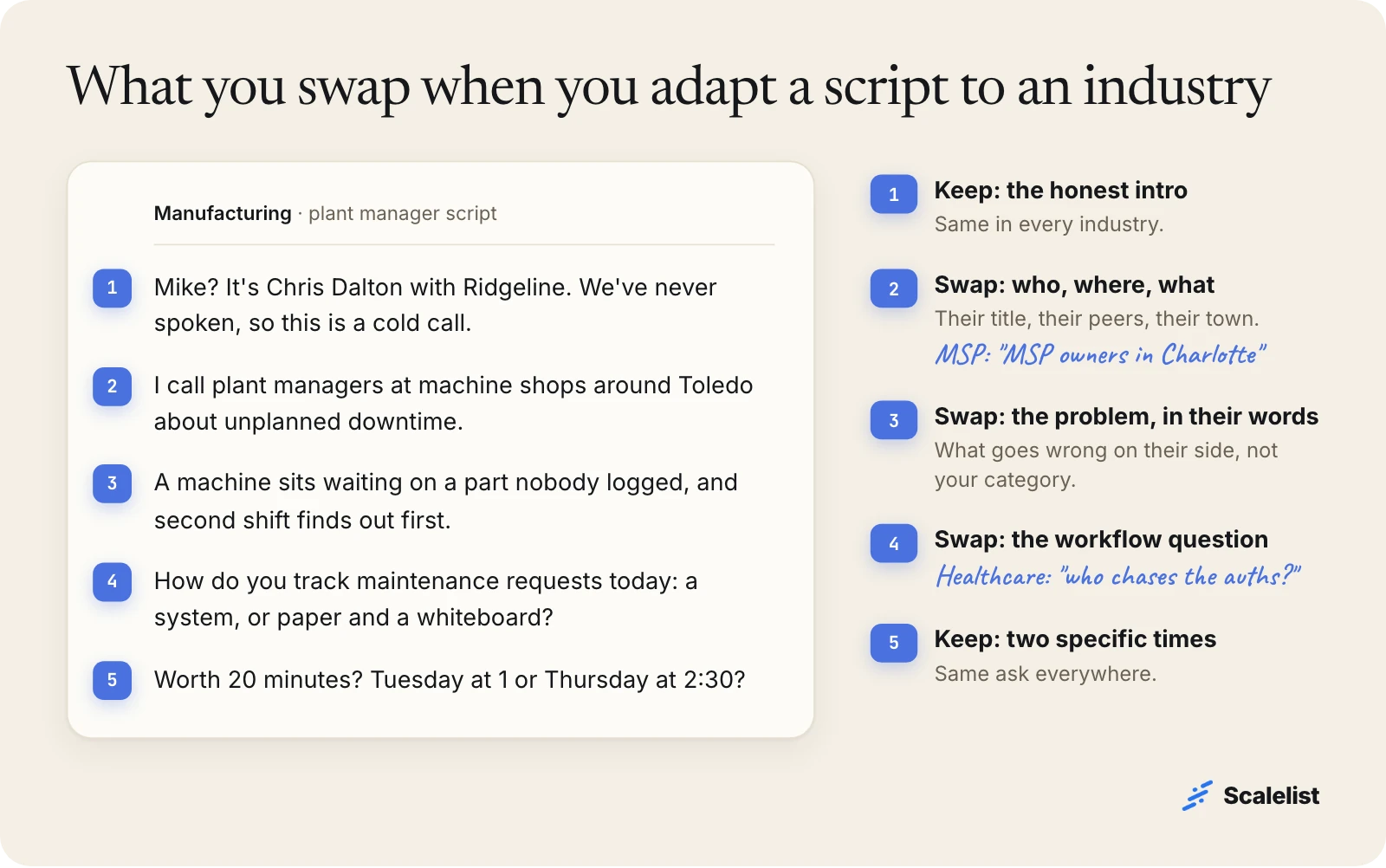
The lines that change from one industry to the next are the reason and the question; the intro and the ask stay the same. Here is the manufacturing script broken down, with what you swap for each industry.
Mistakes to avoid when you adapt a script to an industry
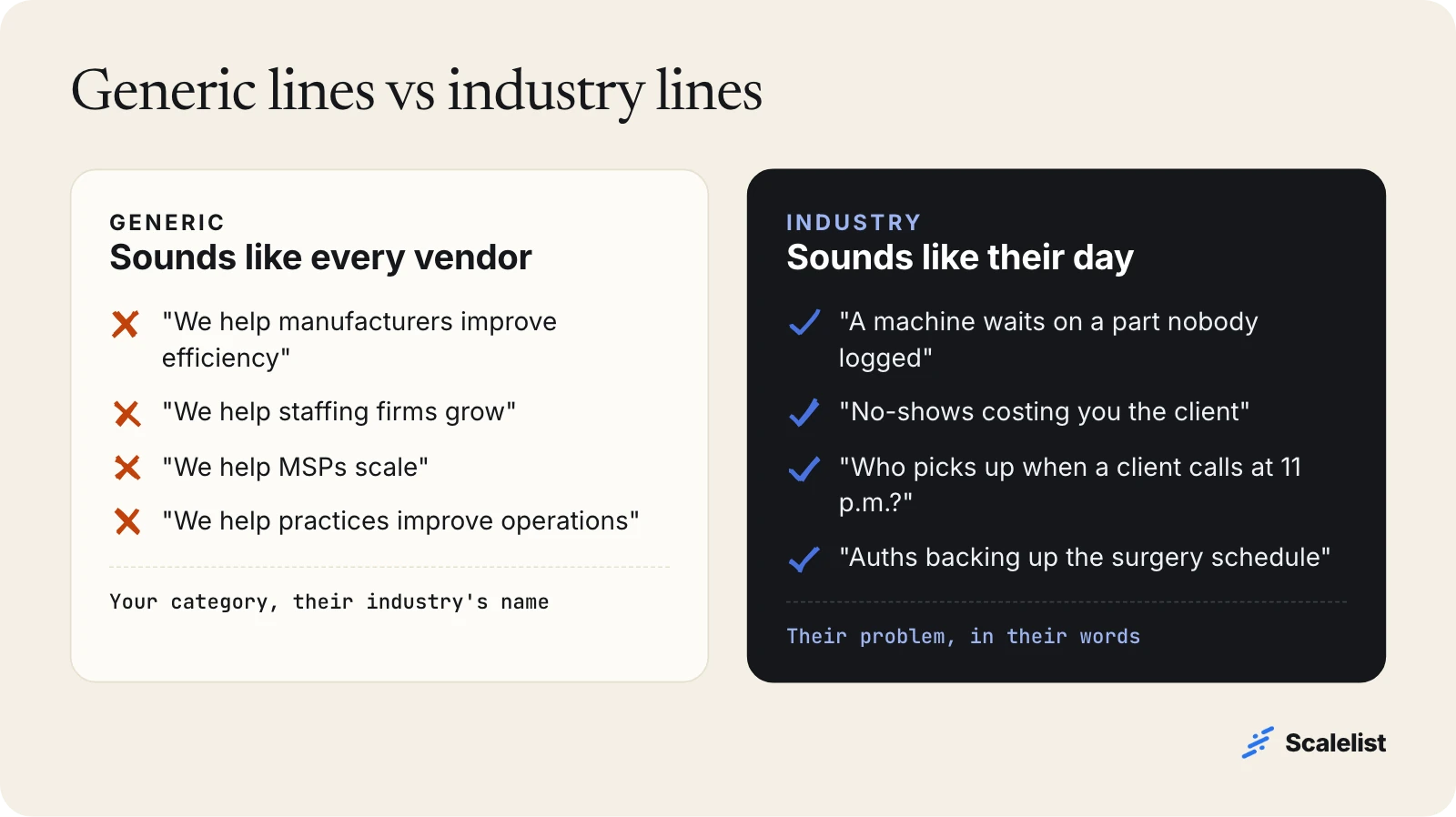
The most common mistake when adapting a script to an industry is keeping the generic line and adding the industry’s name to it. “We help manufacturers improve efficiency” is still a generic line.
- Naming your category before their problem. “Maintenance software”, “prior auth platform” and “PSA add-on” are your words. Describe what goes wrong on their side first.
- Borrowed jargon. Use a term only if you know what it means in their world. Misusing “OEE” or “AR days” costs you the rest of the call.
- The same script for the owner and the manager. Owners care about margin, growth and risk. Plant managers and practice administrators care about their day. Write one version for each.
- Pitching MSPs like end clients. They resell your category. Talk about their margin and their techs, not your features.
- Patient details in healthcare. Never, not even as an example. Keep every line about operations.
- Industry claims you can’t back up. “Most shops your size” only works if you have talked to enough of them to know. Otherwise, ask.
For the replies these buyers give most often, keep our list of 40 sales objections and what to say next to your scripts.
Build every industry call list with one sentence
An industry script only works on the buyer’s own phone, not the plant’s switchboard or the clinic’s front desk. Scalelist, an AI Lead Finder, builds the list. You describe the people you want in one plain-English sentence, and it returns matching people with verified work emails and mobile numbers.
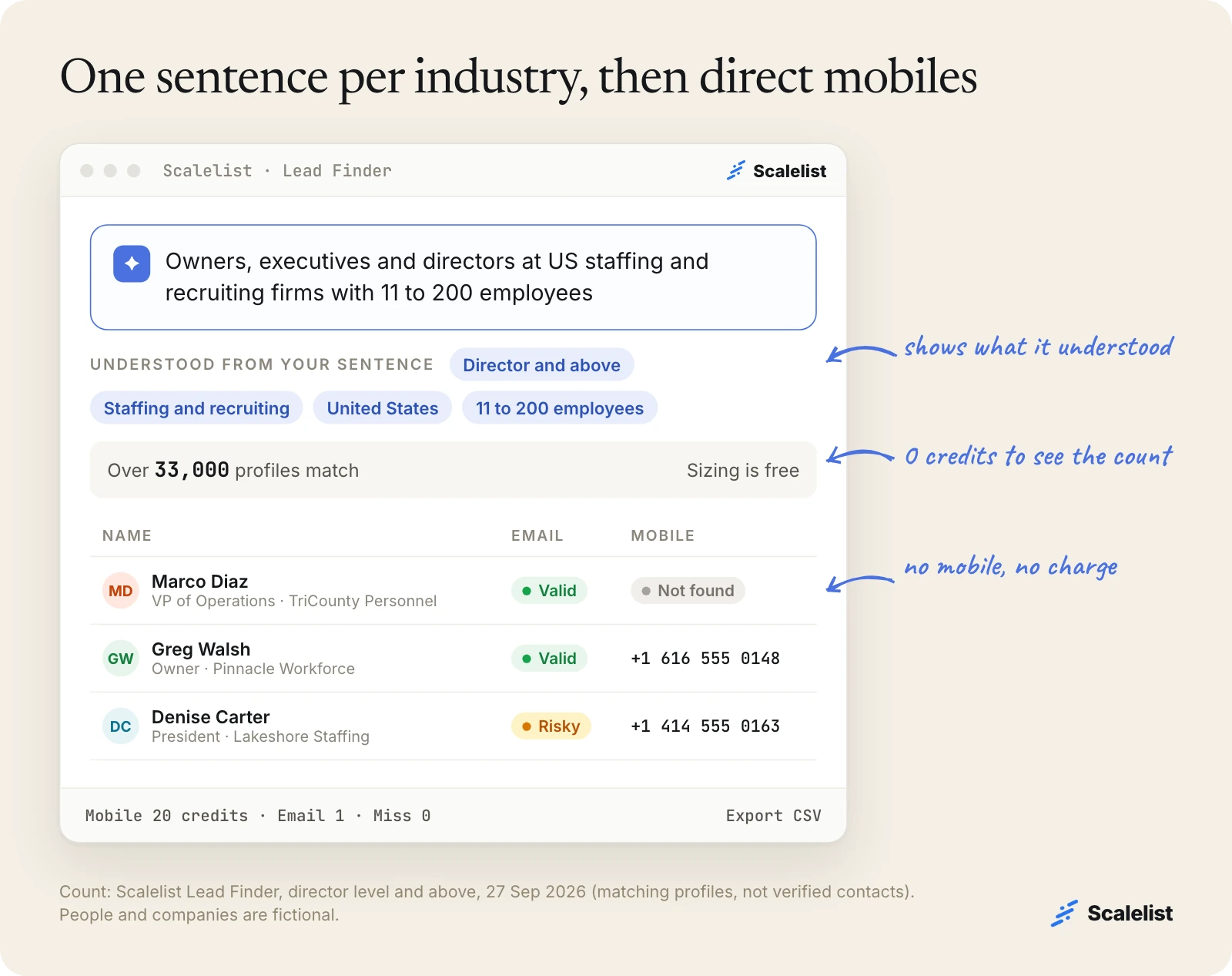
- See the market first. Scalelist’s Lead Finder shows what it understood from your sentence and how many people match, before you spend a credit.
- Pay only for what’s found. 1 credit per lead, 1 per email and 20 per mobile found. A miss costs 0. Emails come back Valid, Risky or Not found.
- Enrich a list you already have. Upload a trade-show list or a CRM export to the Mobile Finder to add direct mobiles.
- Need more sentences? Our 60 lead-finding prompts by role and industry cover other verticals.
A lead with an email and a mobile costs 22 credits, so the 5,000-credit plan at 199 USD a month covers over 220 fully enriched leads. Plans start at 29 USD for 500 credits, with no annual contract, and new accounts get 20 free credits. Scalelist finds and verifies contact details on demand rather than serving a pre-compiled list.
Describe your buyer in one sentence and get the call list with direct mobiles. Misses cost 0 credits.
Describe your buyer in one sentenceFor the rest of the playbook, from call lists to cadences, read the complete guide to B2B cold calling.
FAQ
What is a good cold call script for manufacturing?
A good cold call script for manufacturing talks to the plant manager about the floor: unplanned downtime, the next shift, scrap or on-time delivery. Open with your name and “this is a cold call”, name one problem in plant words, ask how they handle it today, and offer two times for a 20-minute call. Keep it short; they are usually on the floor.
What should a cold call script for a staffing agency owner say?
It should talk about orders, starts and clients, not features. Staffing owners care about filling orders fast, first-day no-shows, winning new clients and margin. Name one of those problems, ask who handles it today, and offer a short call. If you are a staffing agency calling hiring managers, adapt the manufacturing or healthcare script instead.
How do you cold call MSP owners?
Talk about technician hours and margin, because that is how an MSP makes money. Admit they get plenty of vendor calls and ask one concrete question, such as who picks up at 11 p.m. Then compare costs rather than asking them to switch. MSP owners resell tools, so pitch their margin, not your features.
What do healthcare operations leaders care about on a cold call?
Patient access, staffing and payer delays: open slots and no-shows, front-desk turnover, prior authorizations and claim denials. Say early that the call has nothing to do with patients, keep every line about operations, and expect IT and compliance review for anything touching patient data. Offering to call after clinic hours shows you understand their day.
Should the script change for an owner and a manager in the same industry?
Yes. Owners and CEOs care about margin, growth and risk, so give them a short, direct question about an outcome and ask who owns it. Managers such as plant managers or practice administrators care about their day-to-day work, so ask about how the process runs today. Keep the 5 beats; change the reason and the question.
How many decision makers can you call in each of these industries?
Scalelist’s Lead Finder matches nearly 200,000 decision makers at US manufacturers with 51 to 500 employees and over 120,000 at IT services companies with 11 to 200. It also matches over 107,000 at hospitals and health care organizations with 51 to 500, and over 33,000 at staffing firms with 11 to 200. Counts are from September 2026, director level and above, matching profiles.
Sources
- Audience sizes: Scalelist Lead Finder people counts, United States, 27 September 2026 (director level and above; matching profiles, not verified contacts).


