


A cold calling list is only as good as the numbers on it. A list of main lines sends every dial to a receptionist, and a list of old numbers sends it to someone who left.
This guide shows how to build one in Scalelist: named decision makers with direct mobile numbers, the credit cost of every step, and the calling order for your dialer.
What makes a good cold calling list?
A good cold calling list, sometimes called a call list, names one decision maker per row and gives you a number that rings their own phone. Everything else on the row helps you choose who to call first and what to say.
| Field | Why you need it on a call list |
|---|---|
| Name and job title | You ask for a person, not “whoever handles operations” |
| Company and size | Shapes the reason you give in the first 20 seconds |
| Direct mobile | Rings the person, not the front desk |
| Email and its status | Valid or Risky tells you how to send the follow-up |
| State or city | Sets the time zone, the calling window and the call order |
| Trigger or note | One true reason to call this week: a new plant, a hire, a job post |
| Date found | Tells you when to refresh the list |
The mobile is the field that changes results most. Going through a gatekeeper cut the chance of booking a meeting by 39% in Gong’s analysis of more than 300 million cold calls (Gong, 2024), and mobile numbers had a 45% higher connect rate than non-mobile numbers across nearly 3 million dials (Nooks, 2025).
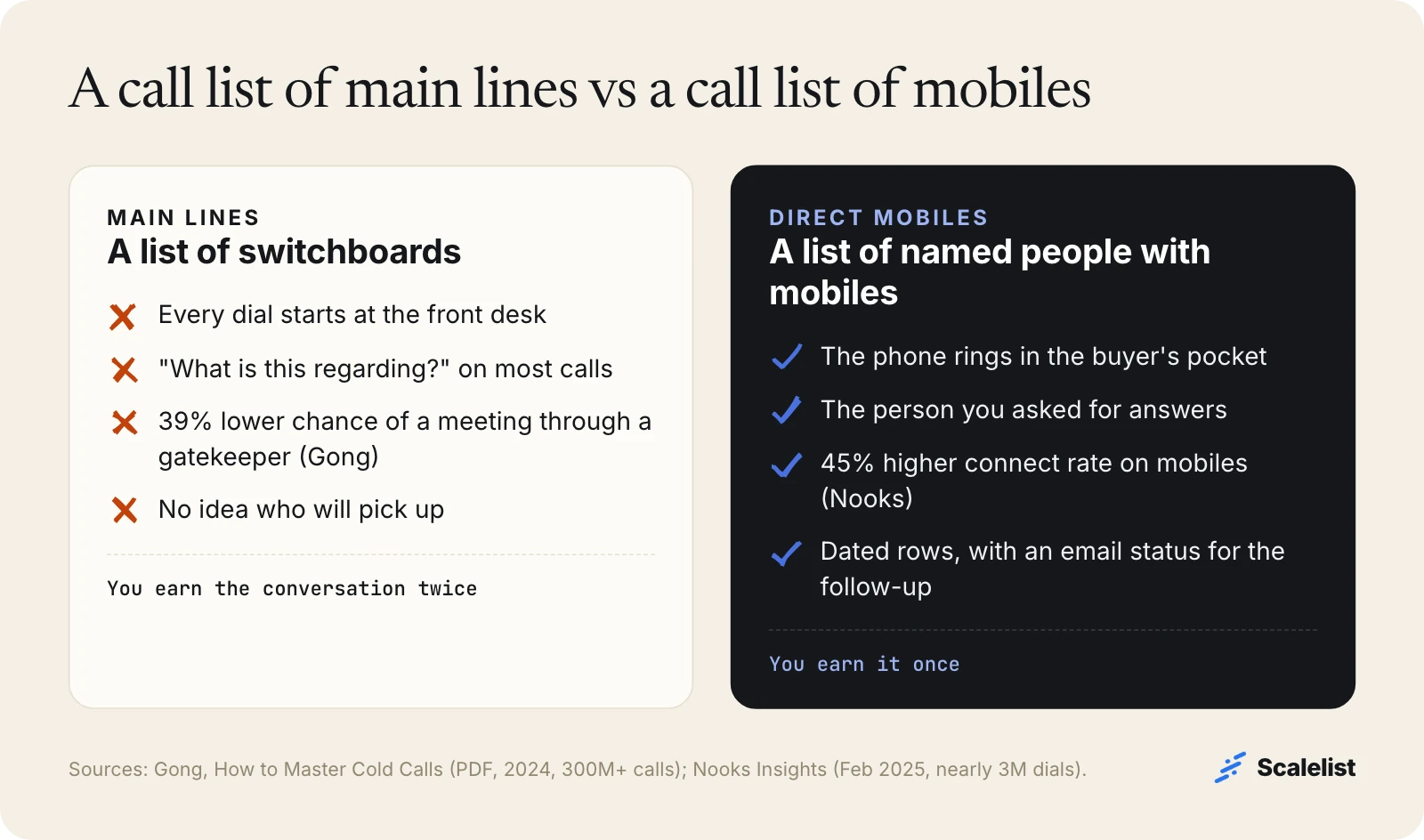
My own logs point the same way: on two afternoon blocks into Australia in August 2026, where every number was a direct mobile, 95 of my 250 dials connected. For what to do when you still hit a front desk, see how to get past the gatekeeper.
How to build a cold calling list in Scalelist, step by step
Building the list in Scalelist takes six steps. Steps 1 and 2 cost nothing, step 3 charges only for what is found, and step 4 is the path when you already have names.
The worked example: Alex Moreno, an SDR at Brightline (a fictional shift-scheduling software company), needs a list of operations leaders at Midwest manufacturers.
1. Describe who you want to call in one sentence
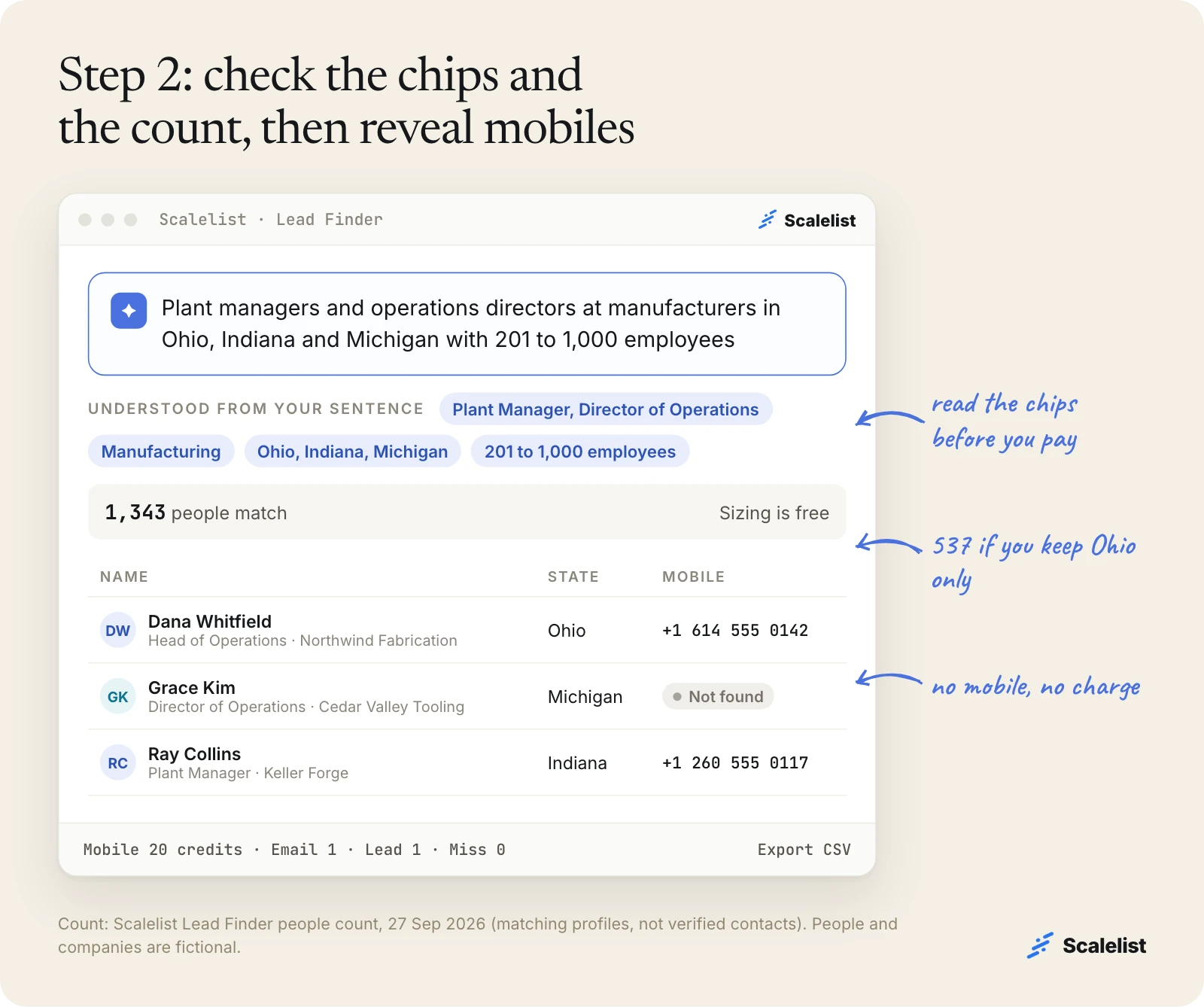
Write the buyer the way you would brief a colleague: titles, industry, location and company size. Alex’s sentence: “Plant managers and operations directors at manufacturers in Ohio, Indiana and Michigan with 201 to 1,000 employees.”
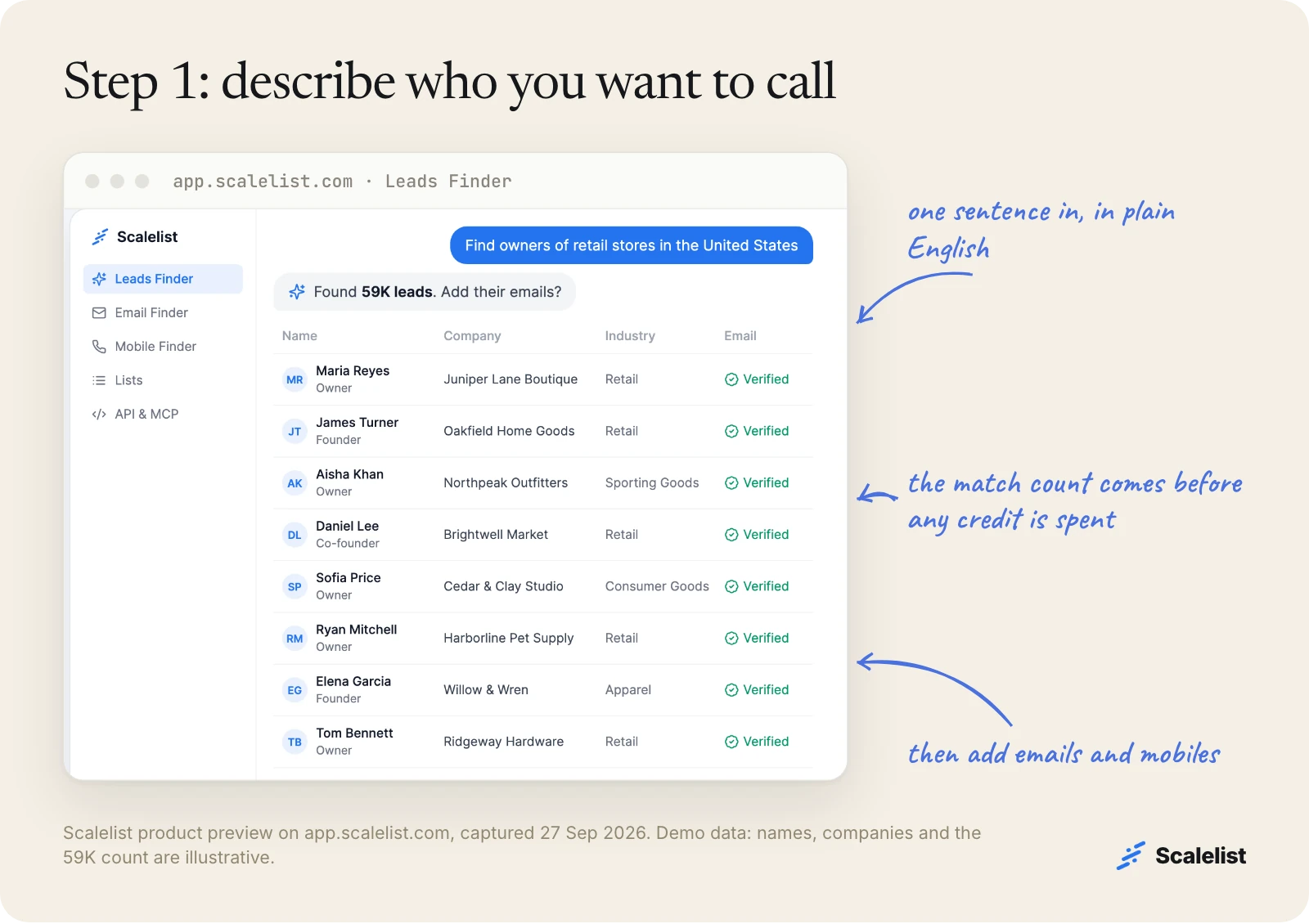
For more sentence patterns, see how to describe your ICP in one sentence.
2. Check what Scalelist understood and how many people match
Scalelist’s Lead Finder shows what it understood from your sentence (titles, industry, states, company size) and how many people match, before you spend a credit. On 27 September 2026, Alex’s sentence matched 1,343 people. Narrowed to Ohio only, it matched 537.
Size the list to what your team can call before the data ages. A phone-centric SDR averages 56 dials a day (The Bridge Group, 2025), and Belkins’ 2025 data shows about three attempts per prospect (Belkins). That works out to roughly 19 new contacts a day, or about 400 a month for one rep. Alex takes Ohio first.
3. Reveal mobiles for the people you will call this month
Pull the people, then reveal mobiles and emails only for the contacts on this month’s calendar. Credits are charged only when something is found: 1 per lead, 1 per email, 20 per mobile, 0 for a miss.
| Alex’s Ohio call list | Quantity | Credits if everything is found |
|---|---|---|
| Leads (people) | 537 | 537 |
| Mobiles for the first 200 calls | 200 | 4,000 |
| Emails for the same 200 | 200 | 200 |
| Maximum total | 4,737 |
That fits the 5,000-credit plan at 199 USD a month, which puts a mobile at about 0.80 USD. Every mobile or email that is not found costs nothing, so the real bill is lower. Unused credits roll over, up to twice your monthly credits, while you stay subscribed. All plans are on Scalelist pricing.
Describe the people you call in one sentence and see how many match before you spend a credit.
Describe your buyer in one sentence4. Already have names? Upload them to the Mobile Finder
If your call list starts from a CRM export, an event list or a target account list, skip the search. Upload a CSV with first name, last name, and company name or website to the Mobile Finder, and Scalelist returns mobiles for the whole file at 20 credits per mobile found.
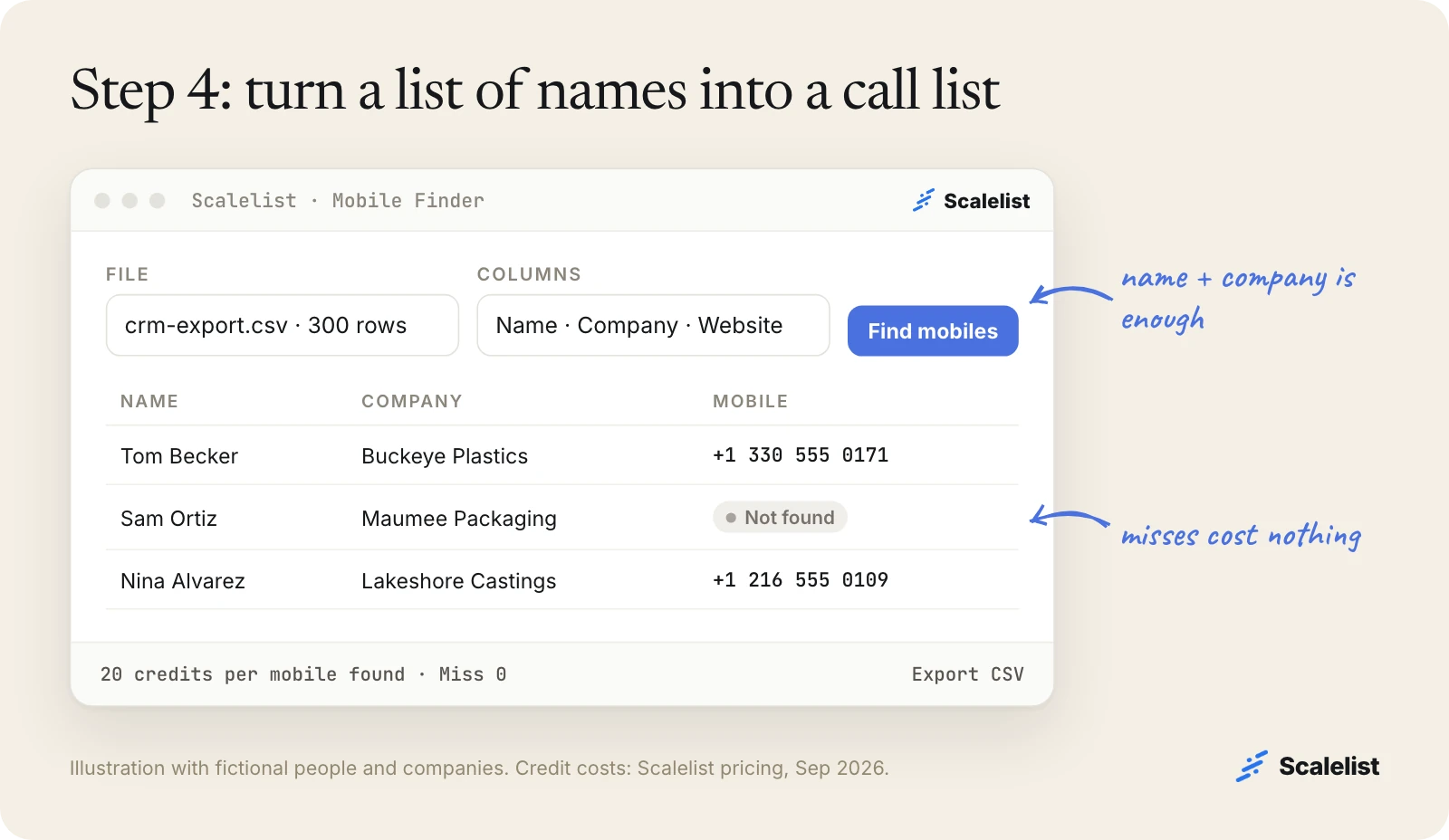
If the Mobile Finder finds a mobile for 250 of 300 uploaded contacts, you pay 5,000 credits, and the 50 misses cost nothing. To keep CRM records callable over time, see CRM enrichment.
5. Review the list before you dial
Check three things in the list view: how many emails came back Valid or Risky, how many phone numbers were found, and which rows have no mobile. Call the rows with mobiles first; email the rest.
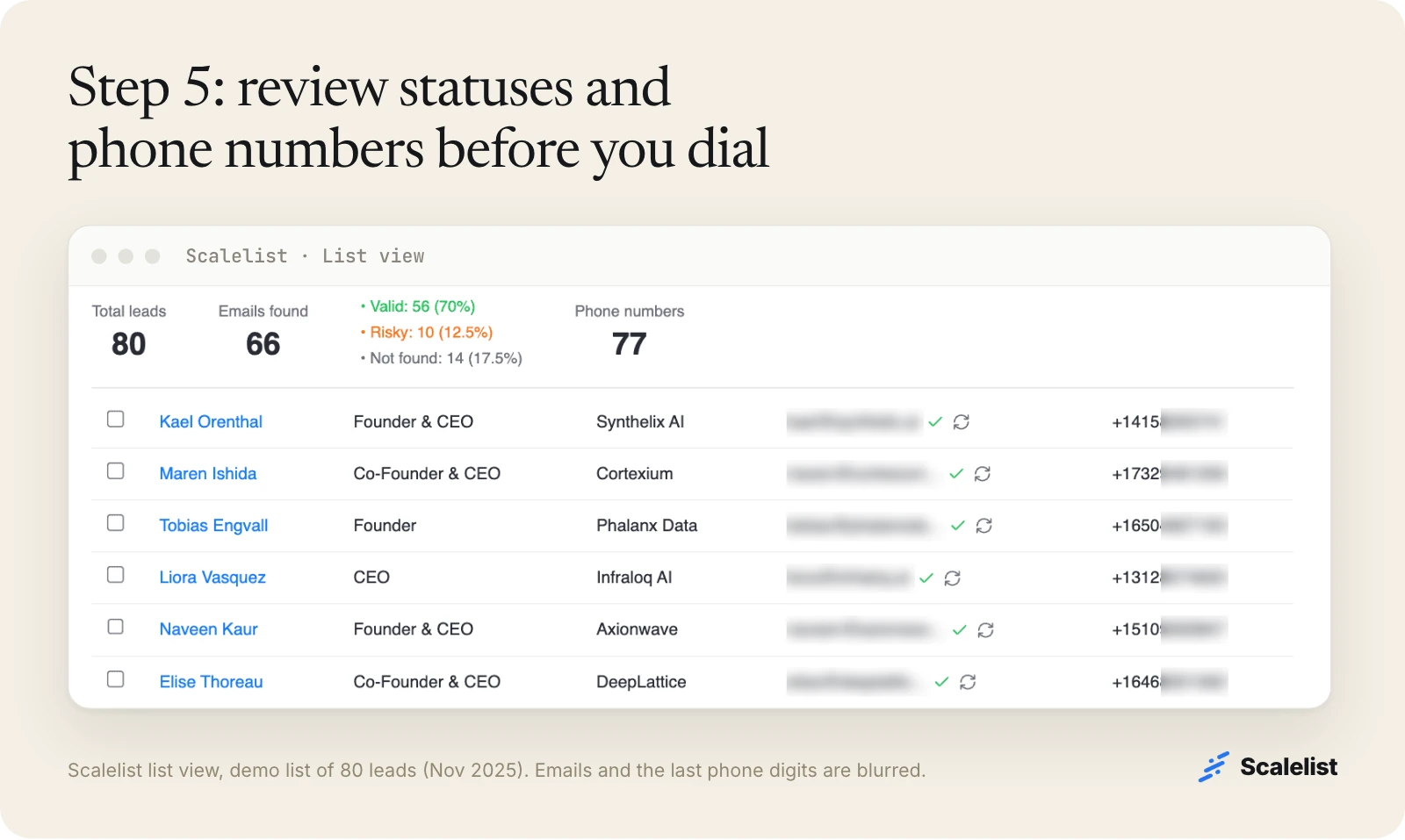
Remove current customers, open deals and anyone on your own do-not-call list before the list reaches a dialer.
6. Export to your dialer or CRM
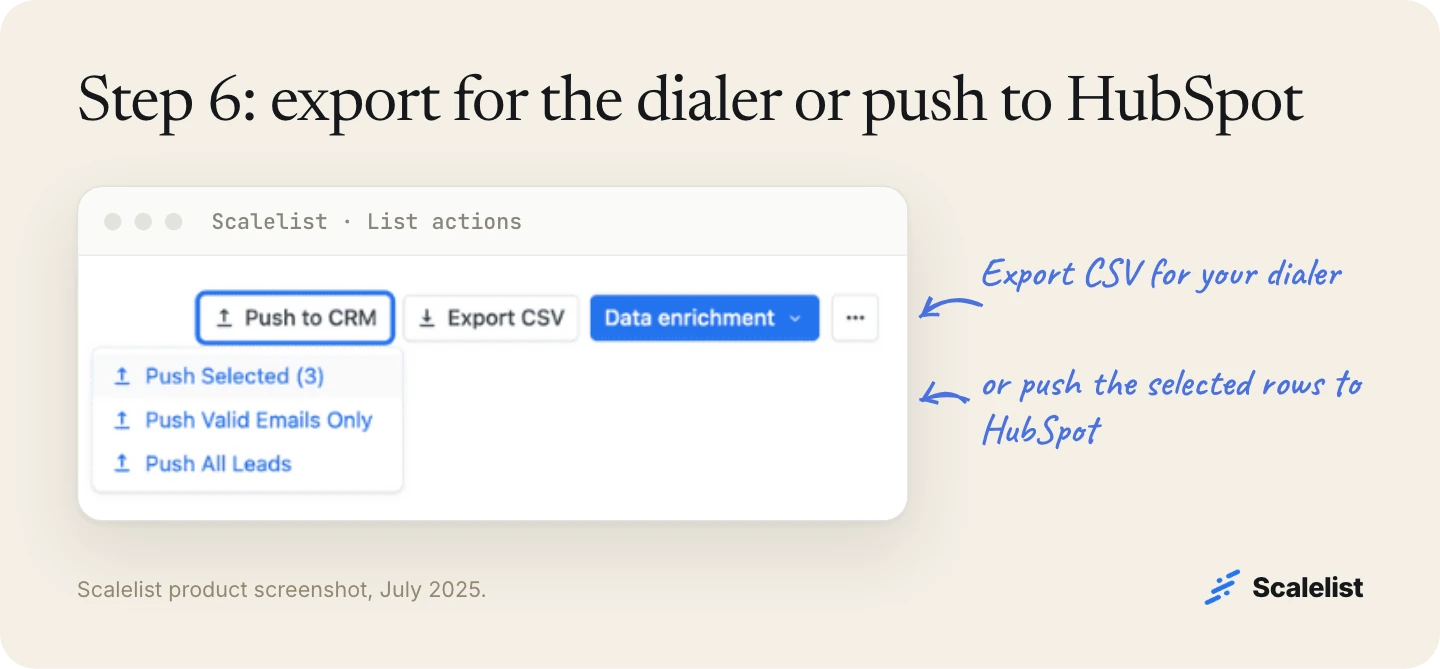
Export a CSV for your dialer, or push selected leads to HubSpot with field mapping. Keep numbers in international format (+1 614 555 0142) so the dialer reads the country code. For Aircall, Orum, Nooks and Kixie imports, see sending Scalelist mobiles to your dialer.
Tips for a call list that connects
A list that connects is narrow, fresh and ordered. These habits make the difference once the numbers are in.
Order the list by time zone
Call each prospect around mid-morning in their own time zone. Gong’s 300M-call data shows connect rates peaking at 8% for calls placed at 10 AM, against 5.5% at 8 AM (Gong). Sort by state, then follow 10 AM across the country:
| Your block (Eastern time) | Call prospects in | Their local time |
|---|---|---|
| 10:00 to 11:00 AM ET | Eastern: Ohio, Michigan, most of Indiana | 10 AM |
| 11:00 AM to noon ET | Central: Illinois, Wisconsin, Texas | 10 AM |
| Noon to 1:00 PM ET | Mountain: Colorado, Utah | 10 AM |
| 1:00 to 2:00 PM ET | Pacific: California, Washington | 10 AM |
More in the best time to cold call.
One segment per list
Plant managers and practice administrators need different reasons to talk, so build them as separate lists with separate sentences:
| Sentence to start from | Profiles matched in the US |
|---|---|
| Plant managers and operations directors at manufacturers in Ohio, Indiana and Michigan with 201 to 1,000 employees | 1,343 |
| Practice administrators and directors of operations at Texas medical practices with 51 to 500 employees | 684 |
| Directors and above at US manufacturers with 51 to 500 employees | Nearly 200,000 |
| Directors and above at US hospitals and health care organizations with 51 to 500 employees | Over 107,000 |
Counts are matching profiles in Scalelist’s Lead Finder on 27 September 2026, not verified contacts. The two broad rows are starting points to narrow, not lists to call.
Put a reason and a date on every row
A trigger in the notes column (a new shift, a hiring post, a new site) gives you the sentence the call opens with; our cold call scripts from real calls show how to use it. The date found tells you when to rebuild the list from your sentence instead of reusing an old file.
Troubleshooting a cold calling list
Most call list problems come from the numbers, the region or the rules. Here are the ones that come up most, with the fix.
No mobile was found for some contacts
Misses cost 0 credits, so nothing is lost. Email those contacts, call the company’s main line with a gatekeeper script ready (see the gatekeeper guide linked above), or try a second contact at the same account.
Your list is outside the US
Mobile coverage varies by region. In our provider benchmark, Scalelist found a phone number for 87% of the North America list, 73% in EMEA, 75% in APAC and 85% in Latin America. It is our own test, published with the raw data; run your own on a sample before a big campaign.
A number reaches the wrong person
Remove it, log it, and look up the right contact at that company. Expect some: in Belkins’ 2025 campaign data, 13.5% of connected calls that did not book a meeting reached the wrong person or a wrong number.
Your connect rate is lower than you expected
Check the number type before you blame the script: mobiles, office lines and switchboards connect at different rates. See cold call connect rates by number type.
US rules for calling mobiles
Most sales calls to a business are exempt from the National Do Not Call rules, but the FCC’s Do Not Call and calling-hours rules (8 a.m. to 9 p.m. local time) extend to wireless numbers, so personal mobiles are a grey area. Oklahoma allows 8 a.m. to 8 p.m. and three solicitation calls per person in 24 hours. Not legal advice: see B2B cold calling laws.
How I build my own call lists
I have made 75,000+ recorded cold calls in 11 years in sales. My setup today: Scalelist AI lead finder pulls the list with direct mobiles, Claude preps every call, Flunter dials and logs everything.
Scalelist, an AI Lead Finder, finds and verifies contact details on demand rather than serving a pre-compiled list, and every email comes back Valid or Risky. New accounts get 20 free credits, no credit card required. For the rest of the calling playbook, read the complete guide to B2B cold calling.
Build your first call list with direct mobiles: 20 credits per mobile found, nothing for a miss.
Get 20 credits to test itFAQ
What is a cold calling list?
A cold calling list is a set of named prospects who fit your buyer profile, with the details you need to call them: name, title, company, a direct mobile or direct line, a verified email for the follow-up, and a location for the time zone. A good one names the decision maker, not the company, so your call does not start at the front desk.
Where can I get a cold calling list?
Build it rather than buy it. A bought list is made for many buyers, and you rarely know when its numbers were found or whether they are mobiles or main lines. Describe your buyer in one sentence in a lead finder, check the count, and reveal mobiles for this month’s calls. If you already have names, upload them to a mobile finder.
How much does it cost to add mobile numbers to a call list?
20 credits per mobile found in Scalelist, and 0 for a miss. On the 5,000-credit plan at 199 USD a month, that is about 0.80 USD per mobile; on the 20,000-credit plan at 649 USD, about 0.65 USD. A fully enriched lead (lead, email and mobile) costs 22 credits, and new accounts get 20 free credits to test.
How many contacts should a cold calling list have?
About one month of calls for the reps who will work it. A phone-centric SDR averages 56 dials a day (The Bridge Group, 2025), and with about three attempts per prospect that is roughly 19 new contacts a day, or about 400 a month per rep. Reveal mobiles for that month only and rebuild the list for the next one.
What is the difference between a direct dial and a switchboard number?
A switchboard number reaches the company’s main line, where a receptionist or phone menu routes you. A direct dial reaches one person’s desk line, and a direct mobile reaches their own cell phone. For calling, rank them mobile first, direct dial second, and switchboard last, because it puts a gatekeeper in front of every call.
Do I need to check the Do Not Call Registry for B2B calls?
Generally not for business lines: most sales calls to a business are exempt from the National Do Not Call rules. Personal mobiles are a grey area, because the FCC’s Do Not Call rules extend to wireless numbers, so check with counsel before a large US mobile campaign. Always honor anyone who asks you to stop calling. Not legal advice.
Sources
- Gong: How to Master Cold Calls, a data-backed guide based on 300 million calls (PDF, 2024)
- Nooks Insights: Here’s who picks up the most (2025)
- Belkins: B2B Cold Calling Benchmarks 2026
- The Bridge Group: SDR Models, Motions and Metrics, 2025 Research Report
- FTC: Q&A for telemarketers and sellers about the Do Not Call provisions
- 47 CFR 64.1200, Delivery restrictions
- Oklahoma Telephone Solicitation Act of 2022 (HB 3168)


