


Outbound sales is when your team starts the conversation: you choose the companies and people you want as customers, then call and email them before they ever ask to hear from you. It is how you put meetings on the calendar when inbound is thin, and it runs on three things: the right list, direct phone numbers and a follow-up plan you actually finish.
Below you get the definition, how outbound differs from inbound, the six-step process, the channels, the numbers to track and the tools you need. Each section links to a deeper playbook.
What is outbound sales?
Outbound sales is a sales motion in which the seller makes the first contact. A rep or a founder picks target accounts, finds the right people inside them and reaches out by phone, email or a social message to book a first meeting, instead of waiting for the buyer to fill in a form.
Outbound prospecting is the top half of that motion: building the list, making the first touches and booking the meeting. Everything after the meeting (discovery, demo, proposal, close) looks like any other deal. Outbound is one part of B2B sales prospecting, the part where you go first.
Outbound vs inbound sales: who starts the conversation
The difference between outbound and inbound sales is who makes the first move: in outbound you contact the buyer, in inbound the buyer contacts you.
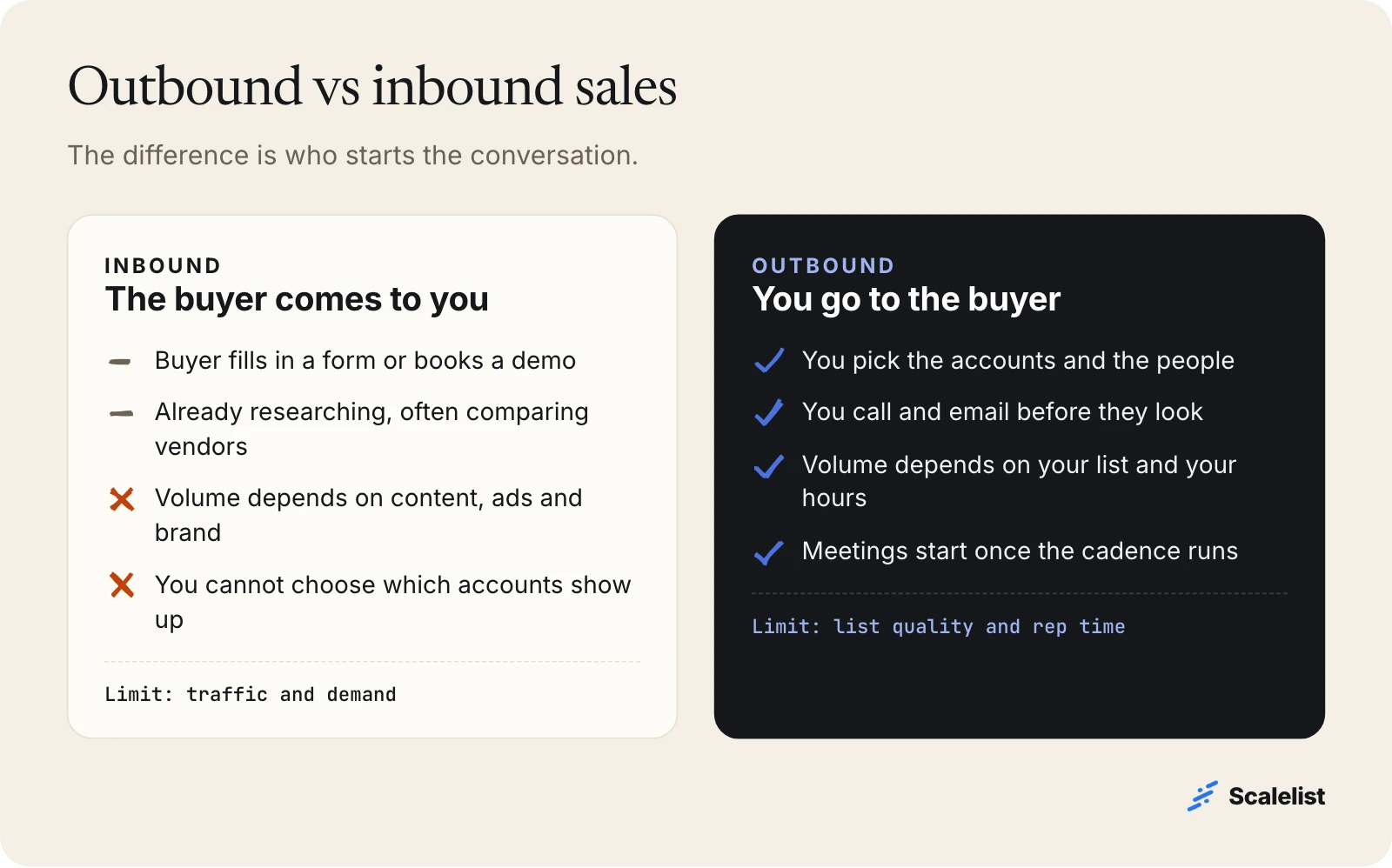
| Outbound sales | Inbound sales | |
|---|---|---|
| Who starts | You | The buyer |
| Buyer’s state | Not looking yet, may not know you | Already researching |
| What you control | Who, when and how many | Little: volume follows marketing |
| First meetings | Weeks, once the list and cadence run | Months, once content and ads build demand |
| Main limit | List quality and rep hours | Traffic and brand |
Most B2B teams run both. Inbound catches buyers already in market. Outbound goes after the accounts you want most, whether they are looking or not.
Buyers are wary of both. In a 2026 Gartner survey of 646 B2B buyers, 67% said they prefer a rep-free buying experience. Yet in RAIN Group’s survey of 488 buyers (2017 data), 82% said they accept meetings at least sometimes with sellers who reach out. The difference is relevance.
How outbound sales works: the 6-step process
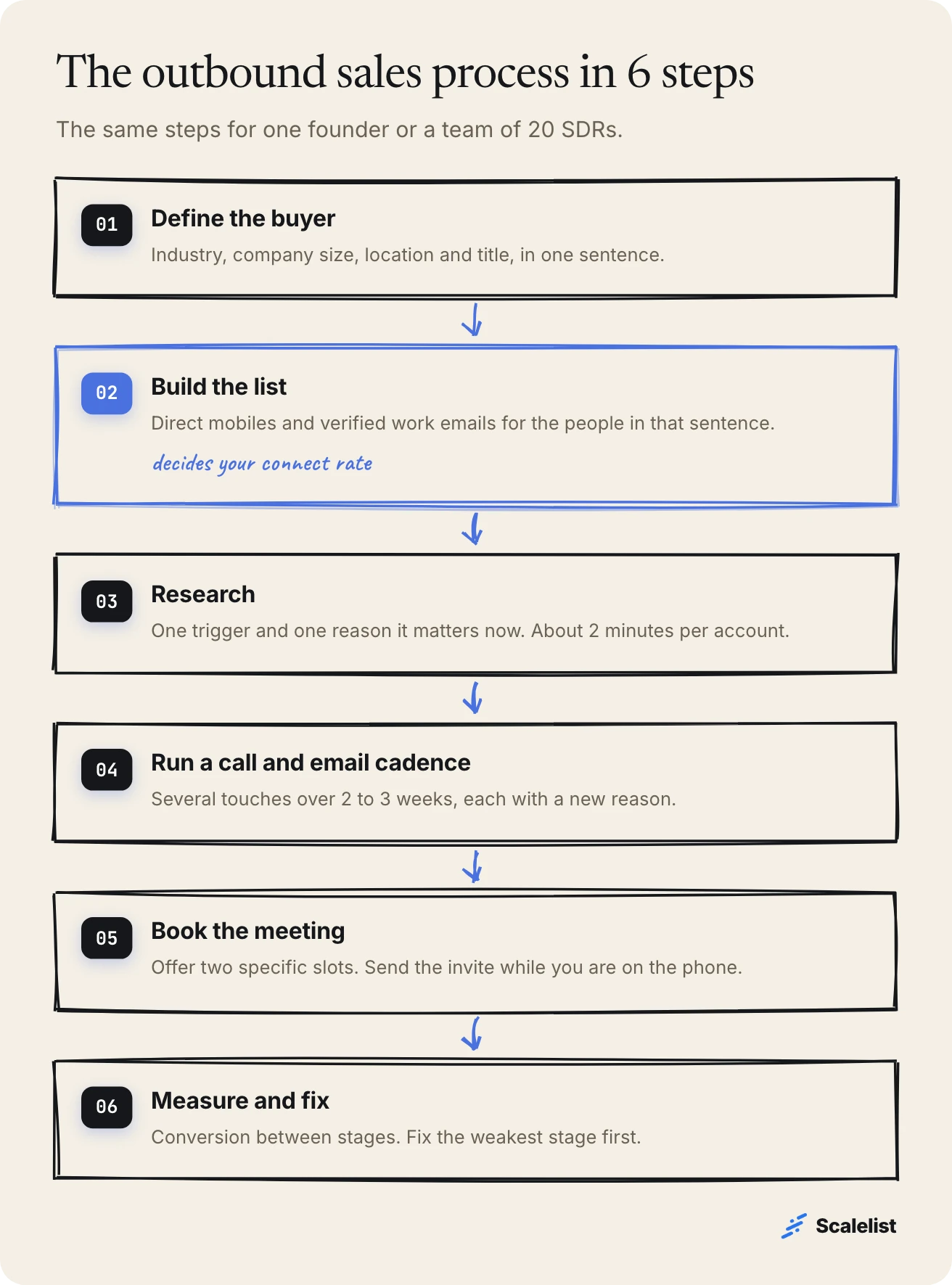
Every outbound sales process follows the same six steps, whether one founder runs it or a team of 20 sales development reps.
1. Define who you sell to, in one sentence
Write down the account and the person: industry, company size, location and the title that feels the problem. “VPs of Sales at US software companies with 51 to 500 employees” is a target. “Mid-market tech” is not. If you have no written profile yet, start from an ideal customer profile template.
2. Build a list with direct mobiles and verified emails
Your list decides your connect rate before you dial. A switchboard number reaches a receptionist; a direct mobile rings the person. In a 2025 Nooks analysis of nearly 3 million dials, mobile numbers connected 45% more often than other numbers.
Verify every email before it enters a sequence. Bounces hurt the domain that all your later emails come from. Our outbound lead generation playbook covers list building step by step.
3. Research just enough to be relevant
Spend two minutes per account: one trigger (a new hire, a funding round, a new location) and one reason your product matters to this person now. Gartner reported in 2025 that 73% of B2B buyers actively avoid suppliers who send irrelevant outreach. Our list of sales trigger events gives you the signals worth checking.
4. Run a cadence that mixes calls and emails
One touch is not outbound. A cadence spaces several calls and emails over two to three weeks, each with a reason to exist. In Belkins’ 2025 data (7.5 million emails), follow-up emails produced 58.6% of all replies.
Copy a ready-made one from our sales cadence examples, and see how to combine phone and email so each touch sets up the next.
5. Book the meeting, not the sale
The first call has one job: a 20-minute meeting with a date and a time. Offer two specific slots (“Tuesday at 10 or Wednesday at 2?”) instead of “let me know when works”. Send the invite while you are still on the phone.
6. Measure and fix one stage at a time
Look at conversion between stages: dials to conversations, emails to replies, conversations to meetings. Fix the weakest stage first, then the next. The section on metrics below shows what “normal” looks like.
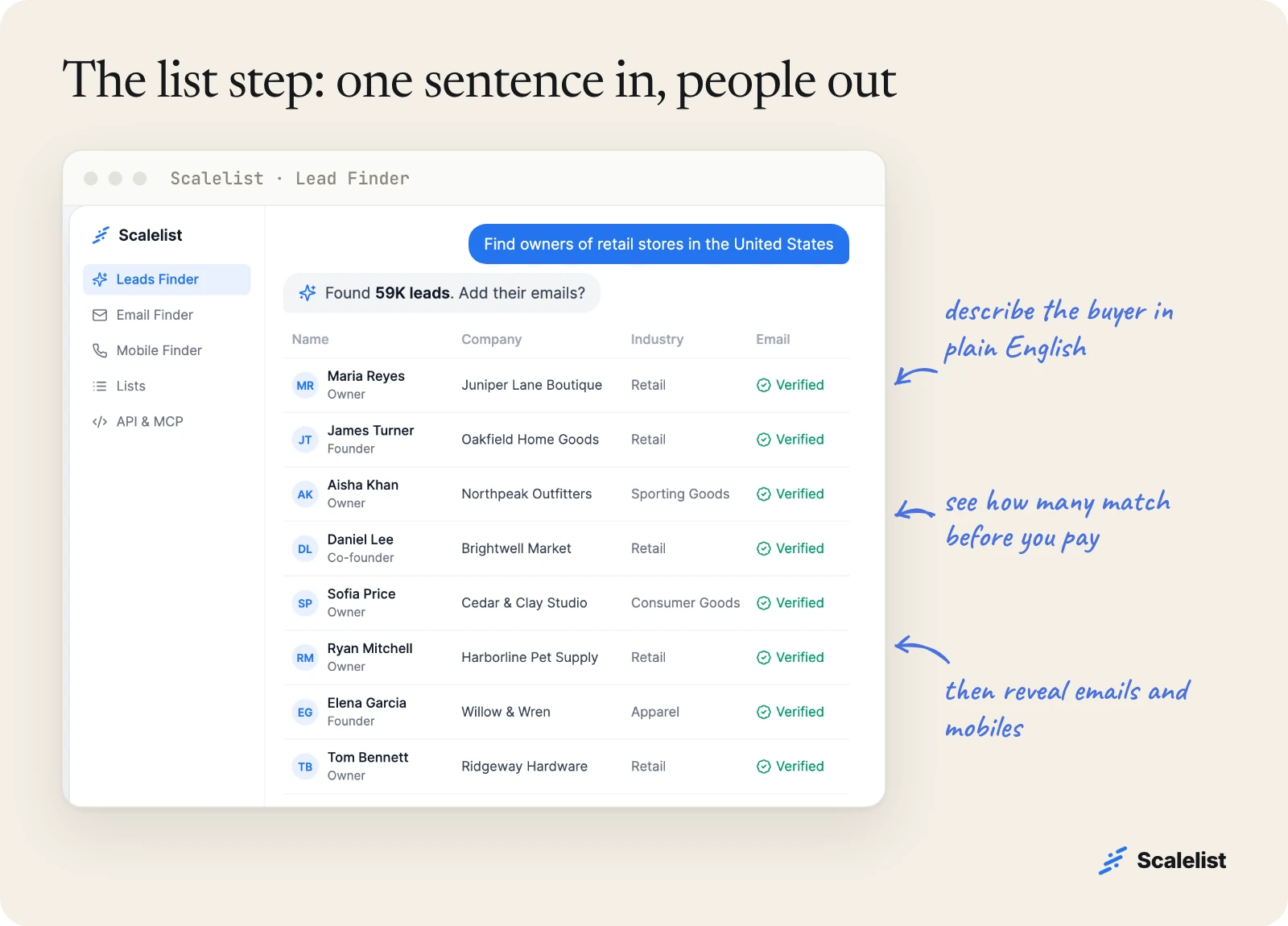
Build your first outbound list: describe your buyer in one sentence and see how many match before you spend a credit.
Describe your buyer in one sentenceOutbound sales channels: phone, email and social
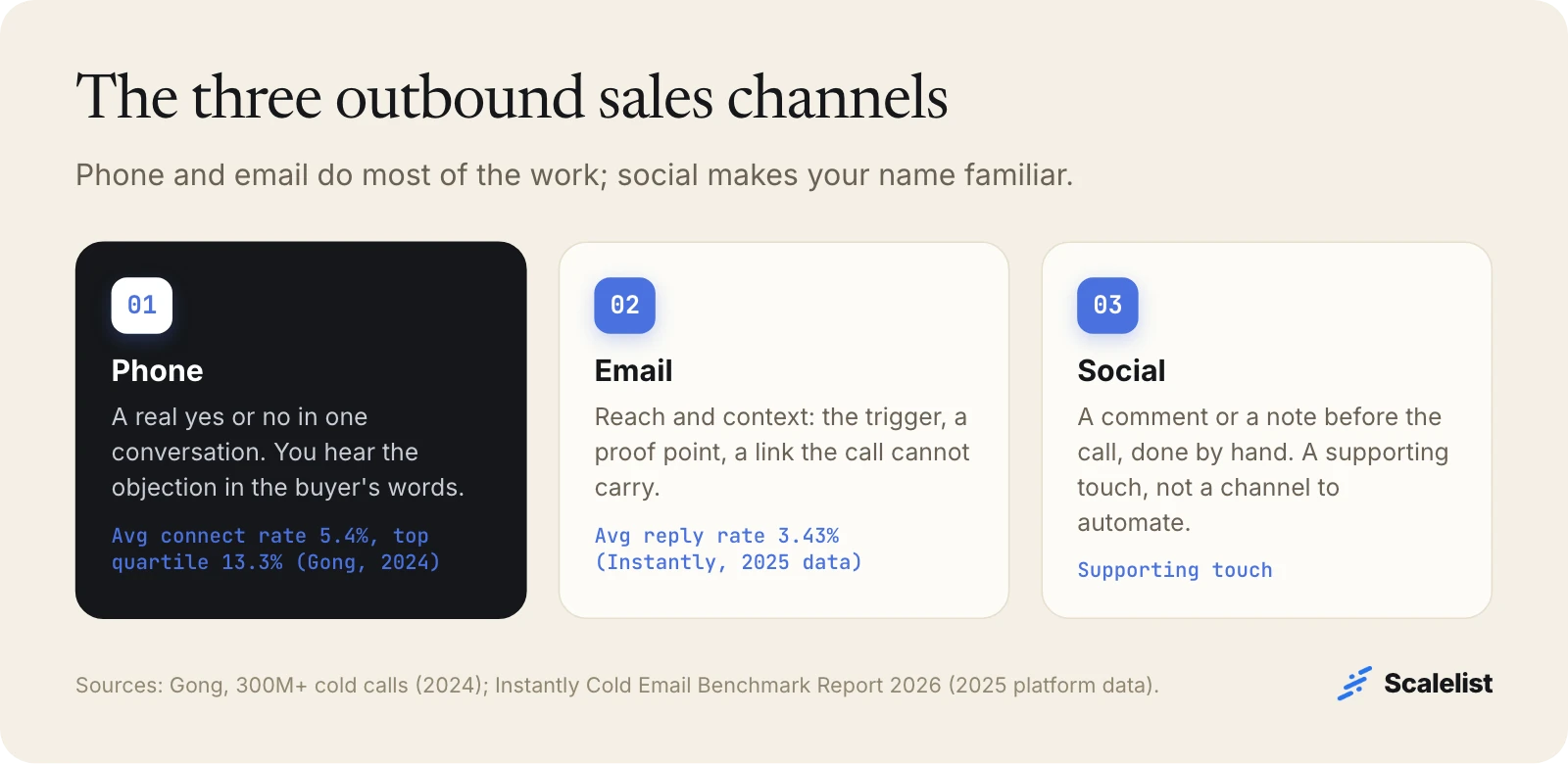
Outbound sales runs on three channels: the phone for conversations, email for reach and context, and social touches for familiarity. Phone and email do most of the work.
Phone: the fastest yes or no
A call gets you a real answer in one conversation, and you hear the objection in the buyer’s own words. In Gong’s 2024 data, the average rep connects on 5.4% of dials and a top-quartile rep on 13.3%. Senior buyers take calls: in RAIN Group’s 2018 survey, 57% of C-level and VP buyers listed the phone as a preferred way to be contacted.
Most of the gap between average and top reps is the number you dial and when you dial it. Our cold calling guide covers openers, objections and call blocks.
Email: reach and context
Email reaches more people per hour than the phone, and it carries the detail a call cannot: the trigger, a proof point, a link. Across Instantly’s platform in 2025, the average cold email reply rate was 3.43%, and the top 10% of campaigns reached 10.7% or more.
Social: familiarity, done by hand
A thoughtful comment on a prospect’s LinkedIn post before you call makes your name familiar. Treat it as a supporting touch you do yourself, not a channel to automate.
Who does outbound sales: SDRs, BDRs, AEs and founders
Outbound is usually run by sales development reps (SDRs) or business development reps (BDRs), who book meetings for account executives (AEs), who close. At an early-stage company, the founder does all three.
| Role | Job in outbound | Measured on |
|---|---|---|
| SDR | Books first meetings from outbound and often inbound leads | Meetings held |
| BDR | Same job; the title many companies use for outbound-only reps | Meetings and pipeline |
| AE | Runs discovery, demo and close; prospects their own accounts | Revenue |
| Founder | All of the above, until the process repeats | First customers and a playbook |
Titles vary by company, and many use SDR and BDR interchangeably. See what a sales development rep does for the role in detail. If you are the only seller today, start with our guide to founder-led sales.
Outbound sales metrics that matter
Outbound sales metrics measure conversion from one stage to the next: dials to conversations, emails to replies, conversations to meetings, meetings to pipeline. Activity counts alone tell you nothing.
| Metric | What it tells you | Published benchmark |
|---|---|---|
| Connect rate (dials answered by the prospect) | Number quality and call timing | 5.4% average, 13.3% top quartile (Gong, 2024) |
| Conversation to meeting | Your opener and your ask | 4.6% average, 16.7% top quartile (Gong, 2024) |
| Email reply rate (replies per email sent) | Targeting and message | 3.43% average (Instantly, 2025 data) |
| Bounce rate | Email list quality | 3.6% average (Hunter, 2025 data) |
| Meetings held vs booked | Qualification and confirmations | Track your own |
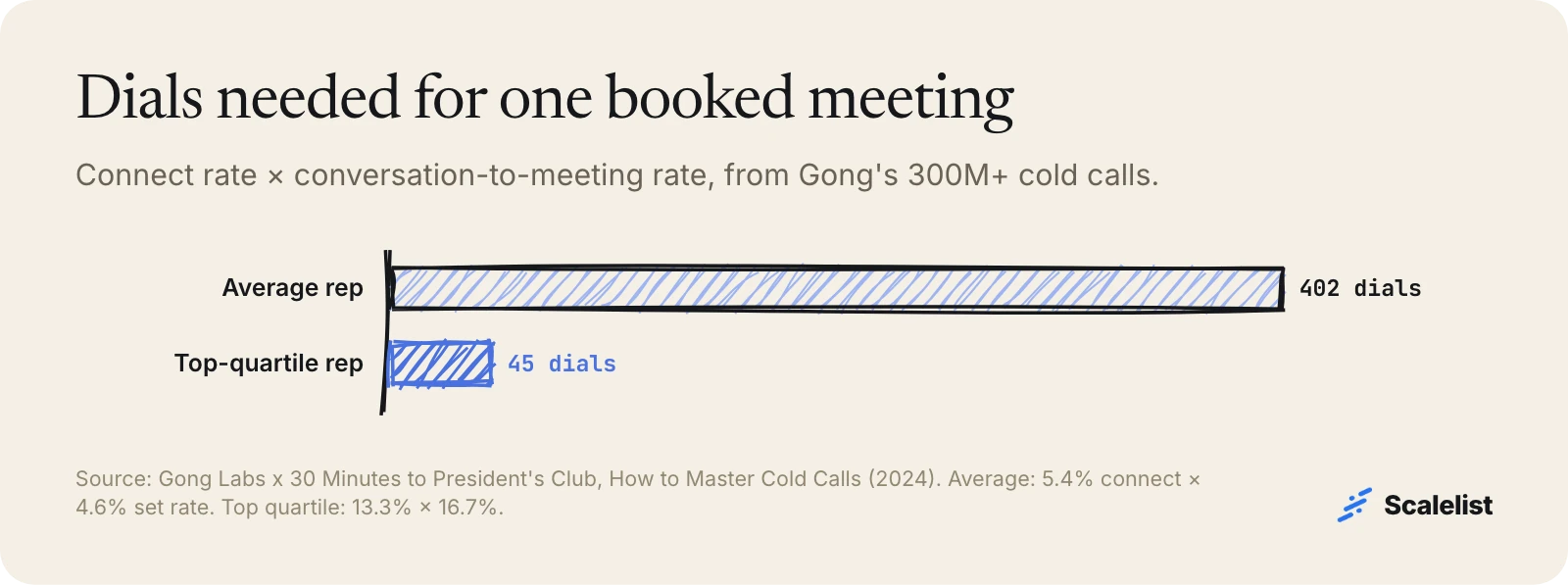
Gong’s two rates multiply into the dial count: 5.4% × 4.6% is about one meeting per 402 dials for an average rep, and 13.3% × 16.7% is one per 45 for a top-quartile rep. Better numbers and a sharper first 30 seconds close most of that gap.
For comparison, Arnaud’s five logged dialer sessions between July 30 and September 7, 2026 booked 13 meetings from 837 dials, about one per 64 dials. That is one experienced caller and a small sample, not a benchmark. For every metric, its formula and where to find it, see our outbound sales metrics and benchmarks.
Outbound sales example: three touches to one VP of Sales
Here is outbound on one real-world-sized target. The company and people are fictional. Rachel Ortiz founded Callboard, a coaching tool built on recorded sales calls, in Austin, Texas. Her buyer: VPs, heads and directors of sales at US software companies with 51 to 500 employees. On September 27, 2026, a Scalelist people count for those titles returned over 6,500 profiles.
She picks 50 companies that posted SDR jobs this month and calls first.
We help sales leaders get new reps booking meetings earlier by coaching them on the team's own recorded calls.
Is ramping the new class something you're working on this quarter, or is it handled?
Marcus does not pick up. She sends the email within the hour, so her name is fresh when she calls again.
Marcus, I tried you earlier. Saw Brightpath is hiring four SDRs in Denver.
When a new class starts, the first weeks usually go to shadowing instead of dialing.
Callboard turns your best reps' recorded calls into coaching the new hires can use in week one.
Worth 20 minutes next Tuesday or Wednesday?
Rachel Ortiz, Callboard
+1 512 555 0143
Touch 3 is a second call two days later at a different hour, referring to the email. For more first lines, see our cold call opening lines.
Common outbound sales challenges (and the fix)
Most outbound programs stall in the same five places. Each has a fix you can apply this week.
Nobody picks up
Usually the numbers, not the rep. Switchboards and old landlines route you to voicemail trees. Fix: dial direct mobiles, and call when people are at their desks. Gong’s hourly data shows connect rates peaking at 8% for calls placed at 10 a.m.
Emails bounce or land in spam
Unverified addresses raise your bounce rate and damage the sending domain. Fix: verify every email before it enters a sequence, send from a secondary domain, and hold back any address you cannot confirm.
Replies, but no meetings
Your message earns attention but your ask is vague. Fix: end every call and email with one specific time slot, and talk about their problem, not your features.
One contact per account
Older Gartner research puts the typical buying group for a complex B2B purchase at six to 10 decision makers. A single champion who cannot bring in the budget holder stalls the deal. Fix: reach two or three people per account from the start.
Stopping after one or two touches
In Belkins’ 2025 data, more than 53% of meetings sourced from email came from step 3 of a sequence or later. Fix: commit to the full cadence before you judge a list.
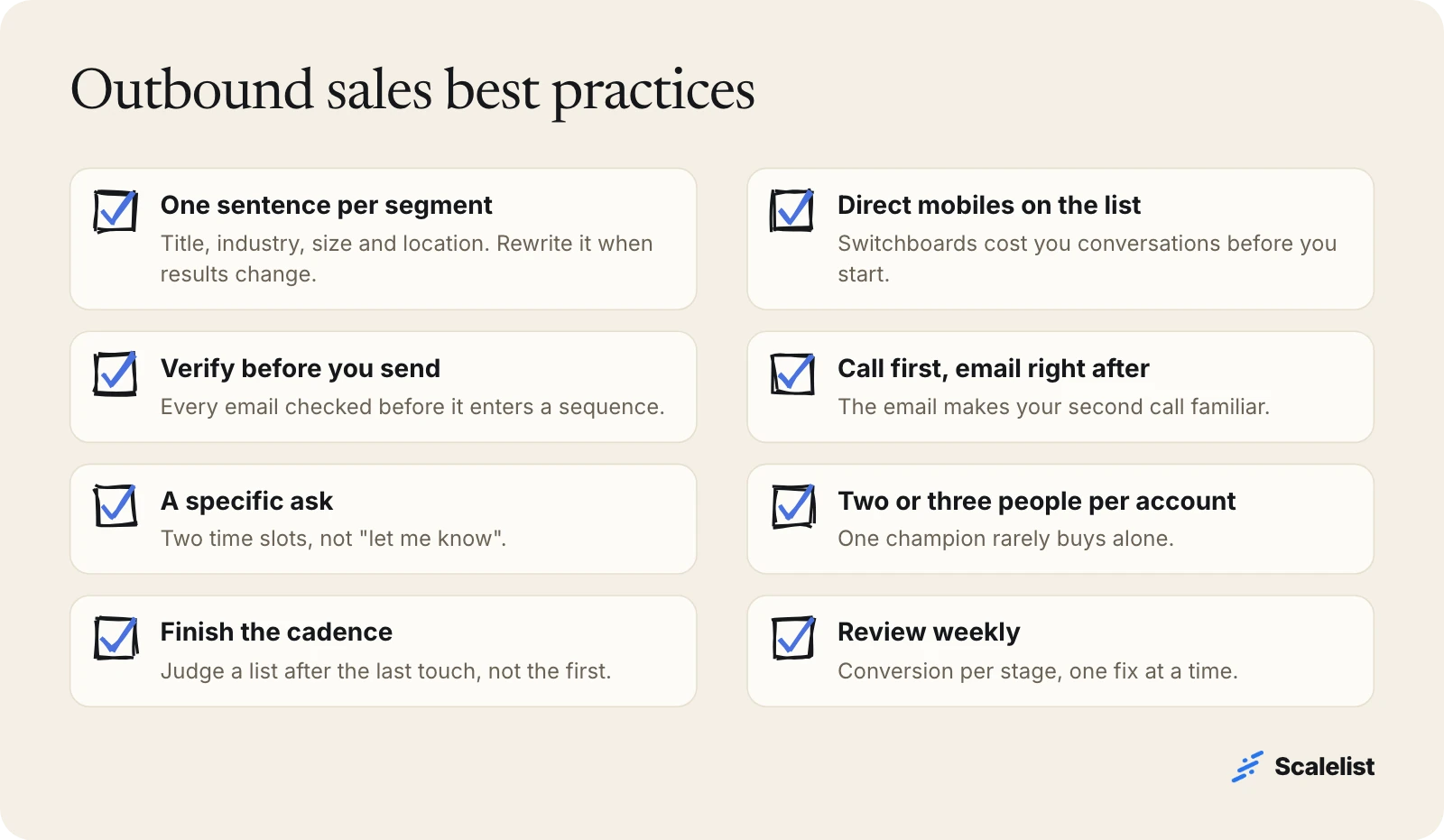
Outbound sales best practices
The outbound teams that book meetings every week do a handful of simple things every time.
For more on the lead generation side of outbound, CrankWheel’s guide covers everything you need to know about outbound lead generation.
What to look for in outbound sales tools
An outbound stack needs four parts: contact data with direct mobiles, a sequencer for email, a dialer, and a CRM that logs every touch.
- Contact data: direct mobiles and verified work emails, a clear status on every email, a count of matching people before you pay, and no charge for contacts it cannot find.
- Sequencer: sends from your own domains, stops the sequence when someone replies, and schedules calls as tasks.
- Dialer: click-to-call or power dialing, with every call logged automatically.
- CRM: one record per account, with calls, emails and meetings on it.
Arnaud keeps his own calling stack to three tools: Scalelist AI lead finder pulls the list with direct mobiles, Claude preps every call, Flunter dials and logs everything. For a wider comparison, see our review of the best sales prospecting tools.
How Scalelist helps with outbound sales
Scalelist, an AI Lead Finder, handles the list step of outbound sales: you describe your buyer in one sentence and get the matching people with verified work emails and direct mobile numbers.
Scalelist’s Lead Finder shows what it understood from your sentence and how many people match before you spend a credit. Then you reveal contact details and pay only for what is found:
- 1 credit per lead found, 1 per email found (Valid or Risky), 20 per mobile found, 0 for a miss.
- Every email is verified before it is returned and labelled Valid or Risky.
- Push selected leads to HubSpot or to lemlist, Instantly, Smartlead, Woodpecker or Saleshandy, or export a CSV for your dialer.
In our provider benchmark of 100 North American contacts, Scalelist found an email for 92% and a phone number for 87%. Scalelist finds and verifies contact details on demand instead of reselling pre-compiled lists. Plans start at 29 USD a month for 500 credits (see Scalelist pricing).
Describe your buyer in one sentence and get direct mobiles and verified emails for the people you want to call.
Get 20 credits to test itFAQ
Is outbound sales still effective?
Yes, when it is relevant and reaches the right person. Buyers still take calls and meetings from sellers who reach out: in RAIN Group’s survey (2017 data), 82% of buyers said they accept meetings at least sometimes with sellers who contact them first. What stopped working is volume without relevance: generic emails to unverified lists and dials to switchboards.
What is the difference between outbound sales and outbound prospecting?
Outbound prospecting is the first part of outbound sales. Prospecting covers building the list, researching accounts and making the first calls and emails until you book a meeting. Outbound sales covers that plus everything after it: discovery, demo, proposal and close. In many teams, SDRs or BDRs prospect and account executives sell.
What is the difference between inbound and outbound sales?
The difference is who starts the conversation. In inbound sales, the buyer contacts you after finding your content, ads or website. In outbound sales, you contact the buyer first by phone, email or social message. Inbound volume depends on marketing; outbound volume depends on your list quality and how many hours your team spends on it.
How many dials does it take to book a meeting?
About 402 dials for an average rep and about 45 for a top-quartile rep, according to Gong’s 2024 analysis of more than 300 million cold calls. The gap comes from connect rate (5.4% vs 13.3%) and the share of conversations that become meetings (4.6% vs 16.7%). Direct mobile numbers and a tight opener move both.
How many touches should an outbound sequence have?
Plan for five to eight touches across phone and email over two to three weeks. In RAIN Group’s research (2017 data), top-performing prospectors needed an average of 5 touches to convert a new prospect and other sellers needed 8. Belkins’ 2025 data found that more than half of email-sourced meetings came from step 3 or later.
Is outbound cold calling legal in the US?
Generally yes for live B2B calls, with limits. The FTC says most sales calls to a business are exempt from the Do Not Call rules, but personal mobiles can be on the National DNC Registry, and autodialed or prerecorded calls to mobiles need prior consent under the TCPA. This is not legal advice: see our guide to B2B cold calling laws.
Who should do outbound sales at a startup?
The founder, at first. Nobody explains the problem with more credibility, and the founder learns which segment buys, which words work and how many touches it takes. Once those answers are written down and a new hire could repeat them, hire a sales development rep or an account executive to run the process.
Sources
- Gong: The hidden power of cold calling, insights from 300M calls (2024)
- Gong: How to Master Cold Calls, data-backed guide (PDF, 2024)
- Nooks: Here’s who picks up the most (2025)
- Instantly: Cold Email Benchmark Report 2026
- Belkins: Sales follow-up statistics in B2B, 2026 study
- Hunter: The State of Cold Email
- Gartner: 67% of B2B buyers prefer a rep-free experience (March 2026)
- Gartner: 61% of B2B buyers prefer a rep-free buying experience (June 2025)
- Gartner: The B2B buying journey (archived January 2023)
- RAIN Group: Top Performance in Sales Prospecting (PDF)
- FTC: Q&A for telemarketers and sellers about the DNC provisions
- 47 CFR 64.1200 (Cornell LII)
- Scalelist people count (POST /api/v1/people/count), queried September 27, 2026, 0 credits.


