


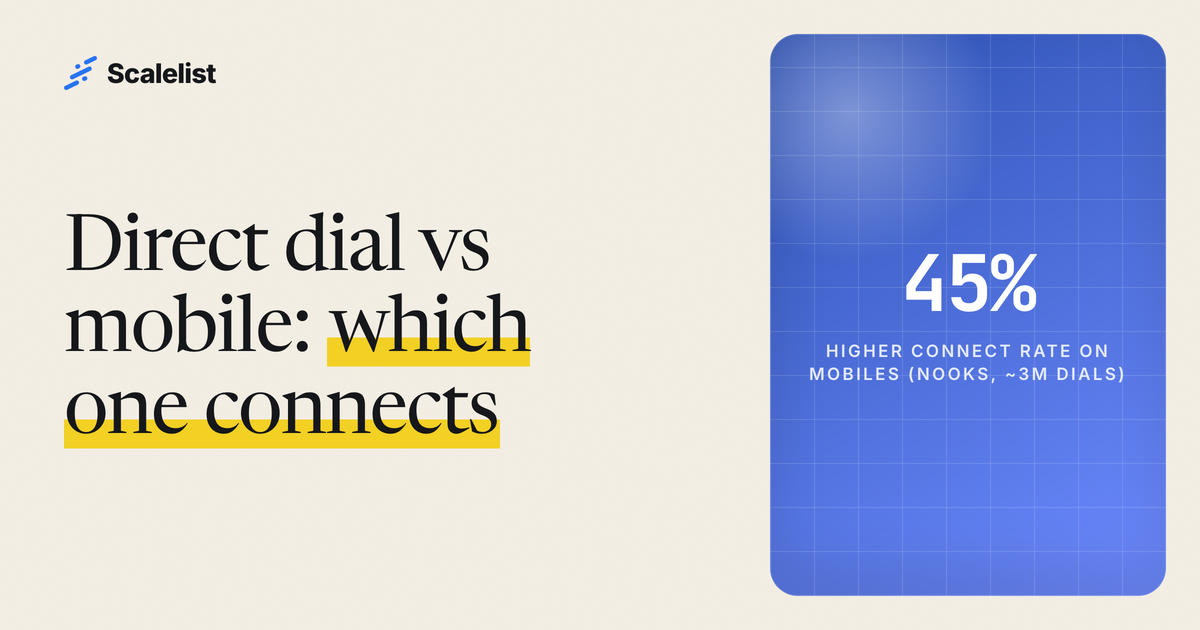
A mobile number connects most often. Across nearly 3 million dials, Nooks found that mobiles had a 45% higher connect rate than other numbers, and those conversations turned into meetings 18% more often. A direct dial skips the receptionist but often rings an empty desk, and a switchboard puts a gatekeeper between you and the buyer.
Below: what each number is, the published data, what I saw in 894 of my own logged dials in 2026, and the order to dial them in.
What is the difference between a direct dial and a mobile number?
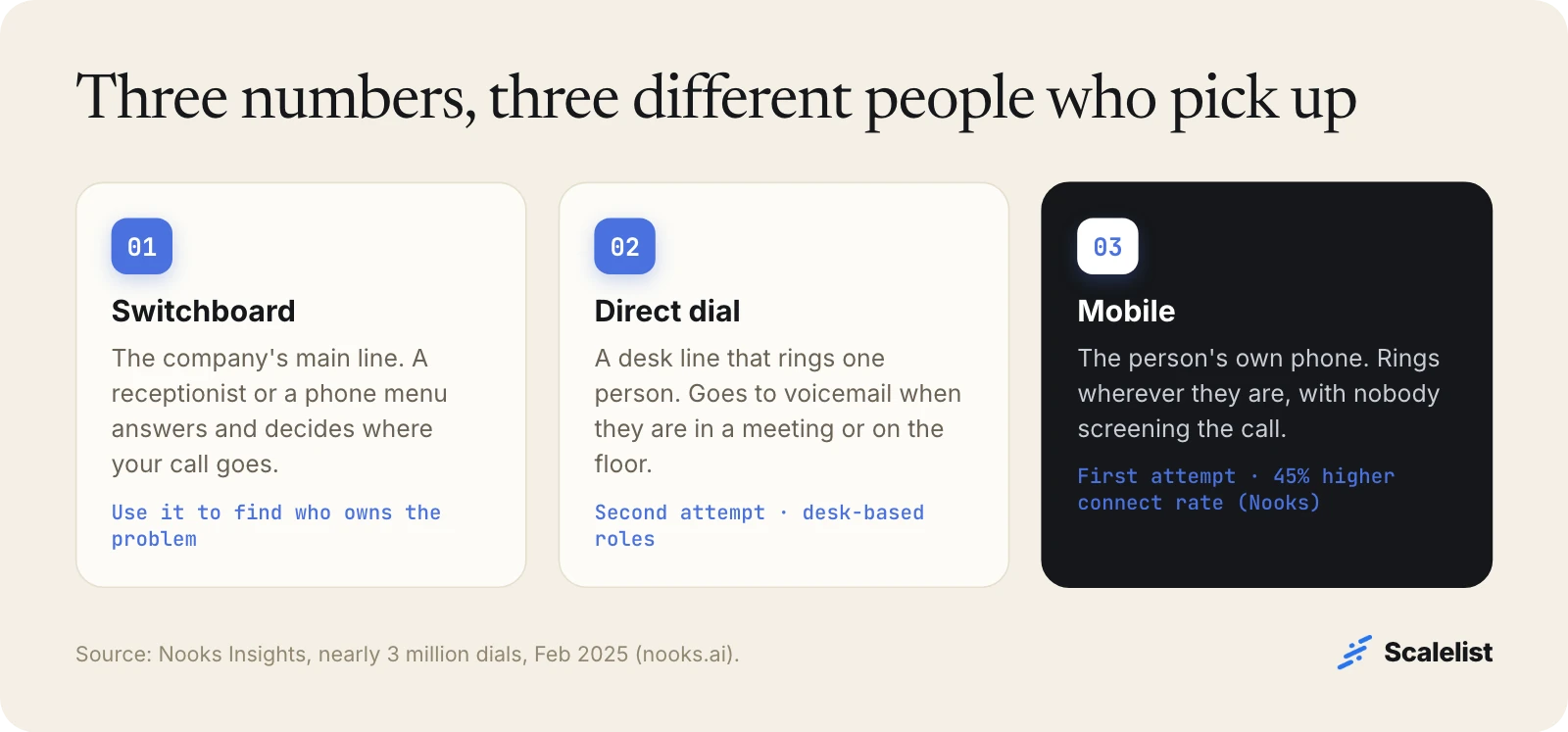
A direct dial is a phone number assigned to one person’s desk line, so it rings that person without going through the switchboard; a mobile is the person’s own cell phone and rings wherever they are. A switchboard, or main line, is the company’s shared number, answered by a receptionist or a phone menu.
All three can reach the same buyer, but not with the same odds. Many data tools label both desk lines and mobiles as “direct dials”, so check the number type before you plan a calling block.
Direct dial vs mobile vs switchboard at a glance
The mobile reaches the person, the direct dial reaches their desk, and the switchboard reaches whoever guards the door. In the direct dial vs switchboard choice, the direct dial wins whenever you know who you want.
| Number | Who picks up | What usually happens | Best use |
|---|---|---|---|
| Switchboard (main line) | Receptionist or phone menu | Screened, transferred or sent to a general voicemail | Finding out who owns a problem |
| Direct dial (desk line) | The person, if they are at their desk | Voicemail when they are in meetings or on the floor | Second attempt; desk-based roles |
| Mobile | The person, wherever they are | A live conversation more often than any other number | First attempt for most B2B buyers |
Which number connects? What the data says
Mobiles connect more often than other numbers in the published data that splits calls by number type, and in my own sessions. Three sources, three different definitions, one direction.
Mobiles connect 45% more often
Nooks analyzed nearly 3 million dials and found that “mobile numbers have a 45% higher connect rate than non-mobile numbers”, with 18% more of those conversations turning into meetings (Nooks, 2025).
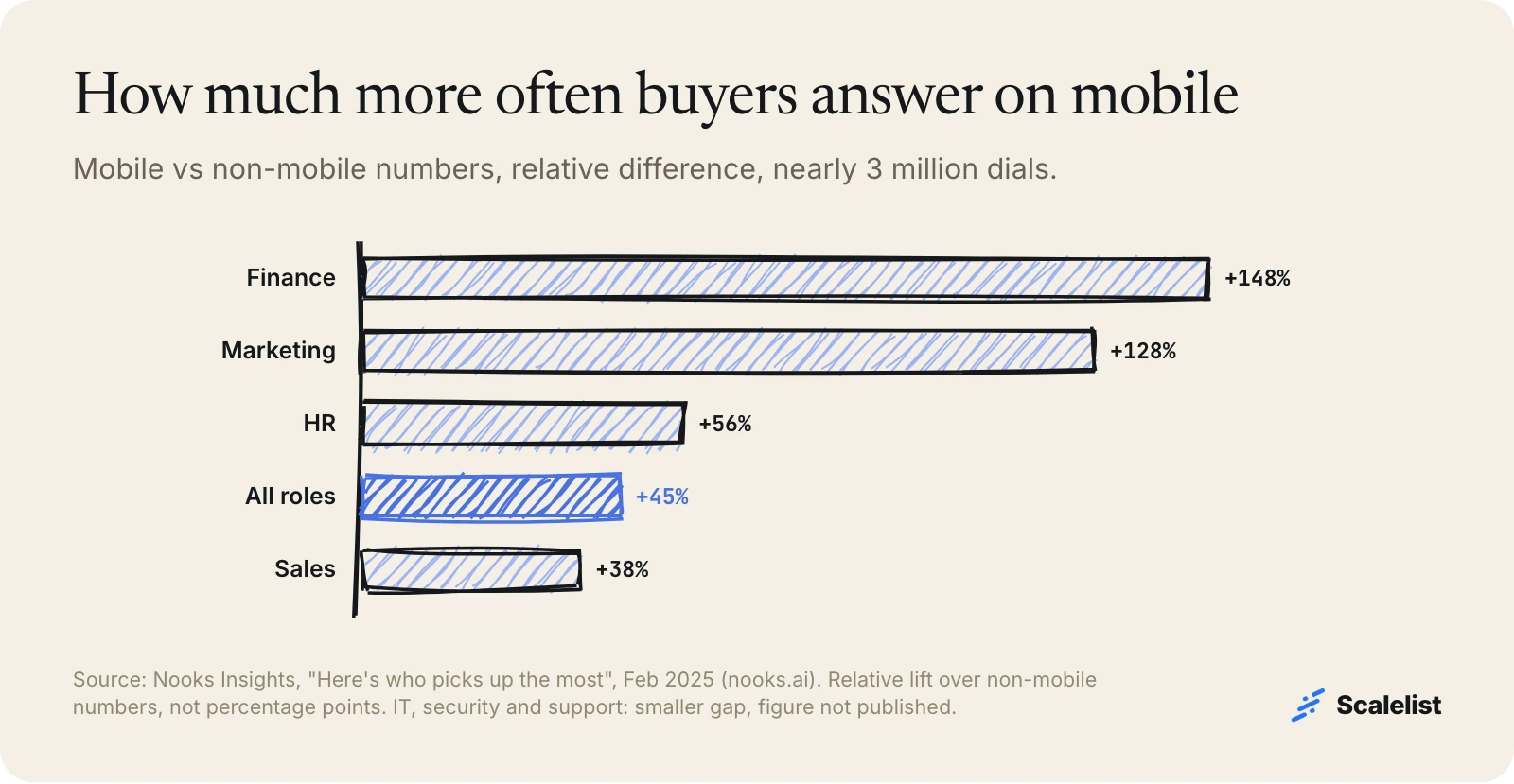
Nooks calls the non-mobile side office lines, so this is the mobile vs landline question answered with data. The 45% is relative: if non-mobile numbers connect on 6% of dials, mobiles connect on about 8.7%, not 51%.
The gap depends on who you call. Finance professionals were 148% more likely to answer on mobile than on other numbers, marketing 128%, HR 56% and sales 38%. For IT, security and support, Nooks found the difference smaller and office lines still viable.
Gatekeepers cut success by 39%
Gong’s 2024 guide, built on 300M+ cold calls, found that going through a gatekeeper “reduces chances of success by 39%”. Its advice is to dial during off hours or to “call mobile numbers to avoid them entirely” (Gong guide). The switchboard is the number most likely to have a gatekeeper on it. If you must go through one, here is how to get past the gatekeeper.
What I saw in 894 logged dials
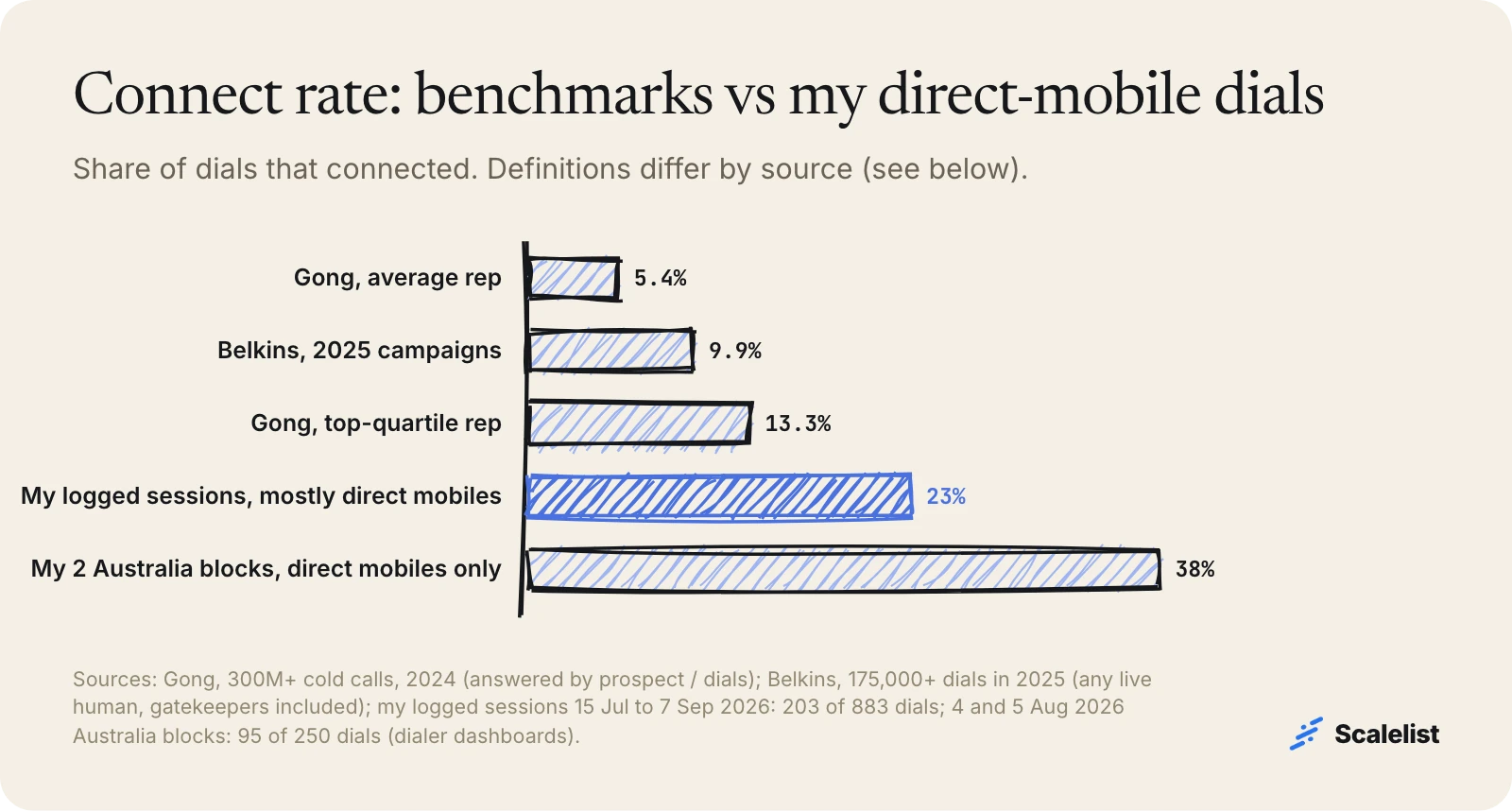
Between 15 July and 7 September 2026, I logged 894 dials across 8 sessions, most of them to direct mobiles of decision makers at Australian mid-market tech companies. In the 7 sessions with a connect count, 203 of 883 dials connected (23%), and the 8 sessions booked 18 meetings, about one per 50 dials.
If you call into Australia too, here is how to find Australian business mobiles and the hours that apply.
The cleanest test is two Australia afternoon blocks on 4 and 5 August 2026, dialed only to direct mobiles: 250 dials, 95 connects (38%) and 7 meetings. For comparison, Gong puts the average rep at 5.4% of dials connected and the top quartile at 13.3% (Gong, 2024).
The number type is not the only lever. My one US session, 120 dials into California on 30 July 2026 between 5:00 and 6:25 PM local time, connected on 10% and booked nothing. Calling after the workday ends undoes much of what a good number gives you.
Why do mobiles connect more often?
A mobile connects more often because it removes the three things between you and the buyer: the receptionist, the empty desk and the phone menu.
- It travels with the person. Plant managers walk the floor, recruiters sit in client offices, clinic managers move between rooms. The desk phone stays behind; the mobile does not.
- Nobody screens it. On a switchboard, someone else decides whether your call is worth the buyer’s time.
- It skips the phone tree. No “press 3 for sales”, no dial-by-name directory that sends you to a voicemail box nobody checks.
- It suits the roles that avoid desk phones. The Nooks data shows the biggest mobile advantage for finance, marketing and HR buyers.
When is a direct dial or the switchboard the better call?
Call the direct dial or the switchboard when you have no mobile, when the buyer works at a desk all day, or when you do not yet know who to ask for.
The buyer is desk-based
For IT, security and support roles, Nooks found the mobile advantage smaller and office lines still a viable channel. A direct dial is a reasonable first attempt there, and a good second attempt everywhere else.
You do not know who owns the problem
The switchboard is the best research tool on the list. Ask who handles the thing you sell, then ask for that person’s direct line.
The company is small
At a 12-person HVAC contractor in Tulsa, the main line and the owner’s phone are often the same number. The switchboard is the direct dial.
Your dialer places calls automatically
In the US, the consent rule for autodialed and prerecorded calls attaches to the cell number, not to the purpose of the call (47 U.S.C. 227). A person dialing by hand is not caught by that rule. If your team runs an autodialer, settle how it handles mobiles before the first block.
The rules change with the number type
The law treats mobiles differently from business lines in most markets, so the number type changes what you may do, not only who picks up.
| Market | Business line or switchboard | Mobile |
|---|---|---|
| United States | Most calls to businesses are exempt from Do Not Call rules (FTC) | Autodialer, prerecorded or AI voice needs prior express consent; DNC rules extend to wireless numbers |
| United Kingdom | Screen against the CTPS and TPS before live B2B calls | Mobiles can be registered on the TPS |
| Australia | Business numbers cannot be on the Do Not Call Register | Mostly private mobiles can be; Industry Standard hours apply to every sales call |
| Germany | B2B calls need at least presumed consent | Same rule as business lines |
Sources: FTC, 47 CFR 64.1200, ICO, Do Not Call Register, ACMA Industry Standard, UWG section 7. This is a summary, not legal advice. For each country, read how to find a prospect’s mobile number legally.
Which number should you dial first?
Dial the mobile first, the direct dial second and the switchboard last, and use a mobile finder when you have nothing.
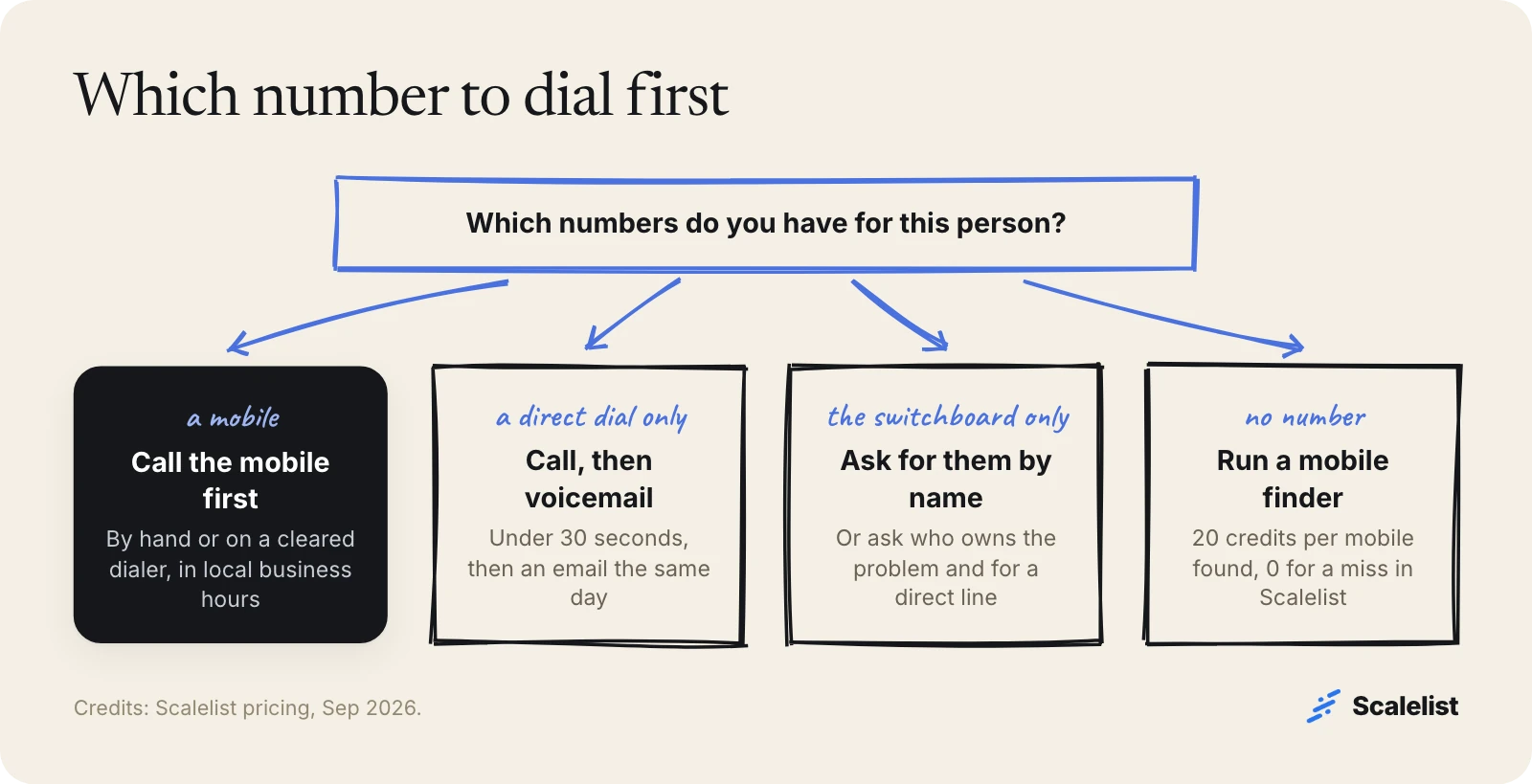
- Mobile, dialed by hand or on a dialer your counsel has cleared, inside business hours in the prospect’s time zone.
- Direct dial, as the second attempt, with a voicemail under 30 seconds. Here are voicemail scripts that get callbacks.
- Switchboard, to ask for the person by name or to find who owns the problem.
- No number? Run the name and company through a mobile finder. A miss costs nothing in Scalelist.
To make this order work, every number in your CRM needs a type label. Here is how to find and label direct dial phone numbers for a whole list.
How Scalelist gets you the mobile
Scalelist, an AI Lead Finder, is where you get the mobile number, not just the email. My own setup: Scalelist AI lead finder pulls the list with direct mobiles, Claude preps every call, Flunter dials and logs everything.
- Mobiles first: the Scalelist Mobile Finder turns names and companies into mobiles and direct dials, at 20 credits per mobile found and 0 when none is found.
- Coverage you can check: in our 8-provider benchmark, Scalelist found a phone number for 87% of the same founder list in North America, 73% in EMEA, 75% in APAC and 85% in Latin America.
- Straight to your dialer: export a CSV or send the mobiles to your dialer, or push leads to HubSpot.
- Known cost: about 0.80 USD per mobile on the 5,000-credit plan (199 USD a month). New accounts get 20 free credits.
For the rest of the contact record, read our playbook on finding business contact information.
Get the mobile numbers for the people on your call list, 20 credits per mobile found and 0 for a miss.
Find your first mobileFAQ
Is a direct dial the same as a mobile number?
No. A direct dial is usually a desk line that rings one person at the office, while a mobile is the person’s own cell phone. Both skip the switchboard. Many contact data tools label both as direct dials, so check the number type: in the direct dial vs mobile comparison, the mobile connects more often and carries extra consent rules in the US.
Do mobile numbers get answered more than landlines?
Yes. Across nearly 3 million dials, Nooks found mobile numbers had a 45% higher connect rate than non-mobile numbers, and those conversations became meetings 18% more often. The gap was largest for finance, marketing and HR buyers and smallest for IT, security and support, where office lines still work.
What is a good connect rate for cold calls?
It depends on the number type and the definition. Gong puts the average rep at 5.4% of dials and the top quartile at 13.3%; Belkins measured 9.9% on its 2025 campaigns, gatekeepers included. My 894 logged dials in 2026, mostly to direct mobiles, connected on 23%. Compare only with benchmarks that count a connect the same way.
Is it legal to cold call a mobile number in the US?
Often yes, with conditions. A live B2B call dialed by hand is not caught by the TCPA rule on autodialed calls, but calls to a cell number made with an autodialer or a prerecorded or AI voice need prior express consent, written consent for telemarketing. Do Not Call rules extend to wireless numbers, while most calls to businesses are exempt. This is not legal advice.
Should I ever call the switchboard?
Yes, for research and for small companies. The switchboard tells you who owns a problem and often gives you a direct line or extension. At very small companies, the main line may reach the owner. Avoid pitching the receptionist: Gong found that going through a gatekeeper cuts the chance of a successful call by 39%.
What does DID mean on a phone number?
DID stands for direct inward dialing. It is a phone number that routes an outside call straight to one extension inside a company’s phone system, skipping the main line. In sales data, a DID is the classic desk-line direct dial number. It rings at the desk, so it reaches the person only when they are there.
Sources
- Nooks Insights: Here’s who picks up the most (2025)
- Gong: How to master cold calls, a data-backed guide based on 300 million calls (2024)
- Gong: The hidden power of cold calling, insights from 300M calls (2024)
- Belkins: B2B cold calling benchmarks 2026
- 47 U.S.C. 227 (TCPA), Cornell LII
- 47 CFR 64.1200, Cornell LII
- FTC: Q&A for telemarketers and sellers about DNC provisions
- ICO: Business-to-business marketing
- Do Not Call Register: FAQs for consumers
- Do Not Call Register: Industry standards
- UWG section 7, gesetze-im-internet.de


