


Before you even think about writing an introductory email, you need a fundamental shift in perspective. It's not about what you want from them; it's about proving you understand what they need. A successful first touch is all about being personal and value-driven. Your message needs to respect their time and offer something genuinely useful.
This means ditching the generic templates for a clear, concise message that feels like the start of a real conversation, not just another sales pitch.
Why Most Introductory Emails Fail
Let's get real for a second. The average professional's inbox is a war zone. With over 120 emails flooding in daily, your message is fighting for just a few seconds of attention.
Most of those emails get deleted on sight for a few totally avoidable reasons. They're impersonal, self-serving, and show zero awareness of who they're talking to. Any email starting with "Dear Sir/Madam" or a lazy "Hope you're having a great week" is headed straight for the trash.
The biggest mistake I see? People treat their first email like a monologue. They list their accomplishments or dump their entire feature list on a stranger. The real goal isn't to close a deal on the first email; it's simply to earn enough trust and curiosity to get a response.
To do that, you have to flip your thinking:
- From "Me" to "You": Stop talking about your product. Start talking about a problem or goal you know is on their radar.
- From "Selling" to "Helping": Offer a useful insight, a relevant resource, or a sharp observation before you ask for anything in return.
- From "Broad" to "Specific": Show you've actually done your homework. Mention a recent project they launched, a shared connection, or a company milestone you noticed.
Of course, none of this matters if your email never even gets delivered. A perfectly crafted message is worthless if it lands in the spam folder. That's why understanding email deliverability best practices is non-negotiable. You have to make sure your email gets a fair shot at being seen.
A truly effective introductory email feels less like an interruption and more like a welcome solution. It proves you understand the recipient's world before you ask to become a part of it.
Crafting a Subject Line That Earns the Open
Let's be blunt: if your subject line doesn't work, nothing else matters. The most perfectly written email is worthless if it never gets opened. And with a staggering 376 billion emails flying around the globe every single day, you're not just sending a message; you're competing for a sliver of someone's attention.
The secret isn't clickbait. It’s about sparking just enough curiosity to earn that click. The best subject lines are personal, specific, and hint at real value. So, instead of a lazy "Checking in," you need something that shows you've done your homework.
Just think about the triage that happens in every inbox, every morning.
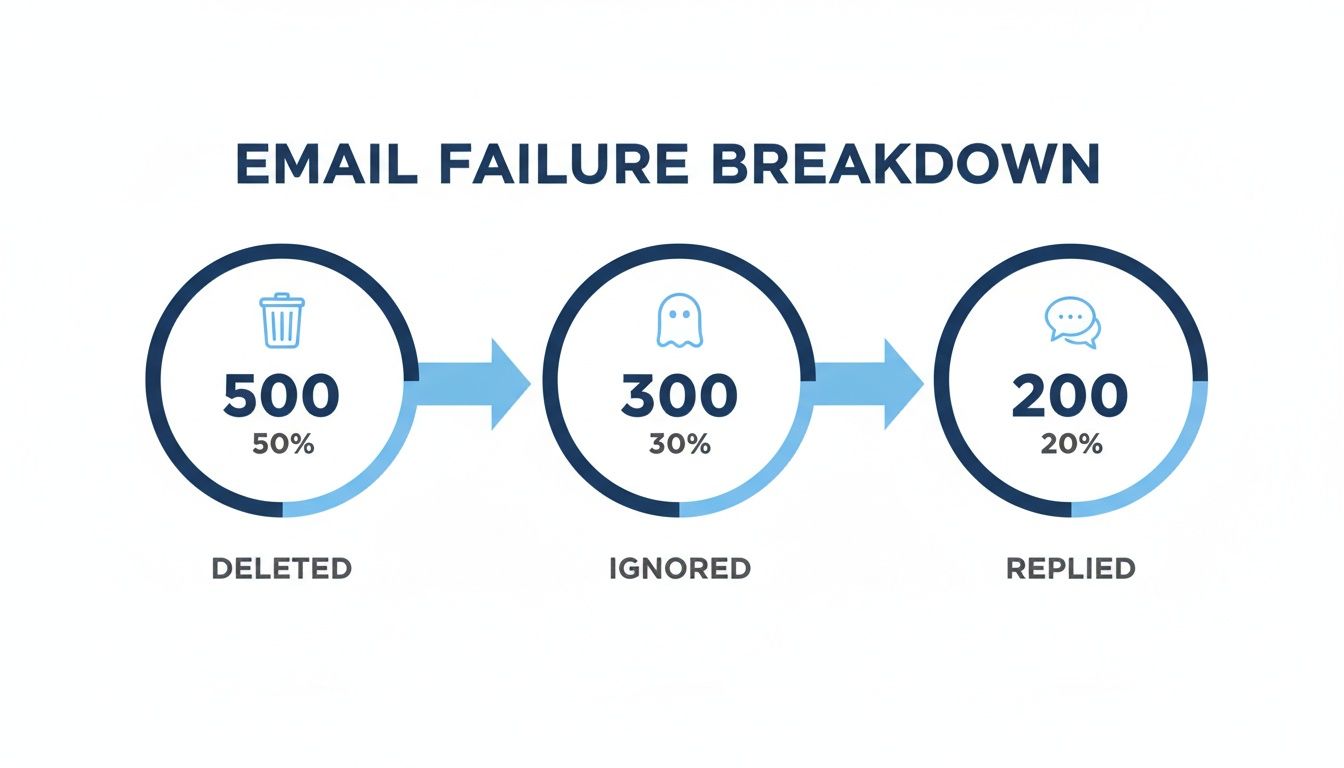
That’s your competition right there. A compelling subject line is your only defense against getting tossed into the "delete" or "ignore" pile.
Proven Subject Line Approaches
To get noticed, you have to move beyond the generic. We know that personalized subject lines can dramatically lift open rates, some data shows open rates hovering around 35% for personalized messages, which crushes the average for generic blasts.
Here are a few battle-tested strategies that consistently work for me:
- The Mutual Connection: "[Mutual Connection's Name] suggested I reach out". This is gold. It instantly builds trust and sidesteps the usual stranger-danger reaction.
- The Quick Question: "Quick question about [Their Recent Project]". I love this one because it's short, respects their time, and proves you’re not just spamming a list.
- The Clear Value: "Idea for improving [Their Company's Goal]". This approach gets straight to the point and makes the email about their world, not yours.
The best subject lines feel less like an advertisement and more like a helpful note from a colleague. They are short, specific, and focused entirely on the recipient.
Ultimately, you need to test what works for your specific audience. Running simple A/B tests can give you incredible insights. For a closer look at what separates a great first outreach from a mediocre one, check out these powerful examples: https://scalelist.com/cold-email-example/. And remember, the subject line is just the first step; there are many other ways for learning how to increase email open rates that will make all your efforts more effective.
Structuring Your Email for Readability and Impact

So, your subject line worked. They clicked. Now the real test begins. You have just a few seconds to convince them your email is worth their time. The secret? A structure that gets straight to the point and guides them from opening line to your call to action without any friction.
Effective emails are never just a wall of text. They’re scannable, persuasive, and built on a simple framework that feels less like a template and more like a natural conversation.
Start with a Personalized Hook
Your opening line is everything. This is your one shot to prove you're not just another generic email clogging up their inbox. Drop the tired "Hope you're having a great week" and lead with something that shows you've actually done your homework.
A solid hook is always specific and relevant to them. It proves you understand their world before asking for a moment of their time.
- Mention a recent achievement: "Congratulations on the recent launch of your new platform. I was particularly impressed with the user interface."
- Reference shared content: "I saw your recent post on LinkedIn about scaling sales teams and completely agree with your take on data-driven prospecting."
- Cite a company milestone: "I noticed that [Their Company Name] was just featured in TechCrunch for its innovative approach to AI."
Clearly Articulate Your Value Proposition
Once you've hooked them, get right to it. This is where you have to answer their silent, all-important question: "What’s in it for me?"
Forget the long-winded company history or a laundry list of features. Your value proposition needs to be a short, sharp statement that connects what you do to a problem they're facing or a goal they're trying to hit.
For example, instead of saying, "We sell CRM software," try something like, "Our CRM helps founders like you cut down on manual data entry by 40%, freeing up time for what actually matters." Shifting from what your product is to what it does for them is a total game-changer.
Your goal isn't to tell them everything you do. It's to tell them just enough to make them curious about what you can do for them.
Smoothly Transition to Your Request
The last piece of the email body is the bridge between your value prop and your call to action. You want this to feel like a natural next step, not a sudden, awkward demand. This is where you gently steer the conversation toward why you’re really reaching out.
A great transition makes your request feel like a logical conclusion. For instance, after explaining how you help companies improve their data accuracy, you could say, "Since you’re leading the new RevOps initiative, I thought this might be relevant." That one line connects your solution directly to their role, making your eventual CTA feel thoughtful instead of transactional.
Writing a Call to Action That Actually Gets a Reply
The very last sentence of your email can make or break your entire effort. Without a clear call to action (CTA), your carefully crafted message isn't a conversation starter, it's just an FYI they'll probably archive and forget.
You absolutely have to guide your reader toward the next step. Vague, passive sign-offs like "Let me know your thoughts" or "Looking forward to hearing from you" are dead ends. They dump all the work on the recipient, and busy people simply don't have the time to figure out what you want.
Making Your CTA Specific and Easy
The trick is to make it incredibly easy for them to say yes. The best CTAs are direct, remove any guesswork, and ask for a very small commitment.
Instead of a broad, open-ended request, propose a specific, low-effort action that they can answer with a simple "yes" or "no." This one change alone can dramatically increase your reply rates.
Here are a couple of tried-and-true methods I use all the time:
-
The Low-Friction Question: This is your go-to for gauging interest without being pushy. It’s a soft ask that opens the door. For example: "Is improving team productivity a priority for you this quarter?" It's a quick, easy question to answer and helps you qualify them right away.
-
The Specific Request: When you feel it's the right time to ask for a meeting, be precise. Don't leave it open. Try this instead: "Are you available for a 15-minute chat next Tuesday or Thursday afternoon?" By offering a couple of simple options, you've done the thinking for them and made scheduling feel less like a chore.
The goal is to make replying feel effortless. Your CTA should be so simple that the recipient can fire back a response in under 30 seconds.
Of course, even with a perfect CTA, you won't always get an immediate reply. That's why having a solid follow-up plan is critical. If you're wondering what to do when you hear crickets, you can learn more about how to approach it here: https://scalelist.com/how-to-follow-up-no-response-email/.
Ultimately, a great introductory email is all about getting that first conversation started. Mastering how to write cold emails that actually get replies is a skill that will pay dividends.
Common Mistakes That Will Get Your Email Deleted
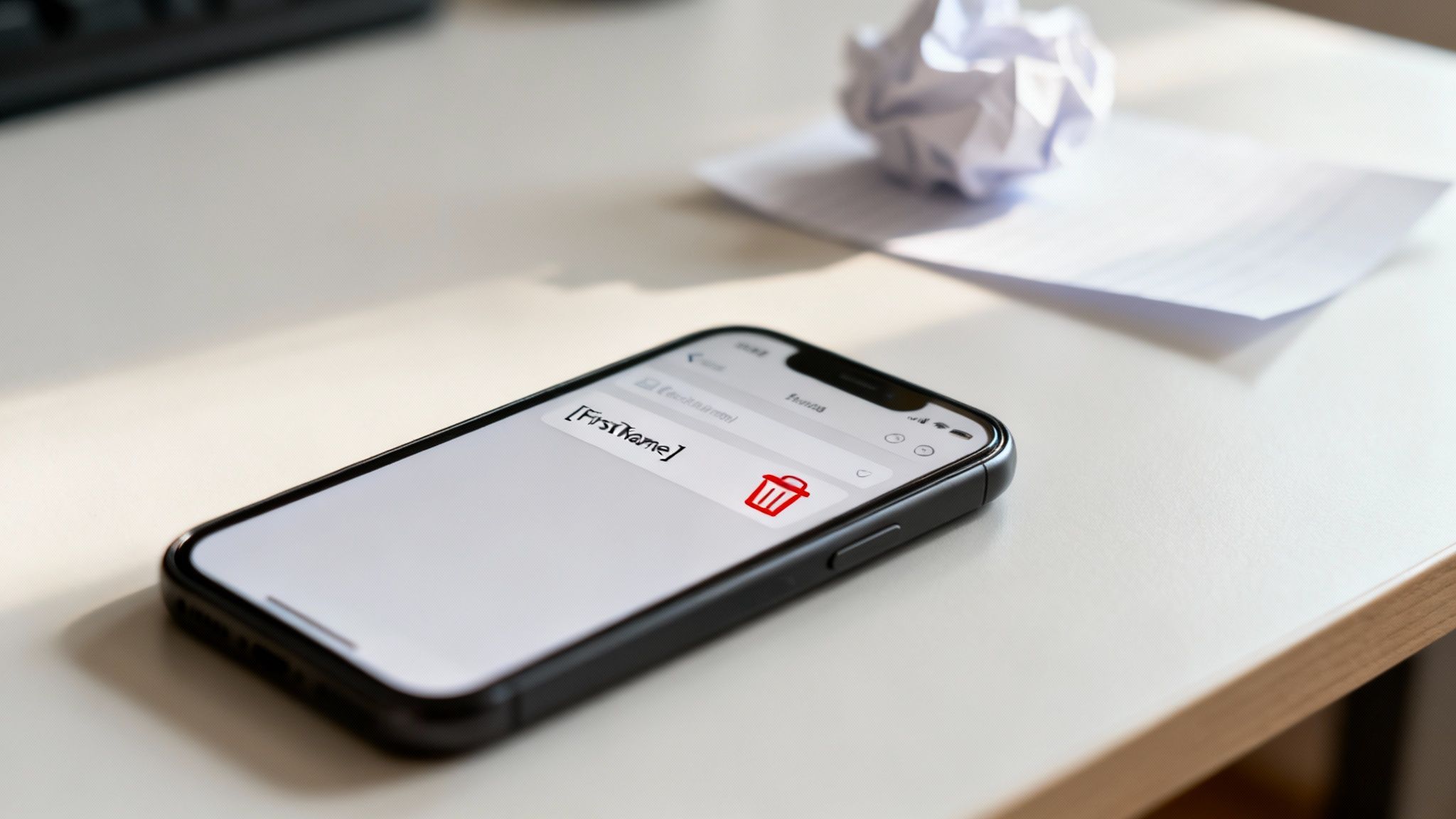
You can craft a nearly perfect introduction, but one simple, avoidable error can send it straight to the trash. The inbox is an unforgiving place, and little slip-ups can completely torpedo your credibility before the recipient even gets past your first sentence.
Honestly, knowing what not to do is just as crucial as knowing the right moves. The good news is that most of these blunders are easy to spot and fix once you know to look for them.
Making It All About You
This is the cardinal sin of outreach. If your email reads like a resume or a sales brochure, you've already lost. Your recipient doesn't have time to read about your company's long history or your personal achievements, they're focused on their own challenges and goals.
Let's look at an example.
- Before: "I'm the founder of a leading SaaS platform that has won numerous awards for innovation. We provide a full suite of project management tools."
- After: "I saw your team is hiring several new project managers, which suggests you're scaling up. Our platform helps teams like yours manage that kind of growth without the usual chaos."
See the difference? That simple shift from "I am" to "I saw you are" changes everything. It proves you're paying attention to their world, not just broadcasting about your own.
Your email should feel like you're starting a conversation about their specific problem, not just announcing your existence. If the first paragraph is all about you, you've given them a permission slip to hit delete.
Using Sloppy or Broken Personalization
Nothing screams "automated spam" quite like a personalization fail. Getting an email that starts with Hello [FirstName] is an instant trip to the trash folder. It tells the recipient they're just another entry in your spreadsheet and you didn't even care enough to double-check your data.
Another common pitfall is getting too personal in a way that feels irrelevant or just plain creepy. Mentioning the university they graduated from 20 years ago or a random hobby from their Instagram feed is more off-putting than impressive.
Stick to professional context that shows you’ve done your homework, a recent article they published, a podcast they were on, or a major company announcement.
Finally, typos and glaring grammatical errors are trust-killers. A simple mistake makes you look careless and unprofessional. Before you hit send, run a spell-check and give it one last read-through. It’s a small step that makes a huge difference.
Quick Answers to Your Introductory Email Questions
Even with the best strategy, you're bound to have questions when you're staring at a blank draft. What's a "good" response rate, anyway? And how long should you wait before nudging them with a follow-up? Nailing these details will make you feel more confident and, more importantly, get you better results.
Let's dig into a few of the most common questions I hear.
What’s a Good Open Rate for an Intro Email?
First, let's set some realistic expectations. You're not aiming for a 100% reply rate, that's just not going to happen. Success is about hitting, and then beating, the typical industry benchmarks.
Generally, a good open rate for commercial emails hovers between 20-40%, with click-through rates (CTR) landing somewhere around 2-3.5%. If your first intro campaign hits those numbers, you know your subject lines and personalization are on the right track. For a deeper dive, check out these insightful email marketing statistics to help you set informed goals.
When Is the Best Time to Send an Email?
This is the million-dollar question, isn't it? While there’s no magic formula that works for everyone, the data usually points to a sweet spot: mid-week mornings.
Think Tuesday, Wednesday, or Thursday, right around 10 AM. Most people have cleared their morning backlog but haven't been hit by the afternoon slump yet. The worst times? Late Friday afternoons when everyone's checked out, or first thing Monday morning when their inbox is an absolute warzone.
Of course, the real best time depends entirely on who you're talking to. A restaurant owner might actually check their email in the mid-afternoon lull, while that tech executive is probably glued to their screen during that classic 10 AM window.
The only way to know for sure is to test it out. Send batches at different times, track your open rates, and let the data tell you when your audience is listening.
Ready to build a high-quality list of prospects for your next campaign? With Scalelist, you can find verified contact data for decision-makers and ensure your message reaches the right inbox every time. Learn more at https://scalelist.com.


