


This is an independent Lusha review for US and UK sales teams deciding whether to buy it. It is not Lusha’s own site: to sign in to Lusha, go to lusha.com. We cover what Lusha publishes as of September 2026: its plans, credit rules, data claims, compliance pages and integrations, with prices in USD.
Lusha was not one of the 8 providers in our own benchmark, so every coverage number below is Lusha’s claim, labeled as such, with a way to test it on your own accounts.
Prices checked on 27 September 2026 from each vendor’s own pricing page.
What is Lusha?
Lusha is a B2B contact data platform that sells work emails and phone numbers on credit plans. You use it through a web app, a browser extension, an API or an MCP server, and it is built for reps and small teams who want to buy online without a sales call.
Lusha says its database holds “290M+ verified contacts” and “117M+ direct dials” (Lusha homepage). Around the contact data, its plans add contact and company lookalikes, buying intent topics, Signals and webhooks.
What Lusha says about its data
Lusha explains its sourcing on its data page. The part we could confirm on 27 September 2026 is that it works with outside data vendors: “We verify each vendor’s data to ensure its accuracy, before and during the engagement.” We did not capture a full source breakdown we could verify, so we do not repeat one here. Ask Lusha for it in writing if your legal team needs it.
Is Lusha legit?
Yes. Lusha publishes its prices and credit rules, and its trust center shows “SOC 2 Type II Certified” and “5 ISO Certifications”. Its plan comparison lists GDPR, CCPA, SOC 2, ISO 27701 and a Do Not Call list. You can cancel online at any time, with the change taking effect at the end of your plan cycle.
Legit is a separate question from fit. Whether Lusha is worth it depends on how many of your accounts it covers and how you prospect, which the rest of this review covers.
What we checked for this Lusha review
We reviewed Lusha the way a careful buyer would before a trial: from Lusha’s own pages, read on 27 September 2026. We did not buy a paid plan or run a long hands-on test, and we give no star rating.
| Area | What we read | What we found |
|---|---|---|
| Pricing | Lusha pricing page | Free, Starter, Pro and Premium published; Scale by quote |
| Credit rules | Lusha credits guide | Email 1 credit, phone 5, API at least 1 per request |
| Data | Homepage and data page | 290M+ contacts and 117M+ direct dials claimed |
| Coverage | Our provider benchmark | Lusha not tested; check it on your own list |
| Integrations | Integrations page | 11 CRMs and sales tools, plus API and MCP |
| Compliance | Trust center and pricing page | SOC 2 Type II, ISO 27701, GDPR, CCPA, Do Not Call list |
| Contract | Pricing FAQ | Monthly or yearly, cancel any time, ends at cycle end |
The 11 integrations are Salesforce, HubSpot, Pipedrive, Zoho CRM, monday CRM, Outreach, Salesloft, Bullhorn, Gong, Clay and Zapier. Priority support is listed on the Scale plan only.
How accurate is Lusha’s data?
Lusha does not publish an accuracy or bounce rate on the pages we read. It publishes coverage claims instead: the contact and direct dial totals above, plus “165M+ emails”, “29M+ companies” and “26 buying signals refreshed weekly”.
Its plans promise “Verified emails & phones”, but the email status labels you would see are not published on the pages we read.
A database total tells you how many records exist, not how many of your accounts have a working mobile. In our own provider benchmark, the six providers with a phone product found a phone number for between 32% and 87% of the same North American list.
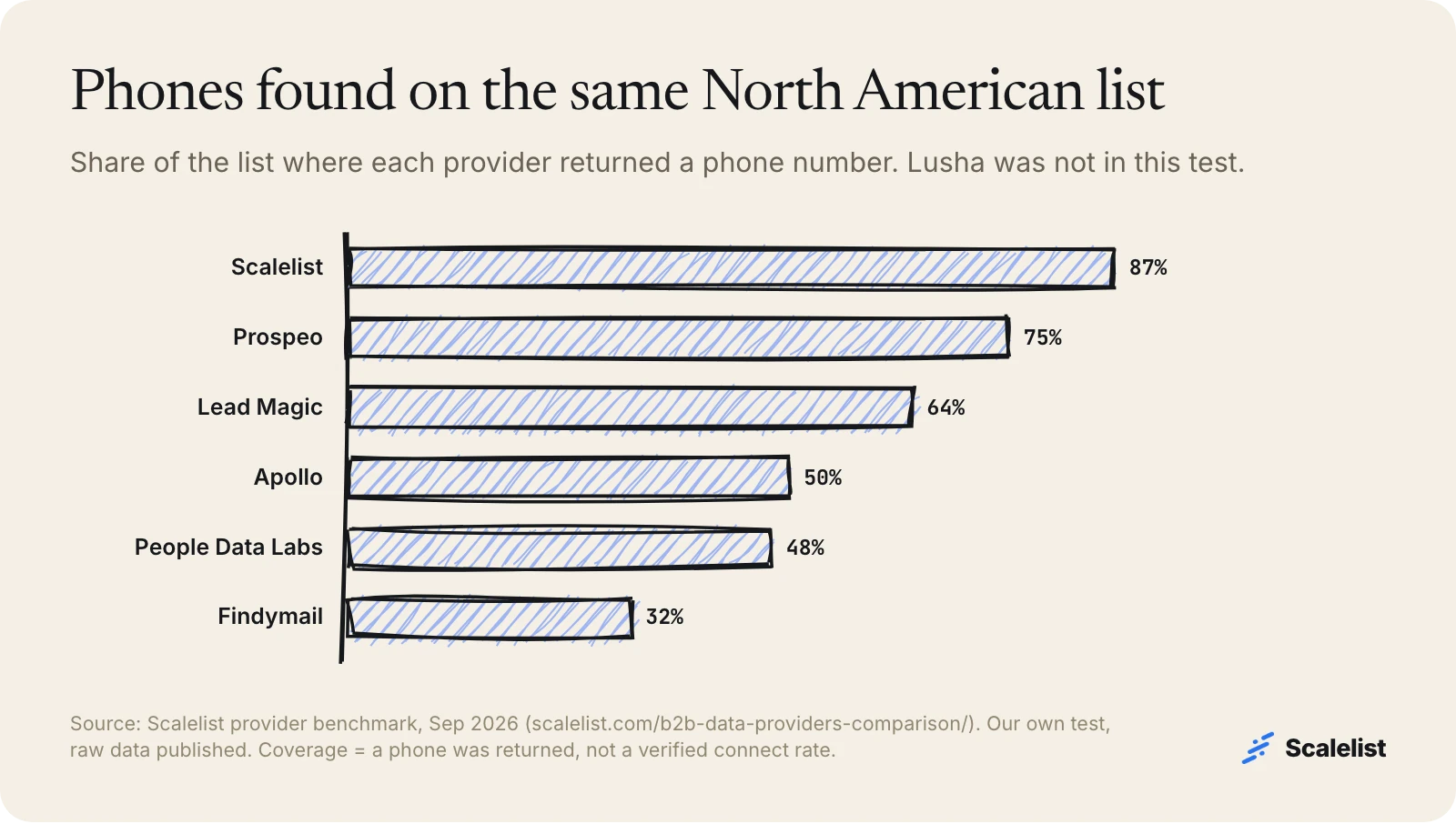
Lusha was not in that test, and we will not guess where it would land. The spread is the reason to test before you buy: reveal 20 to 50 accounts you already know, then count how many numbers reach the right person. Our guide to testing a data provider gives the exact method.
Direct dials are worth that effort. Nooks analyzed nearly 3 million dials and found that “mobile numbers have a 45% higher connect rate than non-mobile numbers” (Nooks, 2025). Here is how direct dials, mobiles and switchboards differ on a real call list.
What a Lusha phone reveal costs
Lusha starts at 49.90 USD a month for Starter (400 credits), or 37.45 USD a month billed yearly. Pro costs 69.90 USD and Premium 399.90 USD a month, with 2 and 5 seats, and Scale is quoted by sales. Every plan draws on one credit pool: 1 credit per email, 5 credits per phone number. Every plan, seat and feature is in our full Lusha pricing breakdown.
One Lusha phone reveal costs between 0.44 and 0.62 USD, and one email between 8.7 and 12.5 cents. The math is the plan price divided by its monthly credits, times 5 for a phone:
- Starter: 49.90 / 400 = 12.5 cents a credit, so 0.62 USD per phone monthly and 0.47 USD yearly.
- Pro: 69.90 / 600 = 11.7 cents a credit, so 0.58 USD per phone monthly and 0.44 USD yearly.
- Premium: 399.90 / 3,400 = 11.8 cents a credit, so 0.59 USD per phone monthly and 0.44 USD yearly.
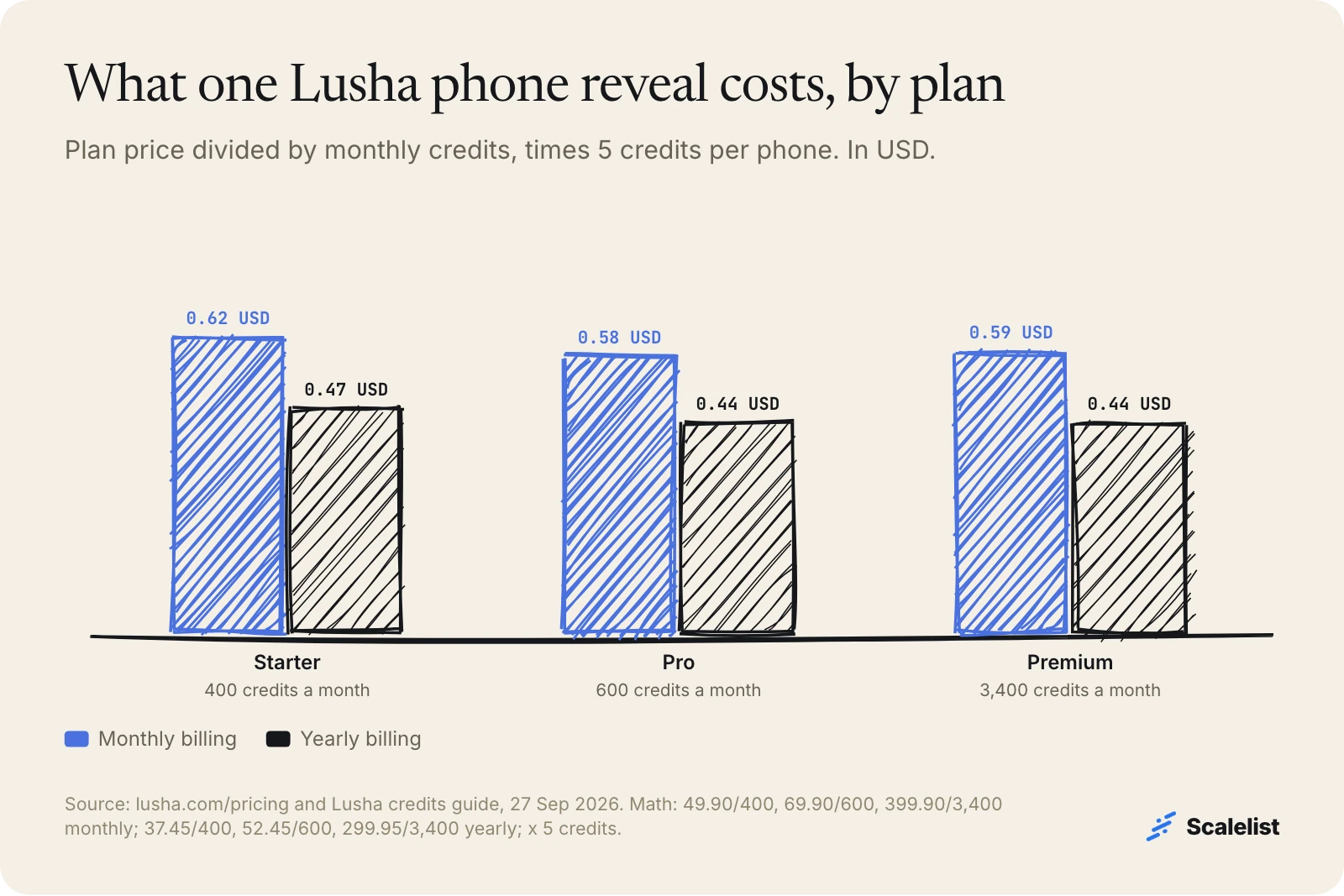
If you spend every Starter credit on phones, you get 80 numbers a month. Pro gets you 120 and Premium 680.
The credit rules that change your bill
The published price is the floor. These rules, from Lusha’s credits guide, decide what you actually spend:
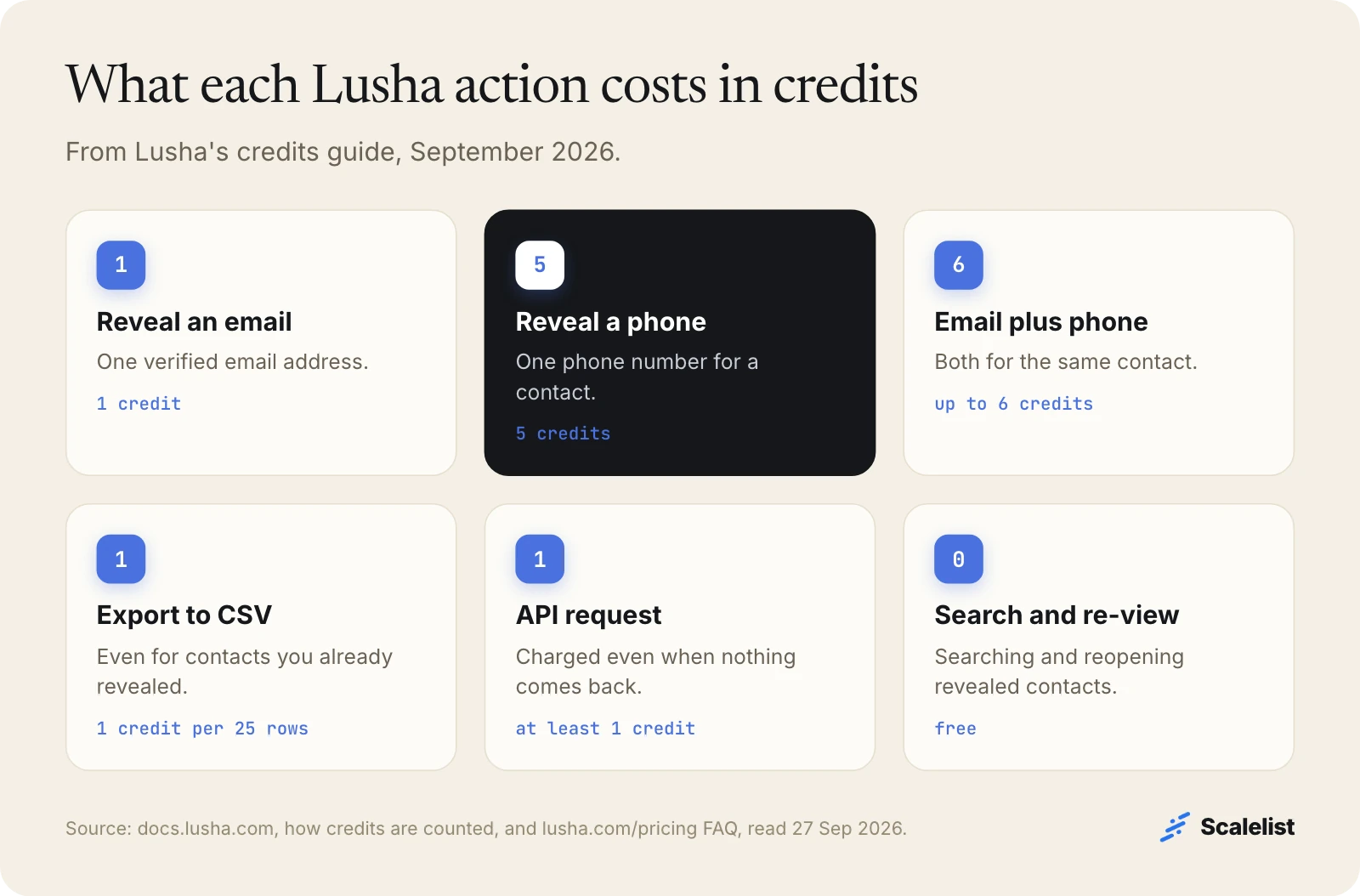
- Bulk reveals charge the whole selection, “including those for whom only partial data was found”.
- API calls cost at least 1 credit, “even if no results are returned”.
- CSV enrichment is fairer: “rows Lusha cannot find a match for are always free.”
- Exports cost extra. A CSV export is “1 credit per 25 rows”, even for contacts you already revealed.
- Yearly credits reset. “Any unused credits will be reset at the end of the annual cycle.” Monthly Pro and Premium credits roll over up to 2x.
- Searching and re-opening a revealed contact are free.
Lusha does not say whether a single reveal in the app that finds no phone number is charged. Ask before you buy if your list is thin on phones.
Lusha pros and cons
Lusha’s strengths are its self-serve buying and its low price per phone reveal. Its weaknesses are credit rules that charge for partial or empty results in some workflows. Each point below comes from Lusha’s own pages.
Pros
- Buy and cancel online. Monthly or yearly billing, “cancel your plan at any time”, with the change taking effect at the end of the cycle.
- Low cost per phone reveal. 0.44 to 0.62 USD per phone on paid plans.
- Search and re-views cost nothing. You only spend credits to reveal or export.
- API and MCP server, so you can pull Lusha data into your own tools and AI assistants.
- Wide integrations. Salesforce, HubSpot, Pipedrive, Zoho CRM, Outreach, Salesloft and more.
- Security paperwork. SOC 2 Type II and ISO certifications published on its trust center.
Cons
- Phones cost 5x emails. 5 credits against 1.
- Some misses cost credits. Bulk reveals charge partial results and API calls charge empty ones.
- Emails are expensive per credit. 8.7 to 12.5 cents each, several times what email-first tools charge.
- Yearly credits do not carry over past the annual cycle.
- Small team cap. 5 seats on Premium; bigger teams go through sales, and per-user credit limits are a Scale feature.
- No independent coverage data. Lusha publishes database totals, not hit rates by region.
Who should choose Lusha?
Lusha fits reps who work one account at a time and value a quick reveal over list volume. It fits less well when you need hundreds of mobiles a month or a bill that only counts successful results.
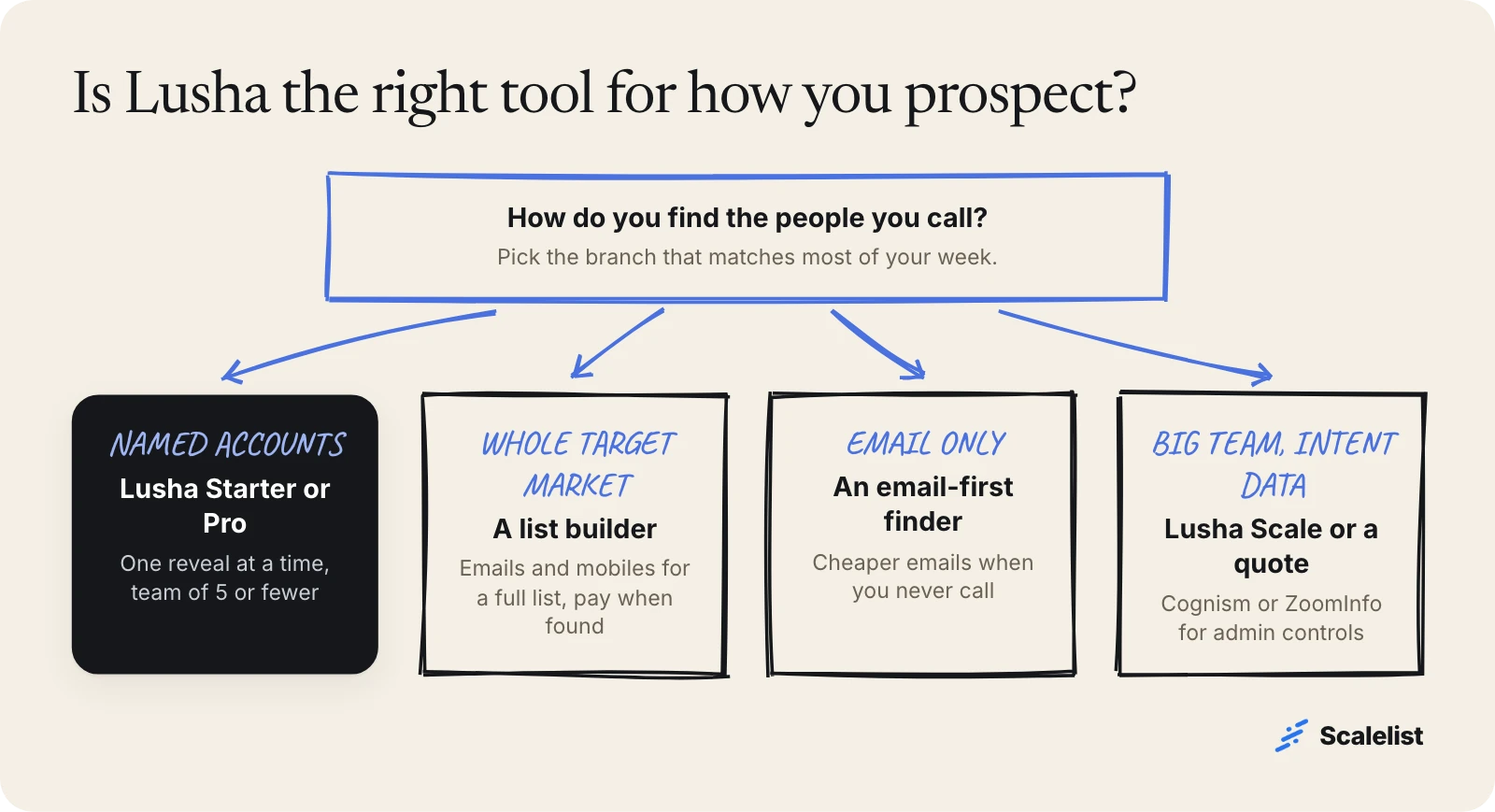
- Choose Lusha if you are an SDR or recruiter prospecting account by account, on a team of 5 or fewer, and you want to start on a monthly plan you can cancel online.
- Look at a list builder if you start from a target market (“VPs of Sales at US logistics companies”) rather than a named account, and need emails and mobiles for the whole list.
- Look at an email-first tool if you never call. A Lusha email costs 8.7 to 12.5 cents; Hunter’s cost 0.84 to 2.45 cents.
- Ask Lusha about Scale, or get Cognism and ZoomInfo quotes, if you have more than 5 users and need intent data and admin controls.
Lusha vs Scalelist for SDRs and agencies
Lusha and Scalelist both return work emails and mobile numbers, but they charge differently. Lusha is cheaper per phone reveal; Scalelist is cheaper per email and charges only when it finds something.
| Field | Lusha | Scalelist |
|---|---|---|
| Entry price | 49.90 USD a month (400 credits) | 29 USD a month (500 credits) |
| Cost per phone, monthly billing | 0.58 to 0.62 USD (5 credits a reveal) | 0.65 to 1.16 USD (20 credits a mobile found) |
| Cost per email, monthly billing | 11.7 to 12.5 cents | 3.25 to 5.80 cents |
| Charged when nothing is found | Partly: API calls yes, CSV no-match rows no | No |
| Seats | 1 to 5, then sales | No seat pricing |
| Unused credits | Pro and Premium monthly roll over up to 2x; yearly reset | Roll over up to 2x while subscribed |
| Native CRM | Salesforce, HubSpot, Pipedrive and more | HubSpot; others through Zapier or API |
| Compliance | Certifications on its trust center; GDPR listed | GDPR and Singapore PDPA, DPA, SCCs |
We will not pretend Lusha loses on price: for a rep who needs a phone number for a few named accounts a day, Lusha’s reveal is cheaper than our mobile. On yearly billing it is 0.44 to 0.47 USD at Lusha against 0.54 to 0.97 USD at Scalelist.
The gap can narrow on thin lists, because Lusha’s bulk reveals charge every contact in the selection while Scalelist charges only for mobiles found.
Lusha also has more native CRM connections and more security certifications than we do.
The case for Scalelist, an AI lead finder, is list building. You describe the people you want in one sentence, see how many match before you spend a credit, and get verified emails and mobile numbers for the whole list.
A found email is 1 credit, a found mobile is 20, and a miss costs nothing. In our benchmark, Scalelist found a phone for 87% of the North American list.
For agencies, seats are the other difference: Lusha includes up to 5 seats before a sales conversation, and Scalelist has no seat pricing. See our Scalelist plans and credits.
Describe the buyers you want in one sentence and get verified emails and mobile numbers; misses cost nothing.
Get 20 credits to test itLusha alternatives worth comparing
Three alternatives worth putting next to Lusha are Apollo, Cognism and ZoomInfo, each with a different pricing model. Here they are on the same fields: price, phone cost, strength and weak spot. Our Lusha alternatives roundup covers more, and the head-to-head pages Apollo vs Lusha and ZoomInfo vs Lusha go deeper on two of them.
Apollo.io
Apollo is 49 USD per seat a month billed yearly (Basic, 2,500 credits per seat a month). A phone number costs 8 credits, about 0.16 USD on Basic billed yearly, and Apollo also bundles sequences and a US dialer.
Where it falls short: in our benchmark it found a phone for 50% of the North American list and 8% in APAC. Read our Apollo review.
Cognism
Cognism is quote only, with 5 seats included in both packages. One credit reveals a contact, email and mobile together. Pro adds on-demand mobile verification, and Cognism screens phone numbers against Do Not Call lists.
Where it falls short: no public price and no single-seat plan. More in our Cognism review.
ZoomInfo
ZoomInfo sells custom-quoted annual contracts; Vendr, a software buying platform, reports a median of 33,500 USD a year. Mobile numbers come inside exported records on paid plans, with no separate published price, and ZoomInfo adds intent data around the contacts.
Where it falls short: annual lock-in and credits that expire. See our ZoomInfo review.
FAQ
Is Lusha legit?
Yes. Lusha publishes its prices and credit rules, its trust center shows SOC 2 Type II certification and 5 ISO certifications, and its plan comparison lists GDPR, CCPA, ISO 27701 and a Do Not Call list. It sells self-serve plans from 37.45 USD a month billed yearly that you can cancel online. Legit does not mean it covers your market, so test it on your own accounts.
Is Lusha worth it in 2026?
For a solo rep or a team of up to 5 who reveals phone numbers for named accounts, yes: a phone reveal costs 0.44 to 0.62 USD, you buy and cancel online, and monthly Pro and Premium credits roll over up to 2x. It is less worth it if you build lists of hundreds of contacts at once, because bulk reveals charge for partial results, API calls cost at least 1 credit even when empty, and teams above 5 users must go through sales.
Is Lusha safe to use?
Yes, for most B2B teams. Lusha shows SOC 2 Type II and ISO certifications on its trust center and names GDPR, CCPA and a Do Not Call list in its plan comparison. It describes its sourcing on its data page, and says it verifies outside vendors’ data before and during the engagement. Check it against your own legal team’s rules before prospecting in the UK or Europe.
How accurate is Lusha?
Lusha does not publish an accuracy or bounce rate; it publishes database totals such as 117M+ direct dials and 165M+ emails. Lusha was not in our 8-provider benchmark, where phone coverage ranged from 32% to 87% between providers on the same North American list. That is why this Lusha review gives no accuracy score: the only reliable answer is a test on 20 to 50 accounts you already know.
How much does Lusha cost?
Lusha costs 0 USD on the Free plan (40 credits a month), 49.90 USD a month on Starter (400 credits), 69.90 USD on Pro (600 credits) and 399.90 USD on Premium (3,400 credits), billed monthly. Yearly billing lowers those to 37.45, 52.45 and 299.95 USD a month. Scale is quoted by sales. Prices are as of September 2026; the full breakdown is in our Lusha pricing guide.
How many credits does Lusha charge for a phone number?
Five credits. An email costs 1 credit, and an email plus a phone together costs up to 6. On paid plans that makes one phone reveal cost 0.44 to 0.62 USD, depending on the plan and billing period. Searching and re-opening a contact you already revealed cost nothing.
Does Lusha work outside the US?
Lusha does not publish coverage by country or region, and it was not in our benchmark, so we cannot give you a number for the UK or anywhere else. Before you buy, reveal 20 to 50 accounts you already know in your own market and count how many numbers reach the right person.
Is Lusha or Scalelist better for SDRs?
It depends on how you prospect. Lusha is cheaper per phone reveal (0.44 to 0.62 USD, against 0.54 to 1.16 USD per Scalelist mobile) and suits reps working named accounts one at a time. Scalelist suits reps who build whole lists: you describe the buyers in one sentence, pay 1 credit per email and 20 per mobile only when found, and a miss costs nothing.
Sources
- Lusha pricing, plans, seats and FAQ, read 27 Sep 2026
- Lusha: how credits are counted
- Lusha data sources and Lusha trust center
- Lusha integrations
- Nooks Insights: Here’s Who Picks Up The Most, 2025
- Apollo pricing, Cognism pricing, Vendr: ZoomInfo


