


Ever heard of the Social Selling Index, or SSI? It’s a free metric from LinkedIn that scores your sales effectiveness on a scale of 0-100. Think of it as a personal report card for how well you’re using the platform to connect with prospects and build your presence.
A higher score isn't just about bragging rights, it’s a clear indicator that your social selling activities are on the right track.
Why Your Social Selling Index Score Matters
Trying to sell on LinkedIn without a clear strategy is like trying to navigate a new city without a map. You might stumble upon a landmark or two, but you’ll waste a lot of time and energy wandering aimlessly. Your SSI score is that map.
It gives you a data-driven look at how you’re performing across the four key areas of social selling, so you can stop guessing and start focusing on what truly works.
Since LinkedIn rolled out the SSI back in 2014, it has become a vital benchmark for modern sales pros. The numbers don't lie: salespeople with high SSI scores generate 45% more sales opportunities and are 51% more likely to hit their quotas.
Even more impressive, the top social sellers are 78% more successful than their peers who don't use social media at all. You can dig into even more of the data on how SSI translates to real results over on HubSpot.
The Four Pillars of Your SSI Score
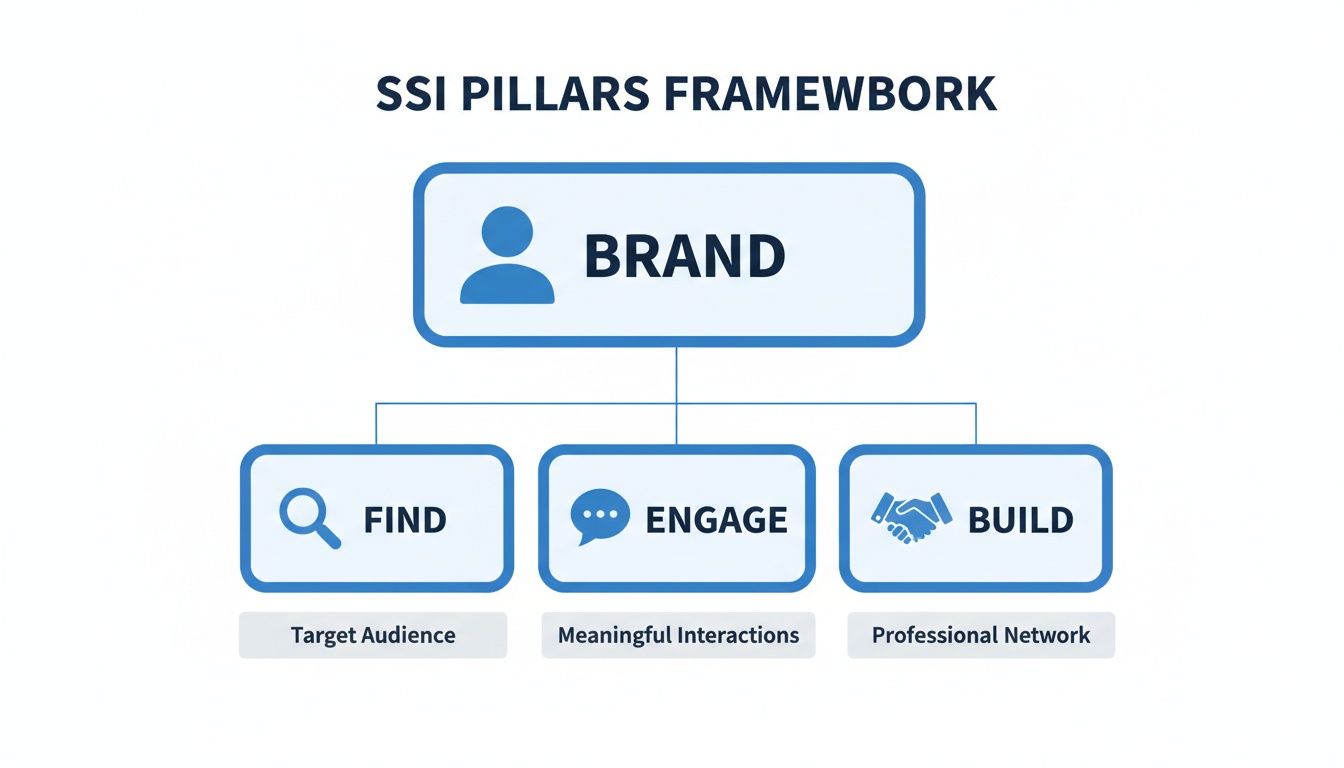
Your total score is built on four pillars, each contributing up to 25 points. Getting a handle on these is the first step to making real improvements. They show you exactly where you're strong and where you have room to grow.
The table below breaks down these four components at a glance.
The Four Pillars of Your Social Selling Index Score
| Pillar | What It Measures | Why It's Important for Sales |
|---|---|---|
| Establish Your Professional Brand | How complete and customer-focused your profile is. This includes having a professional headshot, a compelling headline, and a summary that speaks to your ideal client. | A strong brand builds trust and credibility before you even send the first message. It makes you a magnet for the right prospects. |
| Find the Right People | Your efficiency in using LinkedIn’s tools (like Sales Navigator and advanced search) to identify key decision-makers and prospects. | You can have the best pitch in the world, but if you're talking to the wrong people, it's a waste of time. This pillar ensures you're aiming at the right targets. |
| Engage with Insights | The quality and relevance of the content you share, comment on, and create. It tracks how you contribute to conversations in your industry. | Sharing valuable insights positions you as an expert, not just a seller. It keeps you top-of-mind and builds your reputation as a go-to resource. |
| Build Relationships | How effectively you nurture your network by connecting with new people and strengthening existing ties through meaningful, consistent communication. | This is where connections turn into conversations and conversations turn into contracts. It's about playing the long game to build a network of trust. |
As you can see, each pillar represents a critical stage in the modern sales cycle, from first impressions to closing the deal.

When you check your SSI, the dashboard gives you a quick visual breakdown of your total score and how you measure up in each of these four areas. It even shows you how you compare to others in your industry and network, which makes it an incredible tool for spotting opportunities.
For instance, that first pillarEstablish Your Professional Brand, is the foundation for everything else. If your profile isn't optimized to attract your ideal customer, your outreach efforts will fall flat. For an in-depth walkthrough on getting this right, we've put together a comprehensive guide on LinkedIn profile optimization.
A Practical Breakdown of the Four SSI Pillars
To really move the needle on your Social Selling Index, you have to understand what it’s actually measuring. The score isn’t just some random number; it’s calculated from four core activities that are the bedrock of modern B2B selling on LinkedIn.
Think of it like a balanced scorecard for your sales efforts. Each of the four pillars, your brand, your prospecting, your engagement, and your relationships, is worth up to 25 points. Nail all four, and you get a perfect 100. The great thing is, LinkedIn recalculates this score constantly, so consistent daily habits can create a real impact in just 30 to 60 days. Neil Patel offers a great deep-dive into this scoring system if you want to explore the mechanics further.
Let’s break down each pillar.
Pillar 1: Establish Your Professional Brand
This is all about how you present yourself. Is your LinkedIn profile just a digital resume, or is it a resource for your ideal customer? This pillar scores how well you’ve optimized your profile to attract and inform your target audience. A high score means you look less like a salesperson and more like a helpful expert.
It's more than just a decent headshot. It’s about a headline that speaks to your buyer's problems and a summary that tells a story about the value you deliver.
Your profile should answer a prospect's silent question: "What's in it for me?" Every element, from your banner image to your featured content, should work together to build credibility and establish you as a trusted advisor, not just another salesperson.
Pillar 2: Find the Right People
This pillar measures how good you are at identifying the right prospects. A high score here tells LinkedIn you’re using its search tools effectively, whether that's the standard search or advanced Sales Navigator filters, to zero in on actual decision-makers.
Having a huge network of random connections won't help. The algorithm rewards you for being strategic. It looks at how actively you search for and view the profiles of people who match your ideal customer profile. It’s all about targeted precision, not just network size.
Pillar 3: Engage with Insights
This is where your activity comes into play. Are you just a ghost on the platform, or are you an active voice in your industry's conversation? This pillar tracks how often you share useful content, write thoughtful comments, and participate in relevant discussions.
A strong score means you’re seen as someone who contributes value. You can directly influence this by:
- Sharing relevant articles with your own take to spark discussion.
- Commenting on posts from prospects and industry leaders to get on their radar.
- Joining and actively participating in relevant LinkedIn Groups.
The idea is to shift from being a passive scroller to an active participant. You want to be known as someone who’s on top of the trends and topics your buyers care about.
Pillar 4: Build Relationships
Finally, this pillar tracks how well you turn those initial connections into real business relationships. It’s not just about who you connect with, but how you nurture those connections over time to build trust.
Sending a generic connection request and calling it a day won’t cut it. This score is boosted by personalizing your outreach, following up with new contacts, and consistently communicating. A key part of this is strengthening your network with senior-level decision-makers, making this pillar a direct reflection of your pipeline-building efforts. Our complete guide on prospecting on LinkedIn provides a ton of specific tactics for building these crucial relationships.
How to Find and Interpret Your Social Selling Index Score
Now that we’ve broken down the mechanics behind the Social Selling Index, it’s time to see where you actually stand. The good news is that finding your score is surprisingly simple, you don't even need a paid Sales Navigator subscription.
The real skill, however, comes from interpreting those numbers and understanding what they mean for your day-to-day sales activities. Think of your social selling index score not as a final grade, but as a live dashboard packed with competitive insights. It gives you an overall score out of 100, but more importantly, it shows you exactly how you're performing on each of the four pillars.
Accessing Your SSI Dashboard
Ready to see your score? It only takes a moment. You can check your current social selling index score right now by visiting the official SSI page on LinkedIn.
The dashboard immediately lays out your performance, highlighting which areas are your strengths and which ones could use some work. This direct feedback is what helps you make targeted improvements instead of just guessing what to do next.
What Is a Good Social Selling Index Score?
Okay, you have your score. Now what? Is it good? Bad? Average? Without context, the number itself is pretty meaningless.
LinkedIn defines a clear benchmark for what’s considered a great social selling index score. The magic number you should be aiming for is 75 or higher. Hitting this range puts you in the top tier of social sellers, signaling to the platform and your network that you're an industry leader. For a closer look at what separates top performers, you can find more insights on SSI benchmarks.
Here’s a quick rundown of how LinkedIn categorizes the scores:
- 76-100: Top Performer
- 51-75: Above Average
- 26-50: Below Average
- 0-25: Low
But your personal score is only half the story. The dashboard also gives you two incredibly useful data points: how you rank against others in your industry and how you compare to people in your network.
For example, you might feel pretty good about your overall score of 65. But what if the average for your industry is 72? Suddenly, you have a clear gap to close and a new target to hit. This competitive context is what turns a simple metric into a powerful strategic tool.
When you dig into your individual pillar scores and compare them to these benchmarks, you can pinpoint exactly where to focus your energy for the biggest impact.
Actionable Strategies to Boost Each SSI Pillar

Knowing what the four pillars are is a good start, but the real magic happens when you start improving them. This is how your social selling index score goes from being just a number on a dashboard to a genuine asset that drives sales.
Let’s move past the theory. Here are the specific, no-fluff tactics you can start using today to improve your score and, more importantly, fill your pipeline.
Pillar 1: Establish Your Professional Brand
Think of your LinkedIn profile as your digital storefront. It’s your first impression, and it needs to be polished, focused on your customer, and fully built out. For a deep dive, this guide on how to stand out on LinkedIn is an excellent resource for optimizing your profile.
Here's a quick checklist to get you on the right track:
- Rethink Your Headline: Your job title is boring. Instead, frame your headline around the value you deliver. For example, use something like, "Helping SaaS startups reduce churn with data-driven onboarding strategies."
- Write a Customer-Centric Summary: Your "About" section isn't just a copy-paste of your resume. It should tell a story about how you help people solve their problems. End it with a clear call to action, like inviting them to connect.
- Get Recommendations: Don't be shy. Actively ask happy clients for recommendations that highlight your skills and the results you delivered. This is powerful social proof.
- Invest in a Professional Headshot: A clear, approachable photo builds immediate trust. Ditch the selfies and distracting backgrounds for a clean, professional shot.
Pillar 2: Find the Right People
This part of the score is all about how effectively you use LinkedIn’s search tools. It’s a game of quality over quantity. The goal is to zero in on the decision-makers who matter, not just to collect random connections.
A high score here is a direct reflection of your prospecting efficiency. LinkedIn's algorithm actually rewards you for viewing the profiles of people who fit your ideal customer profile and for having a high acceptance rate on connection requests. It shows you know who you're looking for.
Here’s how to sharpen your targeting:
- Master Advanced Search: Go beyond just typing in names. Use the filters for industry, company size, seniority, and location to build laser-focused prospect lists.
- Put Sales Navigator to Work: If you have a subscription, this is your secret weapon. Use Lead Lists and advanced filters to pinpoint your ideal buyers. Setting up alerts for job changes is a fantastic way to time your outreach perfectly.
- Be Strategic with Profile Views: Make it a habit to visit the profiles of people you plan to engage with. This signals to LinkedIn that you’re actively researching your target market.
Pillar 3: Engage with Insights
You can't just exist on LinkedIn; you have to participate. This pillar measures how much you contribute to the platform's conversations. Are you sharing valuable content and adding your own perspective to discussions?
- Share Content with a Take: Never just hit the "share" button. Always add a sentence or two with your own opinion. Ask a question or explain why you found the article interesting. This turns a passive share into an active conversation starter.
- Leave Thoughtful Comments: Move beyond "Great post!" and leave comments that actually add to the discussion. You can respectfully disagree, offer a new angle, or share a related personal experience. Make a point to comment on posts from your key prospects.
- Create Your Own Content: You don't have to write a novel. Publish short text posts, simple carousels, or quick videos sharing a useful tip, a lesson you learned, or a unique insight. Consistency is far more important than perfection.
Pillar 4: Build Relationships
The final pillar ties everything together. It’s about turning those new connections into meaningful, long-term relationships. This is where you nurture your network and prove you're in it for more than just a quick sale.
Example of a Personalized Connection Request:
Ditch the generic, default message. It gets ignored. Try this instead:
"Hi [Name], I saw your recent post on the challenges of B2B lead attribution and thought your point about channel silos was spot on. I've been following your company's work in this space and would love to connect and follow your insights. Best, [Your Name]"
An approach like this proves you’ve done your homework and have a genuine reason for connecting, which dramatically increases your acceptance rate. Once they accept, keep the momentum going by interacting with their content to stay top-of-mind.
From Influence to Pipeline: Scaling Your SSI with a Smart Workflow

So you've put in the work, and your Social Selling Index score is looking good. That’s a clear sign you’re building a credible, professional presence on LinkedIn and know how to connect with the right audience. But here's the catch: influence alone doesn't pay the bills. You need an efficient system to convert that hard-won authority into a predictable pipeline.
This is where smart prospecting tools change the game. When you pair your polished social selling skills with a data enrichment platform, you build a powerful machine for growth. If your SSI is the engine, think of clean, accurate data as the high-octane fuel that makes it run faster and more efficiently.
A Practical Workflow for Scalable Outreach
Let's walk through what this looks like in practice. You’ve used your sharp "Find the Right People" skills on LinkedIn to spot a handful of ideal prospects. You've liked their posts, left a thoughtful comment, and maybe even connected. The context is warm.
Now, instead of grinding through manual searches for their contact info, you can flip a switch.
Using a tool like Scalelist, you can take those LinkedIn profiles and enrich them in bulk to get verified work emails and direct-dial phone numbers. This gives you the power to move the conversation to another channel, like email, where you can have a more direct, focused discussion. We break down exactly how to blend these strategies in our guide to LinkedIn prospecting.
This isn't about replacing social selling with automation. It’s about amplifying your efforts. You let technology handle the tedious data-gathering, which frees you up to do what you do best: build real relationships and have meaningful conversations.
How Quality Data Feeds Back into Your SSI
Here’s the interesting part: this relationship goes both ways. Using clean, organized data from a platform like Scalelist directly helps you improve your SSI pillars.
- Build Relationships: Imagine getting an alert the moment a key contact lands a new role at a different company. This job-change data gives you the perfect reason to reach out, congratulate them, and restart the conversation, directly boosting this pillar of your social selling index score.
- Engage with Insights: When you know for a fact that you have the correct email for a prospect, you can engage with their content more confidently. You’re no longer just shouting into the void; you can reference their latest article in a follow-up email, proving you’ve done your homework.
Ultimately, integrating a smart workflow is about working smarter, not just harder. Once you start raising your SSI, applying that influence through a data-driven process helps you optimize your sales process from end to end. You turn your social influence into a reliable, repeatable revenue generator.
Synergizing SSI Pillars with Scalelist Features
Here’s a quick-reference table showing how you can pair specific Scalelist features with each SSI pillar to maximize your sales efficiency and impact.
| SSI Pillar | Associated Scalelist Feature | Combined Outcome |
|---|---|---|
| Establish Your Professional Brand | LinkedIn Profile Enrichment | Ensures your outreach list is 100% aligned with your ideal customer profile, reinforcing your niche authority. |
| Find the Right People | Technographic & Firmographic Filters | Moves beyond basic LinkedIn search to pinpoint companies using specific technologies or meeting precise revenue criteria. |
| Engage with Insights | Data Segmentation & Export | Allows you to create highly targeted campaigns based on shared insights (e.g., industry news, company events). |
| Build Relationships | Job Change Alerts & Contact Verification | Provides timely, relevant triggers for outreach and ensures your messages always land in the right inbox. |
This systematic approach connects the dots between building influence on LinkedIn and driving measurable business results through targeted, multi-channel outreach.
Frequently Asked Questions About the Social Selling Index
Once you start paying attention to your social selling index score, a few questions always seem to surface. Getting clear on the details is what separates a vanity metric from a tool you can actually use to drive your sales process forward. Let's tackle some of the most common ones.
How Often Does the SSI Score Update?
Your social selling index score isn't a static report you get once a month. It’s better to think of it as a live pulse-check on your recent LinkedIn activity. LinkedIn updates your score daily.
This is incredibly helpful. It means the work you put in today, tweaking your profile, sharing a great article, or connecting with a new prospect, can show up in your score almost overnight. This gives you immediate feedback on what’s working, so you can double down on the right activities instead of waiting weeks to see if your strategy is paying off.
Does a High Score Guarantee Sales?
This is the big one. The short answer is no; a high social selling index score doesn't automatically translate into closed deals. Think of it like a professional athlete's training regimen. Sticking to a strict diet and workout plan doesn't guarantee a championship win, but it puts them in the best possible position to compete.
A high SSI score gets you in the game. It makes you more visible, builds your credibility, and helps you start conversations with the right people. But it's still your job to turn those conversations into real relationships and, ultimately, revenue.
Your score is a powerful leading indicator, not a lagging one. It measures how effective you are at the top of the sales funnel, building trust and creating opportunities, which is the foundation of a healthy pipeline.
Can I Improve My Score Without Sales Navigator?
You absolutely can. While Sales Navigator is a fantastic tool for anyone deep in B2B prospecting, you don’t need a paid subscription to make a huge impact on your social selling index score. The four pillars of SSI are all based on fundamental activities available to every single LinkedIn user.
You can move the needle significantly just by focusing on the basics:
- Build your professional brand by completing your profile until it’s an "All-Star" profile.
- Engage with insights by sharing content your network finds valuable and leaving thoughtful comments.
- Build relationships by sending personalized connection requests that explain why you want to connect.
- Find the right people by using LinkedIn's standard search filters to identify relevant prospects.
Sales Navigator certainly helps you do these things faster and at a greater scale, but the core habits of social selling are completely free to implement. Consistency is what really matters.
Ready to turn your social selling influence into a scalable pipeline? Scalelist enriches your LinkedIn prospects with verified contact data, helping you move conversations from social channels to direct outreach. Start your free trial today and see how accurate data can transform your workflow.


