


The best Lusha alternatives in 2026 are Scalelist, Apollo.io, Prospeo, RocketReach, Kaspr, Cognism, ZoomInfo and Seamless.AI. The first five publish self-serve prices; the last three are quote-only platforms built for larger teams.
Prices checked on 27 September 2026 from each vendor’s own pricing page.
Every tool below gets the same eight fields, taken from its own pricing page on 27 September 2026: what it is, entry price, pricing model, mobile numbers and their cost, whether a miss is charged, who it fits, where it falls short, and what our own benchmark measured (or “not tested”). When a vendor does not publish something, we write “not published”.
Why people look for Lusha alternatives
Most reps look for Lusha alternatives because of how Lusha prices phone numbers and team growth, not because it lacks direct dials. Its pricing page and credits guide spell out the rules.
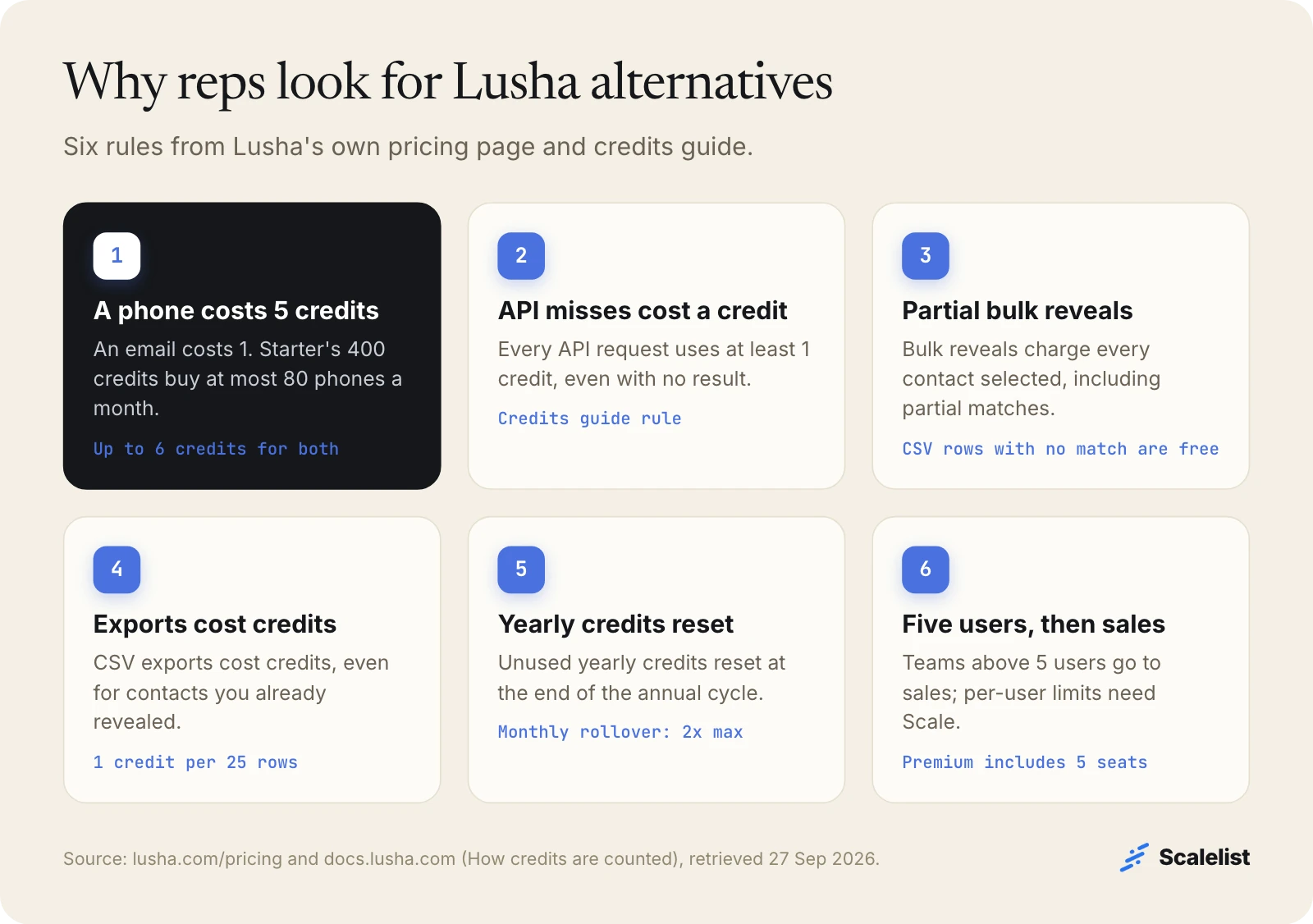
- A phone costs 5 emails. Revealing a phone number costs 5 credits and an email 1, so Starter’s 400 credits a month buy at most 80 phone numbers.
- Misses can cost credits. Through the API, “even if no results are returned, 1 credit is consumed.” Bulk reveals charge every contact in the selection, “including those for whom only partial data was found.”
- Exports cost credits. A CSV export costs 1 credit per 25 rows, even for contacts you already revealed.
- Yearly credits reset. On yearly plans, “any unused credits will be reset at the end of the annual cycle.” Monthly Pro and Premium credits roll over up to 2x the plan.
- Five users, then sales. “For teams larger than 5 users, please reach out to our Sales team.” Per-user credit limits are a Scale feature.
For a calling rep, the first rule matters most. Twenty new prospects a day for 21 working days is 420 phone numbers, or 2,100 credits a month: more than Starter or Pro include. Our Lusha pricing breakdown shows the cost per phone on every plan.
To be fair to Lusha: the Free plan gives 40 credits a month with no credit card, every plan includes an API key, and re-viewing a contact you already revealed costs nothing. Lusha claims 117M+ direct dials, lists integrations with Salesforce, HubSpot, Pipedrive and more, and shows SOC 2, ISO 27701 and Do Not Call list support.
If you are one rep revealing a few numbers a day, Lusha is a sensible buy. This page is for reps and teams who call more than that, or who have outgrown five seats. Our Lusha review covers the product side.
Lusha alternatives compared at a glance
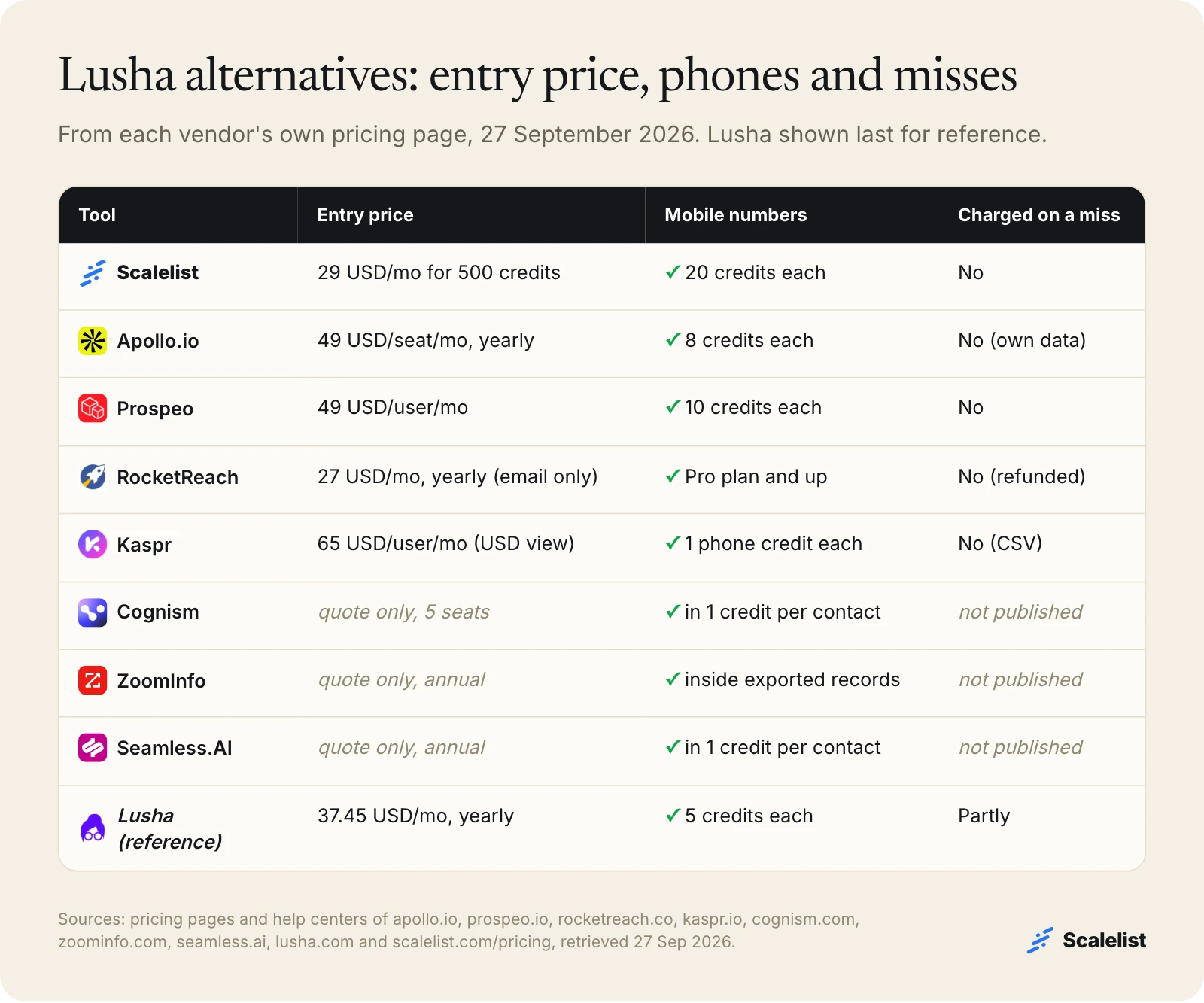
The 8 Lusha alternatives differ most on four things that change your bill: the entry price, the billing model, what a phone number costs and whether you pay when nothing is found.
| Tool | Best for | Entry price | Mobile numbers | Charged on a miss |
|---|---|---|---|---|
| Scalelist | Reps who call and email | 29 USD/mo for 500 credits | Yes, 20 credits each | No |
| Apollo.io | Data plus sequences per seat | 49 USD/seat/mo, billed yearly | Yes, 8 credits each | No, on Apollo’s own data |
| Prospeo | Low-cost mobiles per user | 49 USD/user/mo (37 billed yearly) | Yes, 10 credits each | No |
| RocketReach | Annual lookups, refunds on misses | 27 USD/mo yearly, email only | Yes, from the Pro plan | No, lookup refunded |
| Kaspr | Phone credits per user, Europe | 65 USD/user/mo (USD view) | Yes, 1 phone credit each | No, in CSV enrichment |
| Cognism | Europe and DNC-regulated markets | Not published (quote, 5 seats) | Yes, in 1 credit per contact | Not published |
| ZoomInfo | Enterprise data and intent | Not published (quote) | Yes, inside exported records | Not published |
| Seamless.AI | Annual credit pools | Not published (quote) | Yes, in 1 credit per contact | Not published |
| Lusha (for reference) | Individual reps, self-serve | 37.45 USD/mo, billed yearly | Yes, 5 credits each | Partly |
Which Lusha alternative is best?
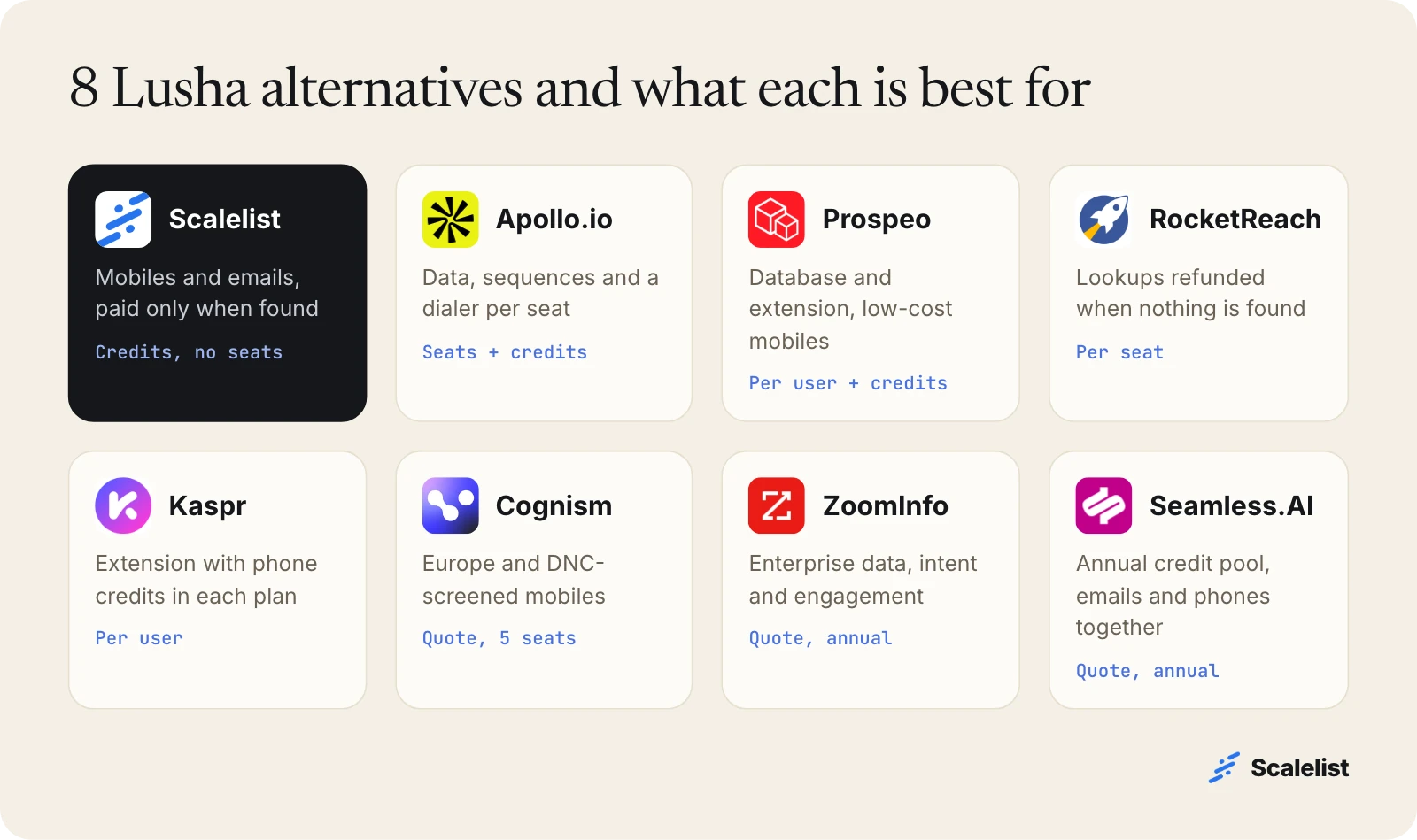
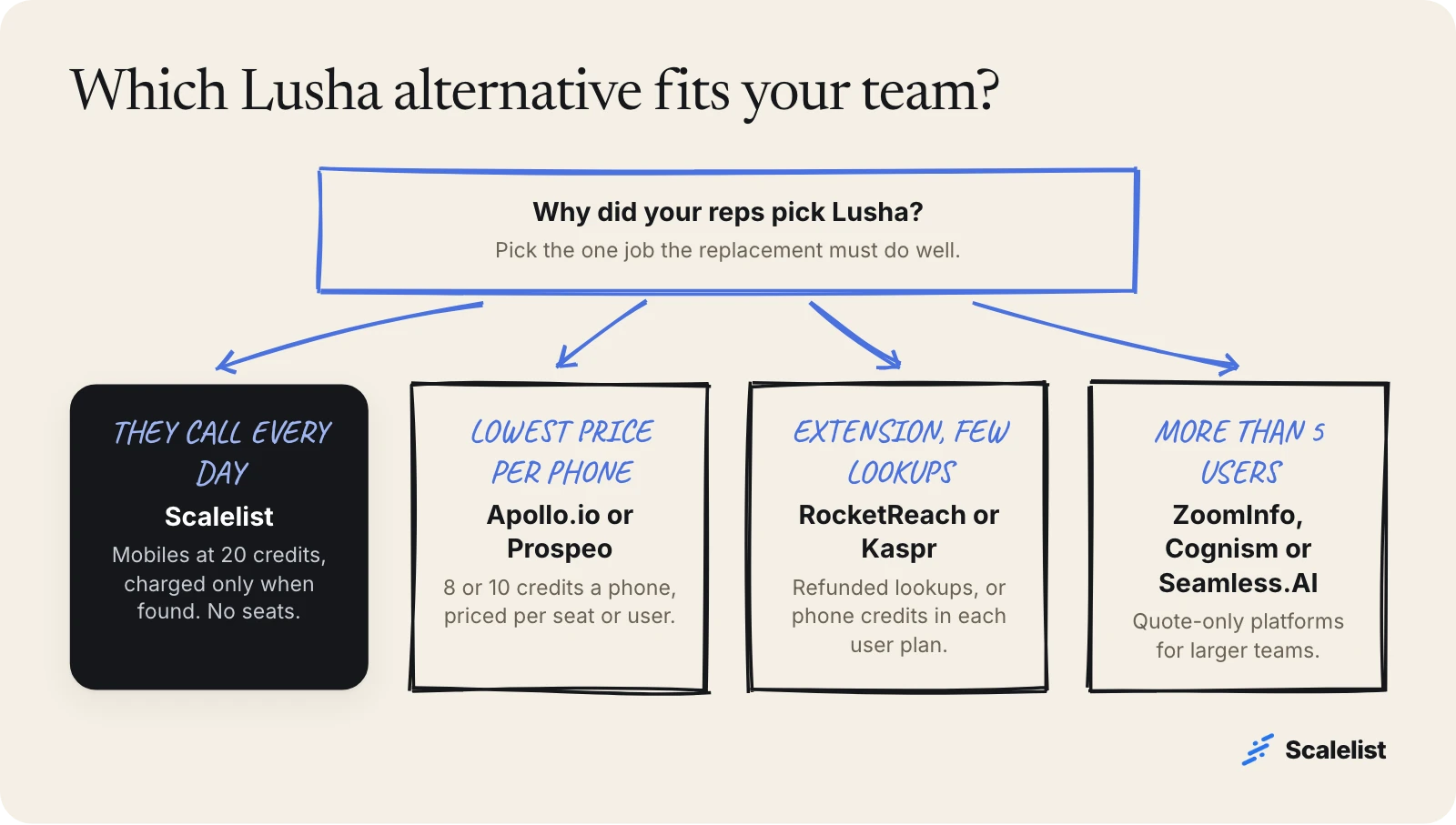
The best Lusha alternative depends on why your reps use Lusha. If they call every day and you want to pay only for the mobiles that are found, with no seats, Scalelist fits. If the lowest list price per phone matters most, Apollo.io (8 credits a phone) and Prospeo (10 credits) cost less than Lusha per number, but both charge per seat or user.
For one rep who wants a browser extension and few lookups, RocketReach refunds lookups that find nothing, and Kaspr includes a fixed number of phone credits with each per-user plan. Teams above five users that want an enterprise contract should compare ZoomInfo, Cognism and Seamless.AI, which are all quote-only.
How we picked and compared these tools
We picked the tools Lusha users shortlist most often for phone numbers, then checked each one against the same criteria on its own website.
- Phones first: every tool here sells mobile or direct dial numbers, because that is what most teams buy Lusha for.
- Published price: the cheapest paid plan, with both billing options where the page shows them. Quote-only means “not published”.
- Billing model: seats, users, credits, lookups or quotes, and whether monthly billing is allowed.
- Misses: whether a lookup that finds nothing costs you anything, in the vendor’s own words.
- Evidence: coverage numbers only from our own published benchmark, and only for the three tools here that were in it. Vendor claims are labeled as claims.
- Date: every pricing page was rendered in a US-locale browser on 27 September 2026. Prices change, so check before you sign.
Coming from a bigger platform? Our ZoomInfo competitors comparison covers the enterprise side. Building enrichment workflows instead? See our Clay alternatives by use case.
The 8 best Lusha alternatives in 2026
The tools are grouped by how they sell: Scalelist first, then the self-serve tools with published prices (Apollo.io, Prospeo, RocketReach, Kaspr), then the quote-only platforms (Cognism, ZoomInfo, Seamless.AI).
1. Scalelist
- What it is: Scalelist is an AI Lead Finder. You describe the people you want in one sentence, see how many match for free, then get them with verified work emails and mobile numbers. Its Chrome extension finds the same data on company websites and profile pages.
- Entry price: 29 USD a month for 500 credits (Scaler 500), or 290 USD a year. Plans go up to 649 USD a month for 20,000 credits, with custom plans above that (Scalelist pricing). Trial: 20 credits for new accounts, no credit card required.
- Pricing model: Credits, with no seats and no annual contract. 1 credit per lead found, 1 per email found, 20 per mobile found. Unused credits roll over up to 2x the monthly allocation while you stay subscribed.
- Mobile numbers: Yes, 20 credits per mobile found: about 1.16 USD on the 500-credit plan, 0.80 USD at 5,000 credits and 0.65 USD at 20,000.
- Charged on a miss: No, in the app, the extension, bulk uploads and the API. Every email comes back labeled Valid or Risky.
- Best for: Reps and teams who call as much as they email and want one credit pool instead of paying per seat.
- Where it falls short: At list price a Scalelist mobile costs more than a Lusha phone (0.65 to 1.16 USD against 0.44 to 0.62 USD across Lusha’s paid plans). No intent data, sequencer or dialer. HubSpot is the only native CRM; Salesforce and others connect through Zapier or the API.
- Measured in our benchmark: found a phone number for 87% of the North America list, 73% in EMEA, 75% in APAC and 85% in Latin America, and an email for 92%, 89%, 76% and 86%.
- Read next: Lusha vs Scalelist for SDRs and agencies
2. Apollo.io
- What it is: Apollo.io is an all-in-one sales platform: a B2B contact database plus sequences, a dialer and deal tools, sold per seat with a credit allowance.
- Entry price: 49 USD per seat a month billed yearly (Basic, 30,000 credits per seat a year), or 65 USD billed monthly (2,500 credits a month). Free plan: 75 credits per seat a month (Apollo pricing page).
- Pricing model: Per seat plus credits. An email costs 1 credit and a phone number 8. The Organization plan is annual only, with a 3-seat minimum.
- Mobile numbers: Yes, 8 credits each: about 0.21 USD on Basic billed monthly and 0.16 USD billed yearly.
- Charged on a miss: No for Apollo’s own data: “You aren’t charged if a source can’t find any data.” Connected providers in its multi-source enrichment can bill for unverified results.
- Best for: Teams that want data, sequences and a dialer in one per-seat tool instead of Lusha plus a separate sequencer.
- Where it falls short: Seats add up as the team grows, and “Apollo doesn’t refund any credits for mobile numbers.” Phone coverage in our APAC test was low.
- Measured in our benchmark: found a phone number for 50% of the North America list, 63% in EMEA and 8% in APAC, and an email for 77%, 77% and 74%. Not tested in Latin America.
- Read next: Apollo pricing · Apollo vs Lusha · Apollo.io alternatives
3. Prospeo
- What it is: Prospeo is a B2B contact database and enrichment tool (search, CSV, CRM and API enrichment, a Chrome extension) that returns verified work emails and mobile numbers.
- Entry price: 49 USD per user a month (Starter, 2,000 credits a month), or 37 USD per user a month billed yearly. Free plan: 100 credits a month, without API access (Prospeo pricing page).
- Pricing model: Per user plus credits. An email costs 1 credit and a mobile 10, with the email included. Searching is free; credits are spent on reveals and exports.
- Mobile numbers: Yes, 10 credits each: about 0.25 USD on Starter billed monthly and 0.18 USD billed yearly.
- Charged on a miss: No. Exports cost “1 credit per email found (0 if no email is found)”, and a lookup with no result costs nothing.
- Best for: Reps who want a searchable database and an extension with low-cost mobiles, and are fine paying per user.
- Where it falls short: “Any unused credits expire at renewal.” Native HubSpot and Salesforce sync start on Growth (99 USD per user a month). It found the fewest emails of the tools in our benchmark.
- Measured in our benchmark: found a phone number for 75% of the North America list, 39% in EMEA, 44% in APAC and 24% in Latin America, and an email for 42%, 39%, 38% and 33%.
- Read next: Prospeo pricing · Scalelist vs Prospeo
4. RocketReach
- What it is: RocketReach is a self-serve contact lookup tool with a Chrome extension that returns verified emails and, on higher plans, mobile and direct phone numbers.
- Entry price: 27 USD a month billed yearly (Essentials, 329 USD a year, email only), or 49 USD billed monthly. Phone numbers start on Pro at 829 USD a year or 99 USD a month. Free account: 5 lookups, no credit card required (RocketReach pricing page).
- Pricing model: Per seat. Monthly plans cap lookups at 100, 250 or 1,000 a month; annual plans list unlimited lookups and cap exports at 1,200, 3,600 or 20,000 a year.
- Mobile numbers: Yes on Pro and Ultimate, inside the same lookup as the email: about 0.40 USD per lookup on Pro billed monthly, or 0.23 USD per export billed yearly.
- Charged on a miss: No. “A lookup is used if we find and verify email or phone, otherwise it is refunded.”
- Best for: Individual reps who want an annual plan with many lookups and no charge for contacts that are not found.
- Where it falls short: No phones on Essentials, pooled team credits need a custom plan from 6,000 USD a year, and a lookup counts even when it returns an email without a phone.
- Measured in our benchmark: Not tested.
- Read next: RocketReach pricing · RocketReach alternatives
5. Kaspr
- What it is: Kaspr is a contact data tool, delivered mainly as a LinkedIn Chrome extension plus a web dashboard, that reveals work emails, personal emails and phone numbers on per-user credit plans.
- Entry price: 65 USD per user a month on Starter in the page’s dollar view (59 EUR by default); the page does not label the billing period. Free plan: 5 phone credits and 15 work email credits a month (Kaspr pricing page).
- Pricing model: Per user, with four credit types: work email, phone, personal email and export. Paid plans list unlimited work email credits under a fair use policy. Starter includes 100 phone credits a month and Business 200.
- Mobile numbers: Yes, 1 phone credit per lead “regardless of the number of phone numbers”: about 0.65 USD on Starter and 0.50 USD on Business. Kaspr says it focuses on direct mobile numbers.
- Charged on a miss: No in CSV enrichment: with phone set as mandatory, “If Kaspr can’t find a phone number, it won’t use credits on that lead.” Export credits are charged on every export. The extension rule is not published.
- Best for: Individual reps and recruiters, mainly in Europe, who prospect one profile at a time in the browser and need a set number of phones each month.
- Where it falls short: Phone credits are capped at 100 a month on Starter and 200 on Business. An account needs a verified business email and at least 20 LinkedIn connections, and Kaspr’s FAQ says California residents cannot log in, citing California privacy regulations.
- Measured in our benchmark: Not tested.
- Read next: Kaspr pricing · Scalelist vs Kaspr · Kaspr alternatives
6. Cognism
- What it is: Cognism is a B2B sales intelligence platform that sells contact data, including phone-verified mobile numbers, through quote-only Standard and Pro packages.
- Entry price: Not published. Both packages route to sales and include 5 seats. Trial: not published; Cognism offers a data sample and demos (Cognism pricing page).
- Pricing model: Quote only. Each seat includes a credit allocation, “1 credit = 1 revealed contact”, and extra credits can be bought at any time.
- Mobile numbers: Yes, inside the same 1 credit per revealed contact. Phone-verified mobiles and on-demand mobile verification are Pro features. Price per credit: not published.
- Charged on a miss: Not published. Cognism says a credit is used “each time a contact record is revealed”.
- Best for: Teams calling into Europe and other markets with Do Not Call rules: Cognism screens phones against registries including the UK TPS, the US, Australia, Germany and France.
- Where it falls short: No public prices and no single-seat plan. Intent data is Pro only, and a contact costs a credit again after a job change.
- Measured in our benchmark: Not tested.
- Read next: Cognism pricing · Scalelist vs Cognism · Cognism alternatives
7. ZoomInfo
- What it is: ZoomInfo is an enterprise B2B go-to-market data platform (contacts, companies and intent) sold on custom-quoted annual contracts, with a free ZoomInfo Lite tier.
- Entry price: Not published: paid plans are custom-quoted, and ZoomInfo Lite is free with 10 credits a month (ZoomInfo pricing article). Vendr, a software buying marketplace, reports a median contract of 33,500 USD; that is third-party data.
- Pricing model: Annual subscriptions, “billed annually upfront” in most cases, with a minimum number of seats. One credit per exported record, charged per user; monthly credits do not roll over.
- Mobile numbers: Yes, inside exported records on paid plans. ZoomInfo claims 135M+ direct dial numbers. A per-mobile price is not published.
- Charged on a miss: Not published.
- Best for: Teams that have outgrown Lusha’s five-user self-serve limit and want data, intent and engagement tools under one contract.
- Where it falls short: No public price, annual upfront billing, seat minimums, and two users exporting the same record pay two credits. ZoomInfo notes that “renewal pricing can increase.”
- Measured in our benchmark: Not tested.
- Read next: ZoomInfo pricing · Lusha vs ZoomInfo
8. Seamless.AI
- What it is: Seamless.AI is a sales intelligence platform that researches contacts in real time to return emails, cell phones and direct dials, sold on quote-only annual credit packages.
- Entry price: Not published. Pro and Enterprise are “Contact sales”. Free plan: 1 user and 50 credits that do not replenish (Seamless.AI pricing page).
- Pricing model: Quote only, per user on Pro, sold as annual credit packages. One credit researches one contact and returns all its titles, emails and phone numbers.
- Mobile numbers: Yes, cell phones and direct dials inside the same 1 credit per researched contact. Price per credit: not published.
- Charged on a miss: Not published for contacts where nothing is found. Seamless.AI refunds the credit when a returned email does not work.
- Best for: Sales teams that prefer an annual contract with a large credit pool and want emails and phones returned together.
- Where it falls short: No public prices and no published monthly option. Its own pages disagree on the Pro allowance: 10,000 credits a year in the pricing FAQ, 10,000 a month in the help center.
- Measured in our benchmark: Not tested.
- Read next: Seamless.AI pricing · Scalelist vs Seamless.AI · Seamless.AI alternatives
Why Scalelist is the better fit for reps who call and email
Scalelist fits reps who pick up the phone, because it prices the mobile number as the product and charges only when one is found. Here is the case, and where it stops.
Mobiles you pay for only when they are found
A mobile costs 20 credits, an email 1 and a lead 1, and a miss costs nothing, whether you search in the app, the extension, a bulk upload or the API. Lusha’s API uses at least 1 credit per request even when nothing comes back, and its bulk reveals charge partial matches.
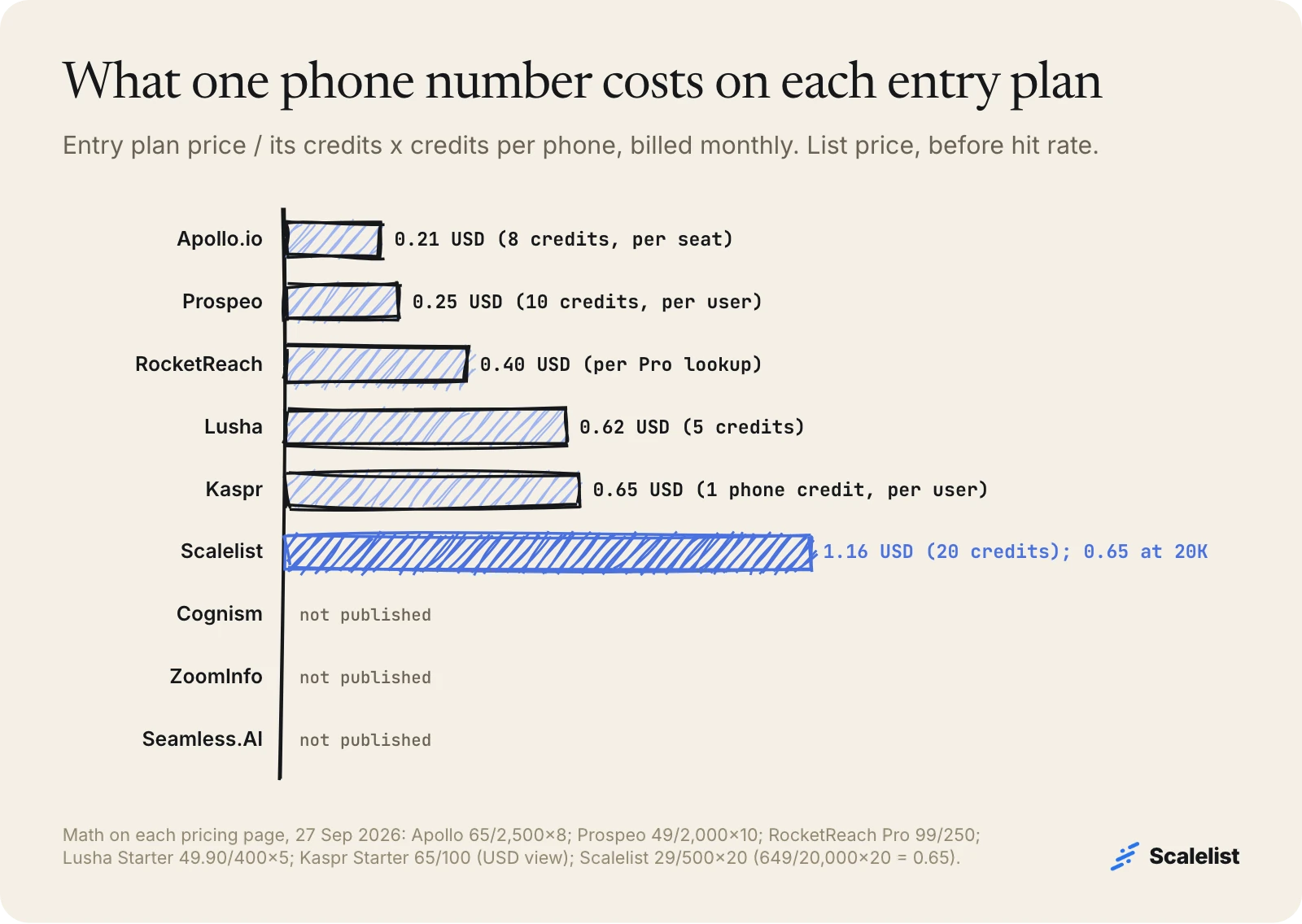
On list price, Scalelist’s entry plan is the most expensive phone on this chart, and it drops to 0.65 USD at 20,000 credits. What a calling team pays in the end is the cost per mobile found and connected, which depends on how many numbers each tool finds for your list.
Coverage we measured and published
We ran the same list of founders through 8 data providers in North America, EMEA, APAC and Latin America, and published the raw data in our B2B data provider comparison. Three tools on this page were in that test; Lusha was not.
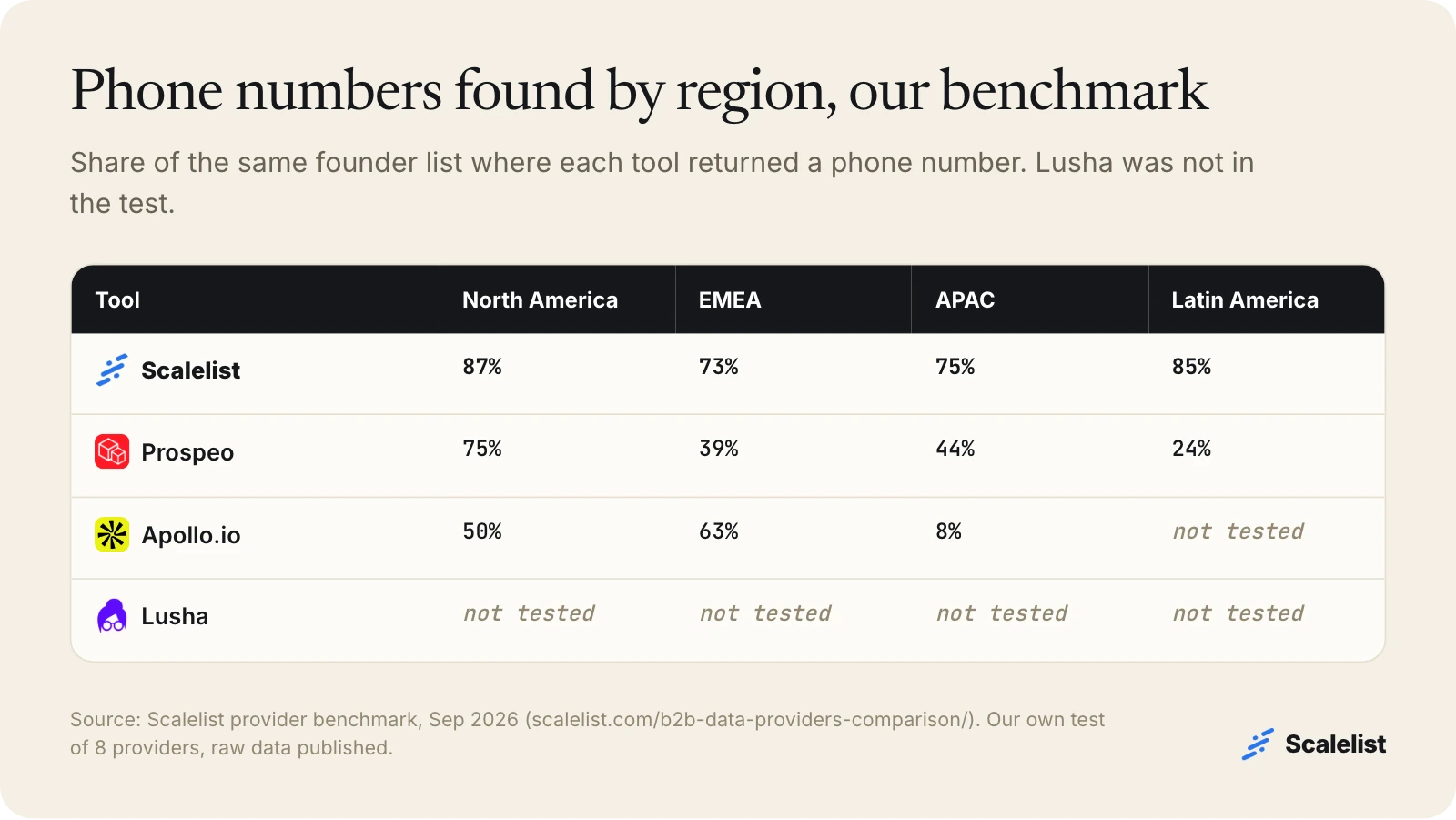
Scalelist found a phone number for 87% of the North America list, 73% in EMEA, 75% in APAC and 85% in Latin America. Prospeo found 75%, 39%, 44% and 24%; Apollo.io found 50%, 63% and 8%, and was not tested in Latin America.
It is our own test, not an independent study, so run 100 of your own contacts through your shortlist before you sign. Our provider test method shows how.
The extension habit, plus the list
Most Lusha users reveal one contact at a time from the browser. The Scalelist Chrome extension works the same way on company websites and profile pages: 1 credit per lead, 20 per mobile found.
It can also build the list for you. Describe the audience, for example “VPs of Sales at US logistics companies with 50 to 500 employees”, and the Scalelist Lead Finder shows what it understood and how many people match before you spend a credit. Leaving Lusha with a file of names and companies? Upload it to the Mobile Finder.
Where Scalelist is not the best choice
- Cheapest phone credit: on paper, Apollo.io (0.16 to 0.21 USD), Prospeo (0.18 to 0.25 USD), RocketReach Pro (0.23 to 0.40 USD) and Lusha itself (0.44 to 0.62 USD) cost less per number than Scalelist’s 0.65 to 1.16 USD.
- Testing allowance: Lusha’s 0 USD plan renews 40 credits (8 phone numbers) every month. Scalelist’s 20 trial credits cover one mobile.
- Intent and sending: Scalelist sells no buying signals, and has no sequencer or dialer. Lusha lists buying intent topics, and Apollo.io includes sequences and a dialer.
- CRM breadth: HubSpot is the only native CRM. Lusha lists integrations with Salesforce, HubSpot, Pipedrive, Zoho CRM and more.
- Security reviews: Scalelist operates under the GDPR and Singapore’s PDPA, with a Data Processing Agreement, Standard Contractual Clauses and a published sub-processor list. It holds no audited certification of the kind Lusha’s trust center shows (SOC 2 Type II and ISO), which some procurement teams require.
- Email-only volume: if your reps never call, email-only tools cost less per email; see our Hunter.io alternatives.
Describe the buyers your reps call in one sentence and see how many match before you spend a credit.
Describe your buyer in one sentenceHow to choose a Lusha alternative
Choose a Lusha alternative by how many phone numbers your reps need each month, then by how you want to pay for them.
- Count last month’s phone reveals. Count the numbers your reps revealed and how many of them connected. That is the volume you are buying.
- Price phones, not credits. Multiply the credits per phone (Lusha 5, Apollo.io 8, Prospeo 10, Scalelist 20) by the price per credit on your plan. Our guide to how credits and seats compare walks through the math.
- Ask how a miss is billed, per channel. Lusha has different rules for CSV, bulk reveals and the API. Get each vendor’s answer in writing.
- Check seats and team size. Lusha’s self-serve plans stop at 5 users. Apollo.io, Prospeo, RocketReach and Kaspr charge per seat or user; Scalelist has no seats.
- Check where your prospects are. Phone coverage changes by region: Apollo.io found 8% in our APAC test, and Kaspr excludes California residents from logging in.
- Test before you switch. Run the same 100 contacts through your top two tools and count connected calls, not returned numbers. Know how a direct dial differs from a mobile before you compare.
Run 20 of your own contacts through Scalelist and compare the mobiles with your Lusha reveals.
Get 20 credits to test itFAQ
Is there a cheaper alternative to Lusha for sales prospecting?
Yes, per phone number. At list price, Apollo.io costs about 0.16 to 0.21 USD per phone and Prospeo 0.18 to 0.25 USD, against 0.44 to 0.62 USD across Lusha’s paid plans, but both charge per seat or user. RocketReach Pro costs 0.23 to 0.40 USD per lookup. On entry price, Scalelist has the lowest monthly-billed plan at 29 USD a month. RocketReach and Prospeo cost 49 USD billed monthly, Lusha 49.90 USD and Apollo.io 65 USD per seat, and Kaspr shows 65 USD per user without labeling the billing period. On yearly billing, RocketReach Essentials is 27 USD a month (329 USD a year, email only) and Scalelist is 290 USD a year. A Scalelist mobile costs 0.65 to 1.16 USD.
What is the best alternative to Lusha?
It depends on why you use Lusha. For mobile numbers you pay for only when found, with no seats, Scalelist. For the lowest list price per phone, Apollo.io (8 credits, per seat) or Prospeo (10 credits, per user). For refunds on lookups that find nothing, RocketReach. For teams above five users on an enterprise contract, ZoomInfo, Cognism or Seamless.AI, all quote-only.
Who are Lusha’s main competitors?
The main Lusha competitors are Apollo.io, ZoomInfo, Cognism, Seamless.AI, Kaspr, RocketReach, Prospeo and Scalelist. ZoomInfo, Cognism and Seamless.AI sell on quotes to larger teams. Apollo.io adds sequences and a dialer. Kaspr, RocketReach and Prospeo are self-serve tools with browser extensions, and Scalelist charges only for the mobiles and emails it finds.
Which Lusha alternative is best for direct dials and mobile numbers?
It depends on where you call. In our benchmark of 8 providers, Scalelist found a phone number for 87% of a North America founder list, Prospeo 75% and Apollo.io 50%. In APAC the figures were 75%, 44% and 8%. Lusha and the other tools on this page were not in that test, so run 100 of your own contacts through your shortlist.
Which Lusha alternatives have a Chrome extension?
Most tools like Lusha do. Scalelist, Prospeo, RocketReach, Kaspr and Seamless.AI list a Chrome extension, and ZoomInfo includes one in its free ZoomInfo Lite tier. Scalelist’s extension finds verified work emails and mobile numbers on company websites and profile pages, at 1 credit per lead and 20 per mobile found. Kaspr’s extension works mainly on LinkedIn profiles.
Which Lusha alternative works for agencies or teams above 5 users?
Seats are the deciding factor. Lusha’s self-serve plans stop at 5 users, and larger teams must go through sales. Scalelist has no seats, so one credit pool serves every rep or client account. Apollo.io, Prospeo, RocketReach and Kaspr charge per seat or user, and ZoomInfo, Cognism (5 seats included) and Seamless.AI are sold on quotes.
Is Scalelist a good Lusha alternative?
For teams that call, yes. Scalelist, an AI Lead Finder, returns verified work emails and mobile numbers from a one-sentence description or a CSV, charges 20 credits per mobile and 1 per email only when found, and has no seats. At list price a Lusha phone costs less, and Lusha adds buying intent topics and more native CRM integrations.
Sources
- Lusha: Pricing
- Lusha docs: How credits are counted
- Lusha: Homepage (data claims)
- Lusha: Trust center
- Lusha: Integrations
- Apollo.io: Pricing
- Apollo.io: How data requests work
- Prospeo: Pricing
- Prospeo help center: How credits work
- RocketReach: Pricing
- Kaspr: Pricing
- Kaspr help center: What are credits
- Kaspr help center: CSV enrichment
- Kaspr help center: FAQs
- Cognism: Pricing
- Cognism: Compliance
- ZoomInfo: How much does ZoomInfo cost (pricing article)
- ZoomInfo help center: Overview of credits
- ZoomInfo: Data
- Vendr: ZoomInfo pricing data
- Seamless.AI: Pricing
- Seamless.AI: Homepage
- Seamless.AI: Credit and license types


