


Sales pipeline management is all about how you organize and track your deals from the moment you first connect with a prospect until the ink is dry on the contract. It’s your visual game plan, showing you exactly where every opportunity stands, what needs to happen next, and which deals are most likely to close. This system is what transforms hopeful guesswork into predictable revenue.
Defining Your Sales Pipeline Management Strategy
Think of your sales pipeline like a real, physical pipeline. Leads flow in one end, and your team's actions, the calls, emails, and demos, are the valves and pumps that push them along toward the other end: a closed deal. Pipeline management is simply the process of controlling that flow, making sure it’s steady and predictable, not a random trickle or a sudden, overwhelming flood.
It’s an active, forward-looking discipline that’s all about your team's actions and internal processes. Without it, you’re flying blind. You can't forecast revenue with any real accuracy, spot deals that are about to go cold, or figure out the real reasons you’re winning or losing. A well-managed pipeline shines a light on the entire sales process, giving you clarity and, more importantly, control.
Pipeline vs. Funnel: A Critical Distinction
You’ll often hear "sales pipeline" and "sales funnel" used as if they’re the same thing, but they offer two very different views of the world. Getting this distinction right is key to building an effective strategy.
- Sales Pipeline: This is all about the seller's journey. It maps out the concrete stages and activities your sales team completes to push a deal forward. It’s about what your reps do.
- Sales Funnel: This represents the buyer's journey. It visualizes the path from the customer's point of view, from becoming aware of your solution to making a purchase. It’s about what your prospects think and do.
The pipeline is your tool for managing deals; the funnel is your model for understanding how many prospects you lose at each stage. Great pipeline management takes the hard truths from the funnel and uses them to sharpen the seller's actions.
A pipeline answers the question, "What exact steps do we need to take to close this deal?" A funnel answers, "How many of our prospects are actually making it from one stage to the next?" You need both, but you can only directly control the pipeline.
The Core Components of Pipeline Management
So, what does it actually take to build a solid pipeline management system? It really comes down to a few foundational pillars. When these components work together, they create a reliable sales engine that drives consistent, repeatable results.
Let's break down the fundamental pillars involved in effective sales pipeline management. The table below gives a quick snapshot of these core elements, which we'll dive into with much more detail throughout this guide.
Core Components of Sales Pipeline Management at a Glance
| Component | Description |
|---|---|
| Defined Stages | Clear, distinct milestones that mark a deal's progress (e.g., Qualification, Proposal, Negotiation). |
| Key Metrics | Crucial data points like win rate and pipeline velocity that measure the health and speed of your sales process. |
| Sales Activities | The specific actions reps take at each stage to move a deal forward, like sending a follow-up or scheduling a demo. |
| Technology Stack | The tools, like your CRM and data platforms, that automate work and create a single source of truth for all pipeline data. |
| Regular Reviews | A consistent rhythm for analyzing pipeline health, identifying at-risk deals, and coaching your reps to success. |
Getting these pieces in place is the first step toward building a sales process that doesn't just close deals, but does so efficiently and predictably.
The Five Essential Stages of a Winning Sales Pipeline
Every potential customer goes on a journey, and your sales pipeline is the map that guides them from that first spark of curiosity to a signed deal. While you can certainly tailor a pipeline to your specific business, most successful sales processes are built around five core stages.
Think of these stages less like rigid boxes and more like milestones in a relationship. Each one has a clear goal, a specific set of sales activities, and an "exit sign" that tells your rep it's time to move the deal forward. Nailing this flow is what effective pipeline management is all about.
This process visualizes how a lead enters the system and is methodically guided toward becoming revenue.
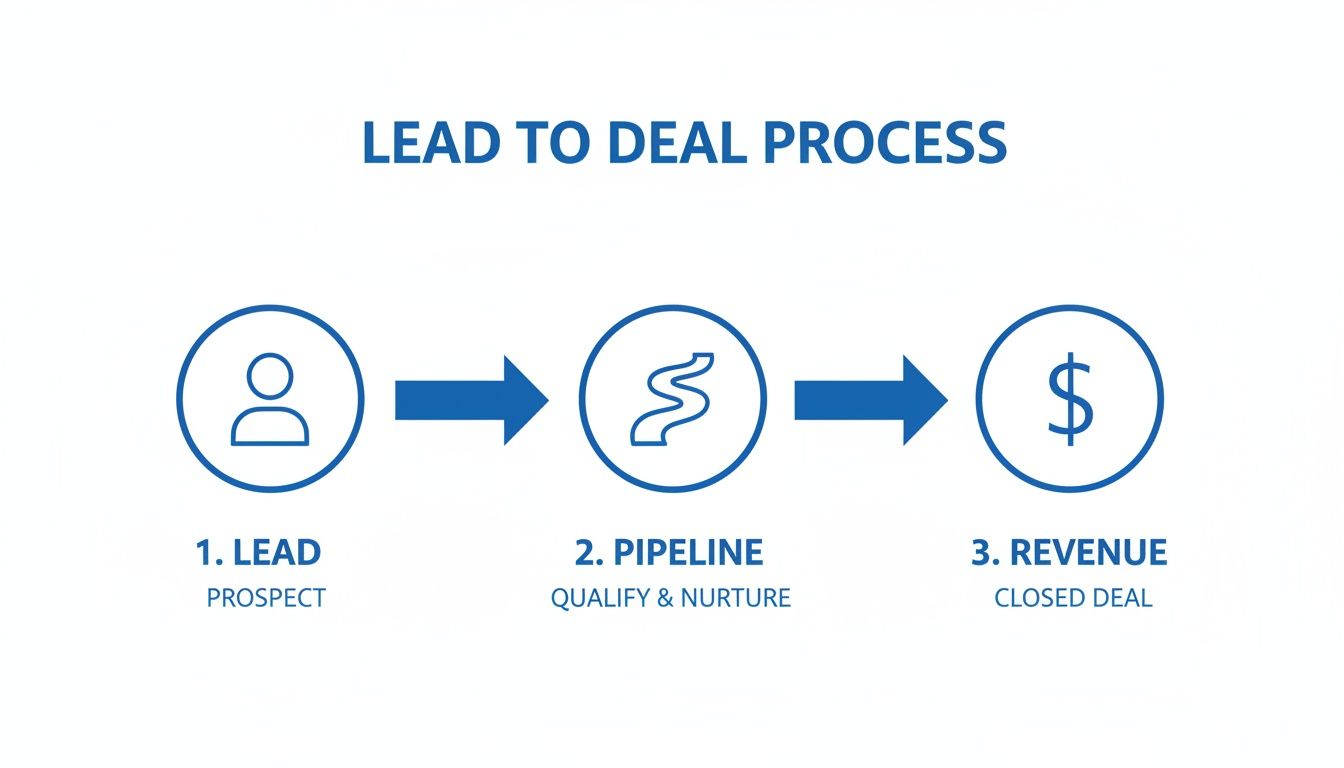
As you can see, a pipeline isn't just a list of names. It’s a living, breathing system designed to turn interest into income.
Stage 1: Prospecting
This is the very top of your funnel, where it all begins. Prospecting is all about finding and engaging with companies or individuals who fit your Ideal Customer Profile (ICP). The main objective here is simple: keep a steady stream of fresh, potential opportunities flowing in.
Common activities include cold calls, targeted email outreach, social selling on platforms like LinkedIn, and following up on inbound leads from marketing. The moment a prospect shows genuine interest and agrees to a conversation, you've successfully completed this stage.
Stage 2: Qualification
Let's be real: not every prospect who raises their hand is a good fit. Qualification is your critical filtering stage, where you figure out if an opportunity is truly worth your team's time and energy. It's about separating the real contenders from the window shoppers.
This is where reps jump on discovery calls to dig into a prospect’s challenges, budget, authority, and timeline. Many teams use a framework like BANT (Budget, Authority, Need, Timeline) to add structure to these crucial conversations.
- Goal: Confirm the prospect has a problem you can actually solve and is a viable customer.
- Key Activity: An in-depth discovery call or an initial meeting.
- Exit Criteria: The prospect is officially a Sales Qualified Lead (SQL). This means they have a defined need, an accessible budget, and the authority to pull the trigger on a purchase.
Stage 3: Proposal or Demo
Once you've qualified a lead, it's time to show them what you've got. This stage is all about presenting your solution, whether that’s through a live demo of your product or a formal proposal that details exactly how you’ll solve their problems. The conversation shifts from discovery to demonstrating value.
A winning proposal is much more than a price sheet; it’s a compelling business case. It should speak directly to the pain points you uncovered during qualification and clearly spell out the return on investment (ROI). This is your chance to connect the dots between your solution and their success.
Stage 4: Negotiation and Commitment
This is where the rubber meets the road. Your prospect has seen the solution and reviewed your proposal, so the conversation now gets down to the nitty-gritty: pricing, contract terms, implementation timelines, and getting buy-in from all the stakeholders.
Great negotiation isn't about giving away discounts, it's about finding a win-win. It’s your opportunity to reinforce the value you bring to the table and smooth over any final concerns to get a firm commitment, verbal or written, from the decision-makers.
A common trap is seeing negotiation as a battle. Instead, approach it as the final collaborative step in building a partnership. The goal is for both sides to feel confident and clear about moving forward together.
For sales teams looking to dial in their process, it's helpful to understand how these stages fit into the bigger picture. You can learn more by checking out our guide on how to build a sales pipeline that actually converts.
Stage 5: Closing
The final hurdle. All objections have been handled, the terms are agreed upon, and it's time to get that contract signed. A deal isn't truly done until the ink is dry and the payment is processed.
Key activities here involve sending the final contract for signature, coordinating with your legal or finance departments, and kicking off the onboarding process for your new customer. The exit criteria are a signed contract and the deal being proudly marked as "Closed-Won" in your CRM. On the flip side, if things don't work out, the deal is marked "Closed-Lost," and the reasons are documented so you can learn and adapt for next time.
Key Metrics for Measuring Your Pipeline's Health
A sales pipeline is so much more than a list of deals. Think of it as a living, breathing system that needs regular check-ups to make sure it's running smoothly. Just glancing at the total dollar value in your pipeline can be dangerously misleading. To really get what’s going on under the hood, you have to measure its health with the right metrics.
These KPIs are your diagnostic tools. They shine a light on bottlenecks, reveal coaching opportunities for your team, and turn your sales process from a complete mystery into a predictable revenue engine.

Let's break down the essential numbers that every sales leader and rep needs to have front and center on their dashboard.
Pipeline Velocity
Pipeline velocity is all about speed, it tells you how quickly deals are moving through your pipeline and actually turning into cash. It's the speedometer for your entire sales operation. The faster your velocity, the faster you're closing deals, which has a direct and immediate impact on your revenue and your ability to forecast accurately.
The formula might look a little intimidating at first, but the idea is simple:
(Number of Opportunities x Average Deal Size x Win Rate) / Average Sales Cycle Length (in days)
This metric brilliantly combines the quantityquality, and speed of your deals into one powerful figure. If you see your velocity slowing down, it's a huge clue that deals are getting bogged down somewhere, maybe in the negotiation stage. It gives you a clear target to go investigate and fix.
Stage-by-Stage Conversion Rates
Let's be real: not every prospect who enters your pipeline is going to become a customer. Tracking stage-by-stage conversion rates shows you exactly where deals are falling through the cracks. It's like checking a physical pipe for leaks at every single joint.
For instance, you might dig into the data and find that:
- 90% of prospects move from "Prospecting" to "Qualification."
- Only 40% make it from "Qualification" to "Proposal."
- Then 70% get from "Proposal" to "Negotiation."
That massive drop-off right after qualification is a giant red flag waving at you. It’s a strong signal that your team might be pushing unqualified leads too deep into the funnel, which wastes everyone's time. Tightening up your qualification criteria here could have an incredible impact on your team's overall efficiency.
Average Deal Size
This one is as straightforward as it sounds. Your Average Deal Size is simply the average dollar value of your closed-won deals over a set period. It might seem basic, but it's an absolutely critical piece of the puzzle for accurate forecasting and long-term strategic planning.
To get this number, you just divide the total revenue from new customers by the number of deals you closed.
Total Revenue from New Deals / Number of Closed-Won Deals
Keeping a close eye on this metric helps you see if your team is getting better at upselling, cross-selling, or successfully moving into bigger, more valuable market segments. If your average deal size starts to shrink, it could mean you're discounting too heavily or focusing on smaller, less profitable clients.
Win Rate
Your Win Rate (often called the close rate) is the bottom-line percentage of opportunities that actually become paying customers. It’s one of the most direct and honest measures of how effective your sales team really is.
The calculation is a simple one:
(Number of Closed-Won Deals / Total Number of Opportunities) x 100
A low win rate often points back to problems at the very top of the funnel, things like poor lead quality or a weak qualification process. On the flip side, a high win rate is proof that your team is fantastic at finding the right customers and expertly guiding them to a close. Fine-tuning this metric is a core part of any solid sales strategy, something we dive into in our guide on sales operations best practices.
Pipeline Coverage Ratio
Keeping these metrics in focus has become even more important recently. Since 2021, sales cycles have stretched by 32%, which means it's taking longer to close deals. This shift means teams need to build and maintain much larger, healthier pipelines just to hit the same targets.
This is where the pipeline coverage ratio comes in, it’s the ratio of your open pipeline's value compared to your sales quota. The best teams out there are aiming for a 3:1 or 4:1 ratio, meaning they have three or four dollars in the pipeline for every one dollar of their quota. You can find more data behind this in these sales pipeline statistics on SalesSo.com.
The Technology Powering Modern Pipeline Management
Trying to manage a sales pipeline with spreadsheets and sticky notes is like trying to navigate a cross-country road trip with a paper map from 1995. Sure, it’s possible, but you’re guaranteed to be slow, inefficient, and you'll probably get lost more than a few times. High-performing sales teams don't leave this to chance; they rely on an integrated tech stack to automate work, bring clarity, and keep deals moving.
At the very center of it all is the Customer Relationship Management (CRM) platform. Think of tools like Salesforce or HubSpot as the command center for your entire sales operation. It’s the single source of truth where every deal, contact, and interaction is logged, tracked, and analyzed.
But the CRM is just the foundation. The real magic happens when you plug specialized tools into it, each one designed to solve a specific pipeline challenge and make the whole process smarter.
Fueling the Pipeline with High-Quality Data
Let's be blunt: your pipeline is only as good as the leads you put into it. A pipeline clogged with bad phone numbers, bounced emails, and outdated company info is a recipe for wasted time and frustration. That's why top-tier teams turn to some of the best B2B lead generation tools available.
Prospecting and data enrichment platforms like Scalelist are built to solve this exact problem. They ensure your team starts every outreach with clean, verified, and actionable data. By pulling information from multiple sources and running it through built-in verification, they deliver accurate professional emails and mobile numbers for the decision-makers you actually need to talk to.
This isn't just about saving a few minutes of Googling. Automating the tedious hunt for data frees up your reps to do what they do best: build relationships and sell.
A clean pipeline is an actionable pipeline. The goal of your tech stack isn't just to store information but to ensure that information is reliable enough to build a predictable revenue forecast upon.
Good data platforms also keep your information from going stale. They can send automated alerts when a key prospect changes jobs, giving you the perfect reason to reach out. This kind of intelligence helps prevent a promising deal from going dark and can even open up a brand new opportunity at your contact's new company.
The Rise of AI in Pipeline Management
Artificial intelligence isn't some futuristic buzzword anymore; it's a practical tool that is fundamentally changing how sales teams operate. AI-driven features are turning pipeline management from a reactive, gut-feel exercise into a proactive, data-driven science.
You can see AI's impact in a few key areas:
- Intelligent Lead Scoring: AI algorithms chew through your historical data to figure out what your best customers look like. Then, they score new leads in real-time, helping your team instantly focus on the opportunities most likely to close.
- Automated Outreach: AI can help write personalized email sequences and suggest the best times to contact prospects based on when they're most engaged, which seriously boosts response rates.
- Predictive Forecasting: Instead of relying only on a rep’s optimism, AI looks at deal progression, the sentiment in emails, and engagement levels to produce a much more objective and accurate revenue forecast.
This fusion of AI and automation is having a massive impact. AI-driven tools are projected to improve lead scoring and forecasting accuracy so much that they could lead to up to 7x higher revenue performance for B2B teams. With 95% of businesses planning to adopt AI in their sales process by 2025, it’s quickly becoming a non-negotiable part of a competitive sales toolkit. You can dig into more of these AI trends on martal.ca.
Ultimately, building an integrated system, a core CRM connected to specialized data and AI tools, is the key. It automates the grunt work, gives reps the intelligence they need to win, and gives leaders the visibility to manage their pipeline with confidence and precision.
Actionable Best Practices for Pipeline Success
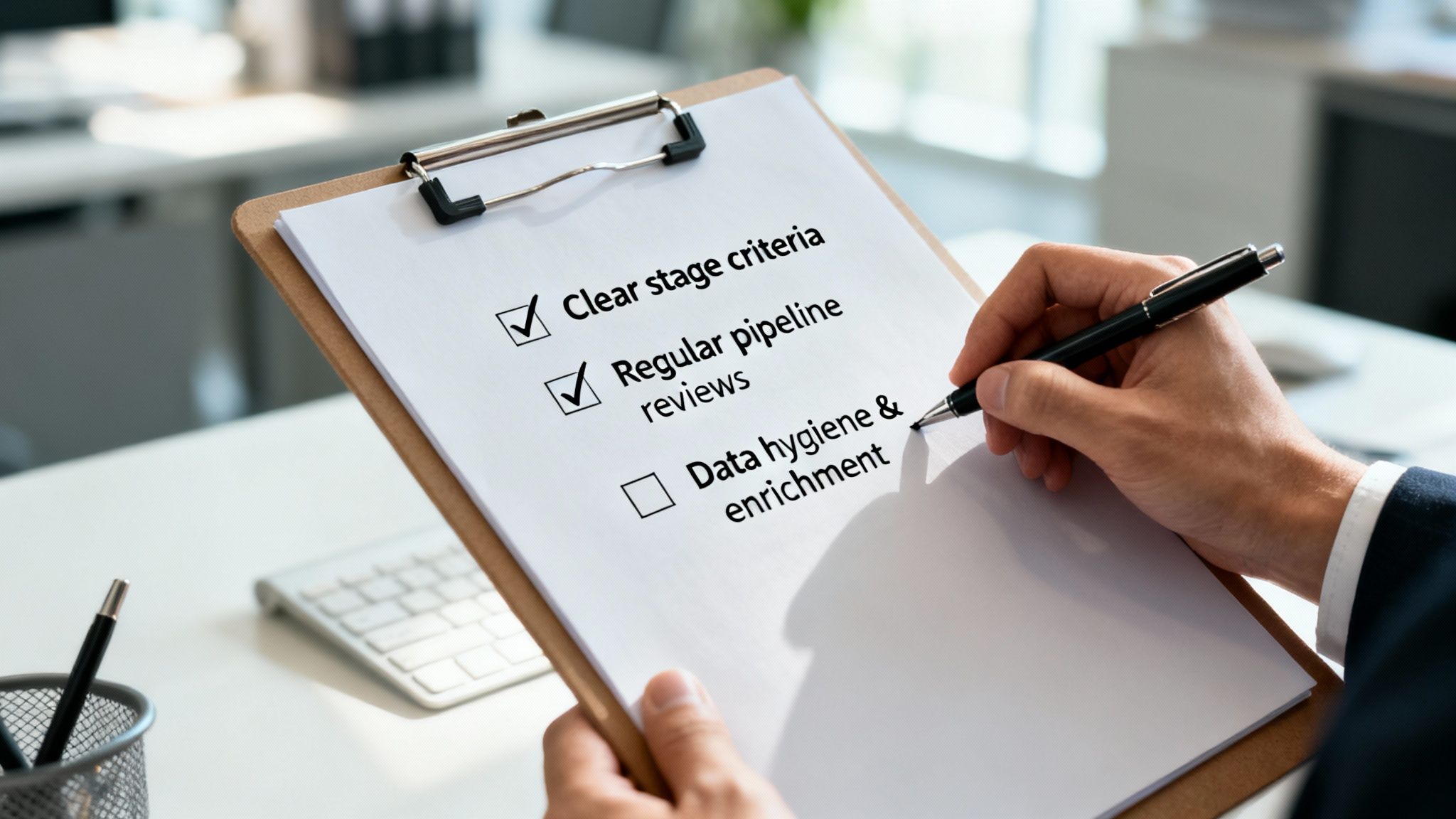
Knowing the theory is one thing, but actually putting it to work is what separates the top-tier sales teams from everyone else. A predictable revenue engine isn’t built on luck; it’s built on a disciplined, repeatable system. The best practices below aren't just suggestions, they are non-negotiable strategies for bringing structure, clarity, and consistency to your sales motion.
When you adopt these habits, your pipeline stops being just a list of deals and transforms into a powerful strategic asset. It gets everyone on the team speaking the same language, following the same playbook, and driving toward the same goals with way more efficiency.
Standardize Your Sales Process and Stages
Consistency is the absolute bedrock of solid pipeline management. If every rep on your team has a slightly different definition of "Qualified," your data is a mess, and forecasting becomes a shot in the dark. You have to establish crystal-clear definitions for every single stage in your pipeline.
This means creating strict rules for what gets a deal into a stage and what gets it out. To move a deal from "Proposal Sent" to "Negotiation," what has to happen? Maybe it requires a verbal confirmation on budget and a follow-up call scheduled with the key decision-maker.
- Define Entry Criteria: What must be true for a deal to enter a stage?
- Define Exit Criteria: What specific actions must be completed to move the deal out of that stage and into the next one?
This simple step removes all the ambiguity. It ensures that a deal's position in the pipeline is a real reflection of its progress, not just wishful thinking. In fact, companies that nail down a formal process have been shown to generate 18% more revenue than their unstructured competitors.
Champion Relentless Pipeline Hygiene
A cluttered pipeline is a dangerous pipeline. It’s a smokescreen, creating a false sense of security with "zombie" deals that will never, ever close but keep bloating your forecast. That's why maintaining excellent pipeline hygiene isn't just a chore, it’s a critical business function.
This is all about regularly clearing out the deadwood: stale leads, unqualified prospects, and unresponsive contacts. Set a simple rule: if a deal has been sitting in one stage for longer than your average sales cycle for that stage, it’s time for an immediate review.
A clean pipeline is an actionable pipeline. Hoarding low-quality leads wastes valuable time and resources that your team could be spending on high-potential opportunities that are far more likely to close.
This practice forces reps to be honest about which deals are actually viable. A smaller, healthier pipeline filled with high-quality, engaged prospects is always more valuable than a massive one clogged with dead ends.
Keep Your Opportunity Data Up-to-Date
Your CRM is the heart of your entire sales operation, but it's only as good as the data inside it. Outdated contact info, incorrect deal values, and missing activity logs can throw a wrench in your whole process. Making data integrity a team-wide priority is essential.
This is where data enrichment and prospecting platforms like Scalelist really shine. They don’t just help you find new leads; they help keep your existing data fresh by providing verified, up-to-date contact information.
Better yet, automated monitoring tools can give you game-changing intelligence. Imagine getting an alert the second a key champion at a target account changes jobs. This trigger event lets you act fast:
- Reach out immediately to congratulate them on the new role and explore if there's a new opportunity.
- Identify their replacement at the old company so you can keep the original deal from falling through the cracks.
This kind of proactive approach stops deals from going dark and turns what could be a pipeline risk into a brand-new opportunity. Integrating these tools automates a huge part of pipeline hygiene and gives your team the timely, actionable intel they need to win.
Common Pipeline Mistakes and How to Fix Them
Even the sharpest sales teams fall into traps that can quietly poison their pipeline and turn forecasting into a guessing game. These mistakes are insidious because they create a false sense of security, hiding serious problems until the end of the quarter is looming and it’s too late to recover.
Spotting these pitfalls is the first step. If you can learn to diagnose and fix them, you’re on your way to building a pipeline that’s a true reflection of your business health, not just a collection of wishful thinking.
The Bloated and Stale Pipeline
This is probably the most common mistake of all: a pipeline clogged with unqualified leads and "zombie deals." We've all seen them, those opportunities that haven't shown a pulse in months but still sit there, artificially inflating your forecast.
- The Problem: Sales reps hate to disqualify anything. It feels like admitting defeat, so they hang on, hoping for a miracle. This means they waste precious time and effort chasing ghosts that will never turn into revenue.
- The Solution: Get serious about pipeline hygiene. Set firm, non-negotiable rules for what makes a deal stale. For example, if there's been no meaningful engagement in 30 days, it’s time for a decision: either establish a concrete next step or mark it as closed-lost. A smaller pipeline filled with real, active deals is infinitely more valuable.
A pipeline filled with junk leads isn't an asset; it's a liability. It drains resources that should be focused on the opportunities that actually have a fighting chance to close.
Vague Stage Definitions and Inconsistent Processes
If "Qualification" means one thing to Jane and something completely different to John, you don't really have a sales process. You have a free-for-all. Without clear, universally understood entry and exit criteria for each stage, your pipeline data is basically garbage. You can't forecast with it, and you can't spot where deals are getting stuck.
You’ll know you have this problem when you see deals jumping from "Discovery" straight to "Closing" or languishing in one stage for months on end. It's a clear sign that reps are ignoring the process because it’s either too confusing or simply not enforced.
The Fix
Your sales playbook needs to be dead simple and explicit on three points for every single stage:
- Entry Criteria: What must be true for a deal to enter this stage? (e.g., "Budget confirmed by the decision-maker.")
- Key Activities: What specific actions must the rep complete in this stage? (e.g., "Deliver a customized demo.")
- Exit Criteria: What non-negotiable proof is required to move to the next stage? (e.g., "Received verbal confirmation to proceed to contract.")
When you standardize the process, every deal's status is based on objective facts, not a rep's gut feeling. This single change can have a massive impact on your forecasting accuracy and make your whole team more effective.
Answering Your Top Pipeline Management Questions
Alright, we've covered a lot of ground on what it takes to manage a sales pipeline effectively. To tie it all together, let's tackle a few of the questions that come up time and time again from sales leaders and reps in the trenches.
How Often Should We Be Reviewing Our Pipeline?
For most B2B sales teams that are serious about hitting their numbers, a weekly pipeline review is the sweet spot. This rhythm is just right, it lets you catch deals that are going sideways, solve problems as they pop up, and coach reps effectively without breathing down their necks. It’s all about creating consistent, forward momentum.
For individual reps, a quick daily huddle with themselves and their pipeline is a game-changer. Just a few minutes in the morning is all it takes to figure out the day's priorities and keep every single opportunity moving.
What’s the Real Difference Between a Sales Pipeline and a Sales Funnel?
This one trips people up all the time, but the distinction is actually pretty simple.
Think of it like this:
- The sales pipeline is your team's playbook. It’s the sequence of steps you take to guide a deal from a new lead all the way to a closed-won customer. It's an internal, action-oriented view.
- The sales funnel, on the other hand, is the buyer's journey. It shows the process from their perspective, visualizing how a large pool of potential customers narrows down as they get closer to a decision. It’s about understanding buyer behavior.
In other words, you actively manage your pipeline, but you analyze your funnel.
The pipeline is your internal roadmap, the set of actions your team follows. The funnel gives you the customer-side context, showing you exactly where you're losing people along the way.
What's the Best Way to Keep Our Pipeline Data from Becoming a Mess?
Keeping your data clean isn’t a one-and-done task; it’s a habit. The secret is a mix of solid processes and the right tech. First, you need to set clear, non-negotiable rules for how everyone enters data into the CRM. No exceptions.
Next, you have to bring in tools to do the heavy lifting. Automation and data enrichment are your best friends here, keeping contact info fresh and even alerting you when a key prospect jumps to a new company. Finally, make data clean-up a regular thing. Periodic audits to get rid of old, stale, or duplicate contacts will ensure your forecasts are built on a foundation of rock-solid, reliable data.
Ready to fill your pipeline with B2B data you can actually trust? Scalelist pulls from over 10 providers and verifies every contact, giving you the direct emails and mobile numbers you need to connect with your ideal prospects. Start your free trial today and scale your outreach with confidence.


