


Last checked: 27 and 28 September 2026, from ZoomInfo’s own pages and Vendr’s contract data.
This ZoomInfo review is built from what ZoomInfo publishes as of September 2026: its data claims, credit and contract rules, trust center and product pages, plus Vendr’s third-party contract data. We did not sign a contract, and ZoomInfo was not in our own provider benchmark, so where we could not verify something, we say so.
What is ZoomInfo?
ZoomInfo is an enterprise B2B go-to-market data platform: contacts, companies and buying intent, sold to sales, marketing and operations teams on custom-quoted annual contracts. It also offers ZoomInfo Lite, a permanent free tier with 10 credits a month.
ZoomInfo says its data is “Built on 500M+ verified professional profiles, 158M+ locations, 122M+ company records, and real-time intent signals from 4,500+ topics” (ZoomInfo data page).
The data sits under several products. These are the ones a sales team meets first:
| Product | What it does | Cost notes from ZoomInfo |
|---|---|---|
| Contact and company database | Search, reveal business emails and phones, export to your CRM | 1 credit per exported record; “Credit consumption varies by data depth” |
| Intent signals | Real-time intent signals from 4,500+ topics | Add-on to base plans |
| WebSights | Website visitor identification | WebSights Lite on the free tier; full WebSights on paid plans |
| Sequences and dialer | “Automated outreach sequences and dialer capabilities” | Add-on to base plans |
| Records under management | Re-pull or re-enrich records you already exported | Free for up to 1 year from the first enrichment |
| API, MCP and GTM.AI | Programmatic access to the data | API: 1 bulk data credit per new contact record; GTM.AI: data credits and AI credits, discovery and search free |
If you only need the first row, you are paying for a platform built around the rest. Our guide to B2B intent data explains when intent is worth adding.
Where ZoomInfo’s data comes from
ZoomInfo’s pricing guide says its data layer is “verified through a multi-source system combining machine learning, third-party partners, and 300+ human researchers”.
Ask ZoomInfo on a demo which sources cover your market, then test them with Lite (below).
Is ZoomInfo legit?
Yes. ZoomInfo is an established B2B data vendor that publishes its security and privacy certifications on a public trust center and documents its credit and contract rules in its help center.
- Certifications. Its trust center lists a 2026 SOC 2 Type II report, ISO 27001, 27017 and 27701 certifications, a TRUSTe GDPR attestation and a TRUSTe CCPA validation.
- Published rules. Credit use, view caps, credit expiry and contract terms are written down in ZoomInfo’s help center and API docs, and this review quotes them below.
- Your side of compliance. As with any data provider, you stay responsible for how you contact people. Our guide to whether B2B contact data is legal explains what that means for you.
Legit and worth it are different questions; the rest of this review covers the second one.
What we checked for this ZoomInfo review
We reviewed ZoomInfo the way a buyer would before a demo: from its own pages, read on 27 and 28 September 2026, plus one third-party price source. We did not run a hands-on test, and we give no star rating.
| Area | What we read | What we found |
|---|---|---|
| Pricing | ZoomInfo pricing guide, Vendr | Quote only; Vendr median 33,500 USD a year |
| Credits | Credits overview, API docs | 1 credit per exported record, per user |
| Data sources | Pricing guide | Machine learning, third-party partners, 300+ human researchers |
| Coverage | Our provider benchmark | ZoomInfo not tested; spot-check it with Lite |
| Integrations | Help center, product pages | 9 CRMs and work tools, plus extension, API and MCP |
| Compliance | Trust center | Security and privacy certifications |
| Contract | Pricing guide | Annual, billed upfront, minimum seats |
The 9 integrations are Salesforce, HubSpot, Microsoft Dynamics, Zoho, SugarCRM, Pipedrive, Slack, Microsoft Teams and Google Analytics. ZoomInfo says integrations need a paid plan.
How accurate is ZoomInfo data?
ZoomInfo publishes accuracy claims on its data page: a “96% Email Deliverability Rate” and “87% Mobile Number Accuracy”, across “300M+ Verified Emails” and “135M+ Direct Dial Numbers”. Those are ZoomInfo’s own figures, not independent measurements.
Independent accuracy figures vary with who runs the test, which list they use and which region they check. Treat any single number, ZoomInfo’s or a third party’s, as a starting point, and treat the totals as a size claim, not a count of your market.
ZoomInfo was not in our provider benchmark, so we cannot confirm or dispute its numbers. In that test, phone coverage on the same North American list ranged from 32% to 87% across six providers, and from 8% to 73% in EMEA.
How to check ZoomInfo’s accuracy yourself
ZoomInfo Lite includes 10 credits a month (25 with Community Edition), and each reveal shows “their business email and direct or in-office phone number”. Reveal 10 contacts you already know in your core market, then count how many emails deliver and how many numbers reach the right person.
Our data provider test method shows how to score the results. Run it on your hardest region, not your easiest.
On freshness, exported records are “placed under management”, so your team can “re-pull or re-enrich those records for free for up to 1 year from the initial enrichment date”.
ZoomInfo pricing in 2026
ZoomInfo does not publish prices for paid plans: they are annual subscriptions quoted per company, and the only public price is 0 USD for ZoomInfo Lite, with 10 credits a month. Vendr, a software buying platform, reports a median contract of 33,500 USD a year, which is third-party data, not a ZoomInfo price. For the cost per month, per user and per contact, see our breakdown of ZoomInfo pricing, per month and per contact.
ZoomInfo credit and contract rules to read before you sign
ZoomInfo’s help center spells out rules that change how far a contract goes:
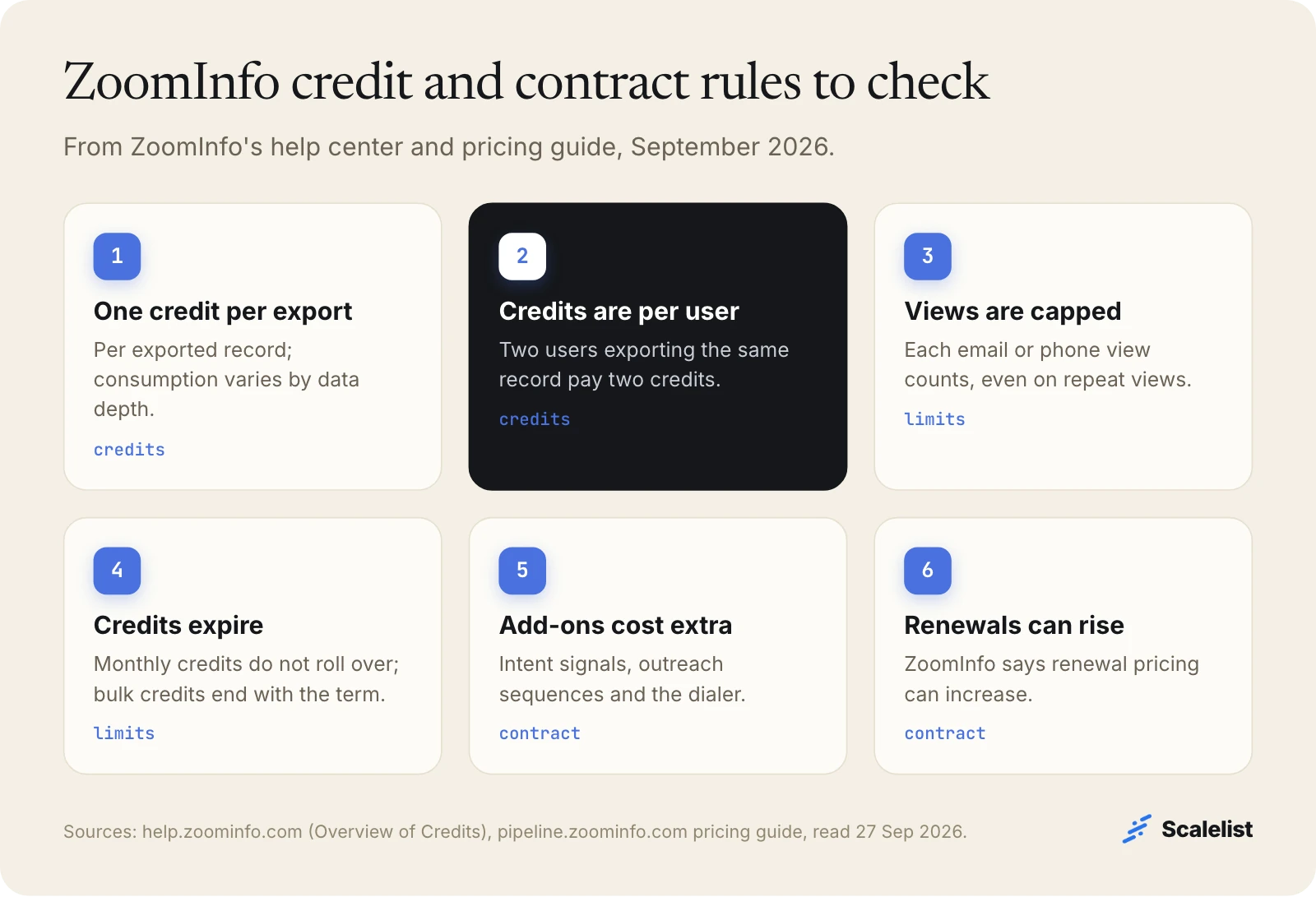
- One credit per exported record, and “Credit consumption varies by data depth.”
- Credits are per user. “If User A and User B both export the same record, two credits will be charged.”
- Views are capped. Each user gets “a set number of views per month”, and each view of an email or phone deducts one, “even if the same contact is viewed multiple times.”
- Credits expire. Monthly credits “can not be rolled over”, and bulk credits “expire at the end of your contract term”.
- Add-ons cost extra. Intent signals and “Automated outreach sequences and dialer capabilities” are listed as add-ons to base plans.
- Renewals can rise. ZoomInfo’s guide warns: “Renewal pricing can increase from the initial contract rate”.
Questions to ask ZoomInfo before you sign
Several rules that decide your real cost are not published, so ask on the call and get the answers in the order form.
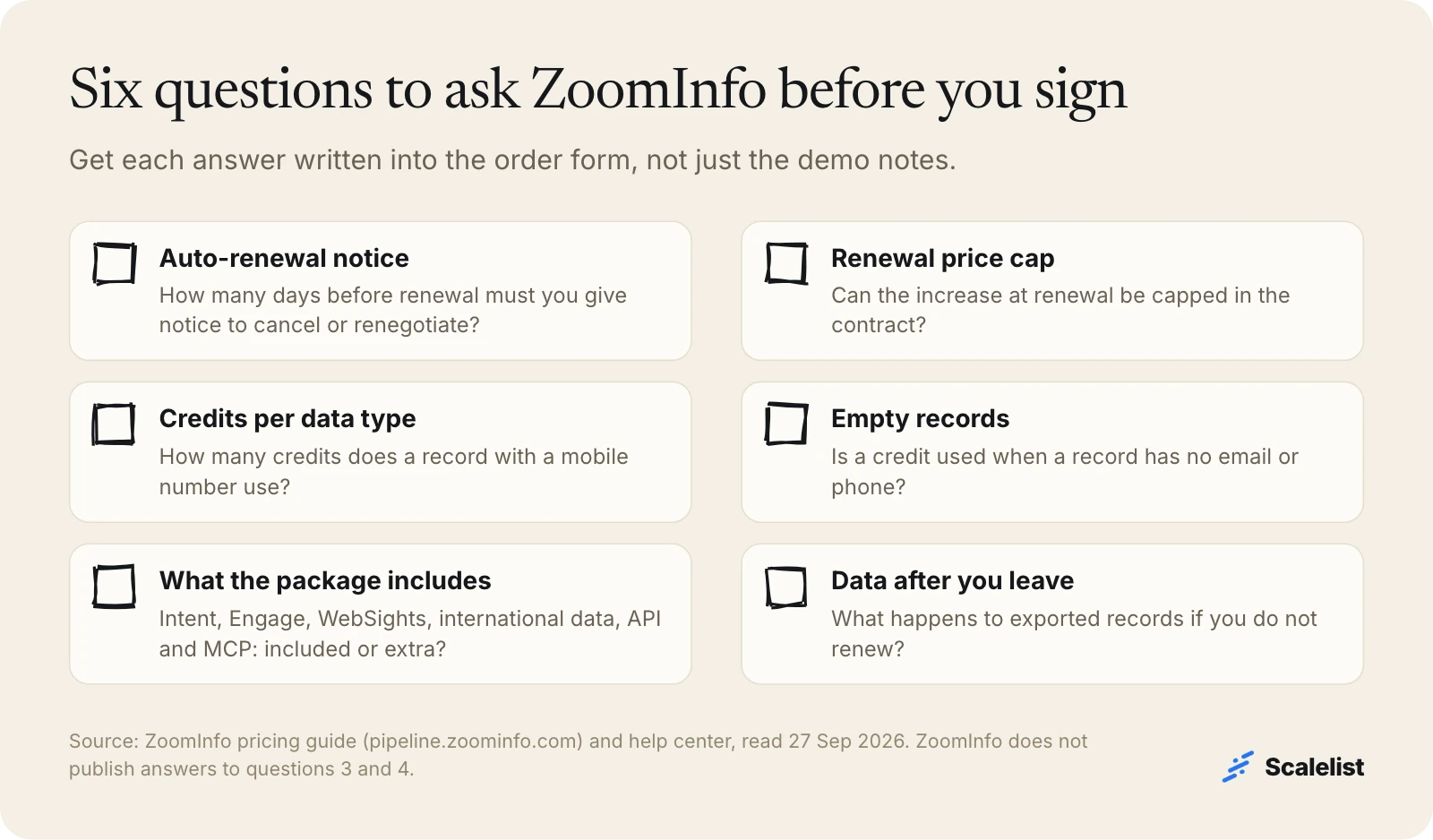
- How many days before renewal must we give notice to cancel or renegotiate?
- Can the renewal increase be capped in the contract?
- How many credits does a record with a mobile number use?
- Is a credit used when a record has no email or phone?
- Are intent, Engage, WebSights, international data, API and MCP included or extra?
- What happens to our exported records if we do not renew?
ZoomInfo pros and cons
ZoomInfo’s strengths are breadth and enterprise readiness. Its weaknesses are cost visibility and contract rigidity. Each point comes from ZoomInfo’s pages or Vendr’s data.
Pros
- Large published data set. 500M+ profiles, 122M+ company records and 135M+ direct dials, per ZoomInfo.
- Intent and visitor data from 4,500+ topics, plus website visitor identification.
- Research team. 300+ human researchers on top of machine learning and partners.
- Enterprise integrations, including Salesforce, Microsoft Dynamics and SugarCRM, plus an API and MCP.
- Published certifications on a public trust center, including a TRUSTe GDPR attestation.
- Free re-pulls of managed records for up to a year, and a free Lite tier to test with.
Cons
- No public price. You need a sales process to learn the cost.
- Annual commitment. Billed upfront, with a minimum number of seats.
- Strict credits. Per-user exports, capped views, no rollover, bulk credits that expire.
- Key features are add-ons, including intent, sequences and the dialer.
- Renewals can go up, by ZoomInfo’s own account.
- Unpublished credit rules. Credits per data type are not published, and neither is whether a record with no email or phone uses a credit.
Is ZoomInfo worth it?
ZoomInfo is worth it for teams that use the platform daily across many users: sales, marketing and operations on one data set, with intent data and admin controls. Its gold-standard reputation rests on that depth.
At a median of 33,500 USD a year, it pays off when your team exports tens of thousands of records and uses the add-ons it paid for.
It is hard to justify for a team of 2 to 10 reps who mainly need verified emails and mobile numbers for outbound. That team pays for platform depth it does not use and locks into an annual contract.
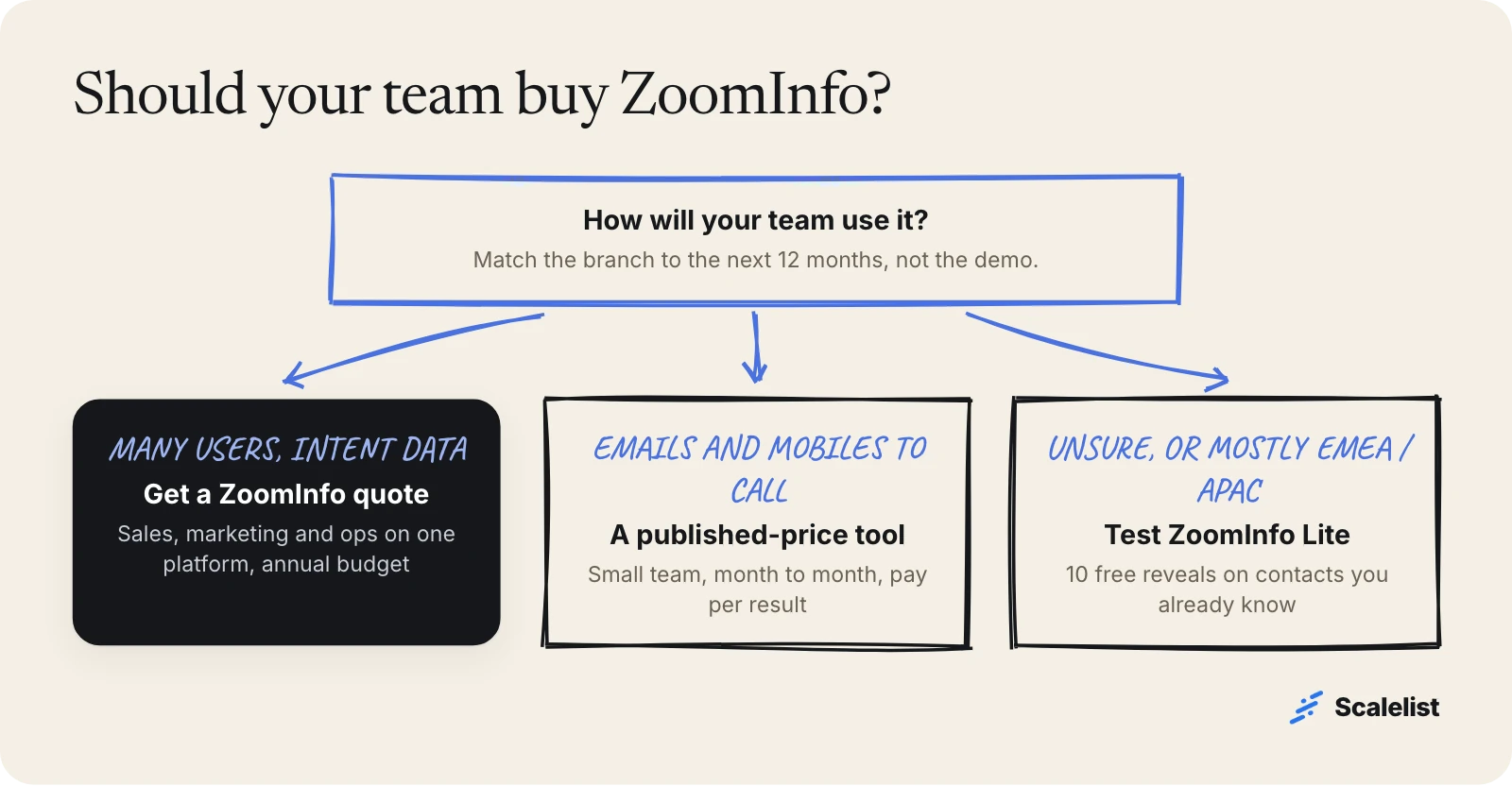
- Get a ZoomInfo quote if you have many users, need intent and visitor data, sell mostly in North America, and can budget annually.
- Choose a published-price tool if you need emails and mobiles for a calling list, month to month.
- Test Lite first if you are unsure, or if most of your pipeline is outside North America: 10 reveals on accounts you know tell you more than a demo.
ZoomInfo vs Scalelist
ZoomInfo and Scalelist solve different problems. ZoomInfo is a full go-to-market platform on an annual contract; Scalelist, an AI lead finder, returns verified emails and mobile numbers for the people you describe, month to month.
| Field | ZoomInfo | Scalelist |
|---|---|---|
| Price | Custom annual quote; Vendr median 33,500 USD a year | From 29 USD a month (500 credits) |
| Contract | Annual, billed upfront, minimum seats | Monthly or yearly, no seats |
| Mobile numbers | Inside exported records; cost per type not published | 20 credits per mobile found |
| Charged when nothing is found | Not published | No |
| Intent and visitor data | Yes (intent is an add-on) | No |
| Native CRM | Salesforce, HubSpot, Dynamics and more | HubSpot; others through Zapier or API |
| Compliance | Certifications listed on its trust center | GDPR and Singapore PDPA, DPA, SCCs |
Where ZoomInfo is stronger: intent data, visitor identification, org charts, enterprise CRM connectors and more certifications than we have. If your team uses those every day, Scalelist does not replace them.
Where Scalelist fits: a smaller team that wants emails and mobile numbers without an annual contract. You describe the buyers in one sentence, see the match count for free, and pay 1 credit per email and 20 per mobile, only when found.
In our benchmark Scalelist found a phone for 87% of the North American list and 73% in EMEA. ZoomInfo was not tested, so this is not a head-to-head result. See Scalelist pricing and the full Scalelist vs ZoomInfo comparison.
Describe your buyers in one sentence and get verified emails and mobile numbers, month to month; misses cost nothing.
Get 20 credits to test itZoomInfo alternatives
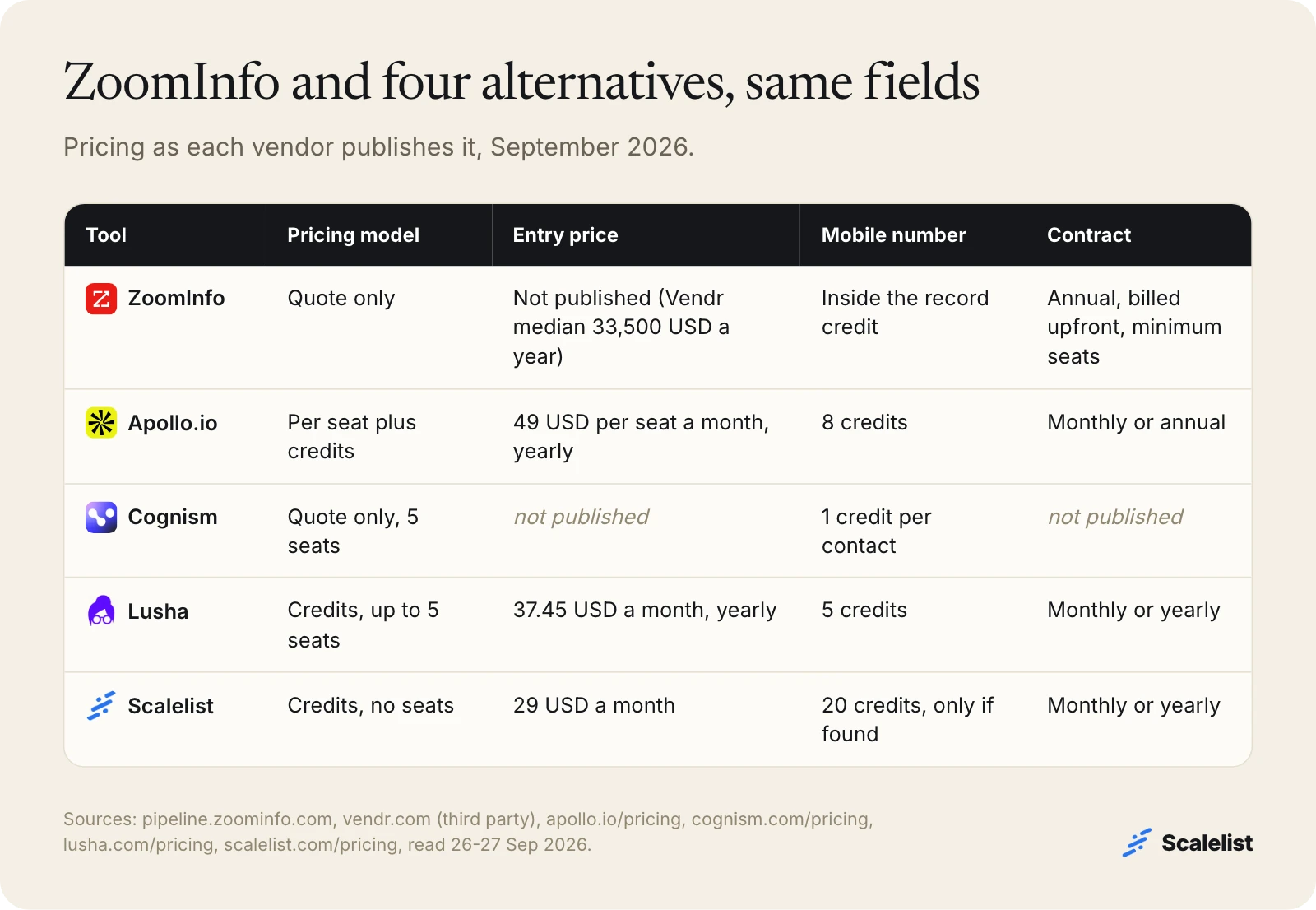
The closest alternatives to ZoomInfo are Apollo, Cognism and Lusha, each with a different buying model. Here they are on the same fields: price, phone cost, strength and weak spot. Our ZoomInfo alternatives guide covers more options.
Apollo.io
Apollo publishes its prices: 49 USD per seat a month billed yearly for Basic, with 2,500 credits per seat a month. A phone number costs 8 credits, and sequences and a US dialer are included.
Where it falls short: in our benchmark it found a phone for 50% of the North American list and 8% in APAC. Our Apollo review has the detail, and ZoomInfo vs Apollo compares them head to head.
Cognism
Cognism is also quote only, with 5 seats in each package, and one credit reveals a contact with email and mobile. It screens phone numbers against Do Not Call lists and sells phone-verified mobiles, a strength for European calling.
Where it falls short: no public price and no single-seat plan. Read our Cognism review.
Lusha
Lusha is self-serve, from 37.45 USD a month billed yearly, with 5 credits per phone and monthly plans you can cancel.
Where it falls short: seats cap at 5 before a sales conversation, and some bulk and API lookups charge for partial or empty results. See our Lusha review.
ZoomInfo compared head to head
- ZoomInfo vs Apollo
- Cognism vs ZoomInfo
- ZoomInfo vs Lusha
- ZoomInfo vs LeadIQ
- Clay vs ZoomInfo
- ZoomInfo vs Crunchbase
FAQ
Is ZoomInfo legit?
Yes. ZoomInfo is an established B2B data vendor, and its public trust center lists a 2026 SOC 2 Type II report, ISO 27001, 27017 and 27701 certifications, a TRUSTe GDPR attestation and a TRUSTe CCPA validation. Legit does not mean right for every team: it is sold on annual, custom-quoted contracts built for larger sales and marketing organizations.
Is ZoomInfo safe to use?
Yes, from a security and compliance standpoint: ZoomInfo publishes third-party certifications and privacy attestations on its trust center. As with any data provider, you remain responsible for how you contact people, so check email and calling rules for each country you prospect into and verify emails before large sends.
How accurate is ZoomInfo data?
ZoomInfo publishes a 96% email deliverability rate and 87% mobile number accuracy on its data page. Those are its own figures, not independent measurements, and independent accuracy figures vary with the test, the list and the region. ZoomInfo was not in our provider benchmark, so this review cannot confirm them. The fastest check is to reveal 10 contacts you already know with the Lite credits.
How do I check ZoomInfo’s accuracy before buying?
Use ZoomInfo Lite. It includes 10 credits a month (25 with Community Edition), and each reveal shows the contact’s business email and direct or in-office phone number. Reveal 10 contacts you already know in your hardest market, then count how many emails deliver and how many numbers reach the right person.
Is ZoomInfo worth the price?
It is worth the price for larger teams that use the whole platform: many users, intent data, visitor identification and high export volume. With annual contracts and a Vendr median of 33,500 USD a year, it is hard to justify for a small team that mainly needs emails and mobile numbers to call, where a published-price tool is usually cheaper.
How much does ZoomInfo cost?
ZoomInfo does not publish prices for paid plans; contracts are custom-quoted and billed annually, and Vendr reports a median of 33,500 USD a year. Our ZoomInfo pricing guide breaks the cost down per month, per user and per contact.
Is ZoomInfo good for small businesses?
Usually not as a first purchase. Paid plans are annual, billed upfront, with a minimum number of seats, and the Vendr median is 33,500 USD a year. A small team can start on ZoomInfo Lite at 0 USD, but 10 credits a month will not fill a calling list, so most small teams compare it with published-price tools first.
Can you pay for ZoomInfo monthly?
Not as standard. ZoomInfo says “Most paid plans are billed annually upfront. Monthly billing is not standard.” Contract terms are covered in our ZoomInfo pricing guide.
Sources
- ZoomInfo: how much does ZoomInfo cost, pricing guide, updated 7 Jul 2026
- ZoomInfo data page, data claims, read 27 Sep 2026
- ZoomInfo help: overview of credits and ZoomInfo Lite credits
- ZoomInfo API credit usage
- ZoomInfo trust center
- Vendr: ZoomInfo, third-party contract data
- Apollo pricing, Cognism pricing, Lusha pricing


