


Lusha vs ZoomInfo is a choice between two ways of buying contact data. Lusha is self-serve: plans from 37.45 USD a month, a phone number at 5 credits, and you can cancel any time. ZoomInfo sells enterprise contact, company and intent data on custom-quoted annual contracts with seat minimums, and publishes no paid price.
Prices checked on 27 September 2026 from each vendor’s own pricing page.
Below, both get the same 11 fields, in the same order, from their own pricing pages and help centers on 27 September 2026. Neither tool was in our own benchmark, so this page compares published terms and labels every data figure as the vendor’s claim.
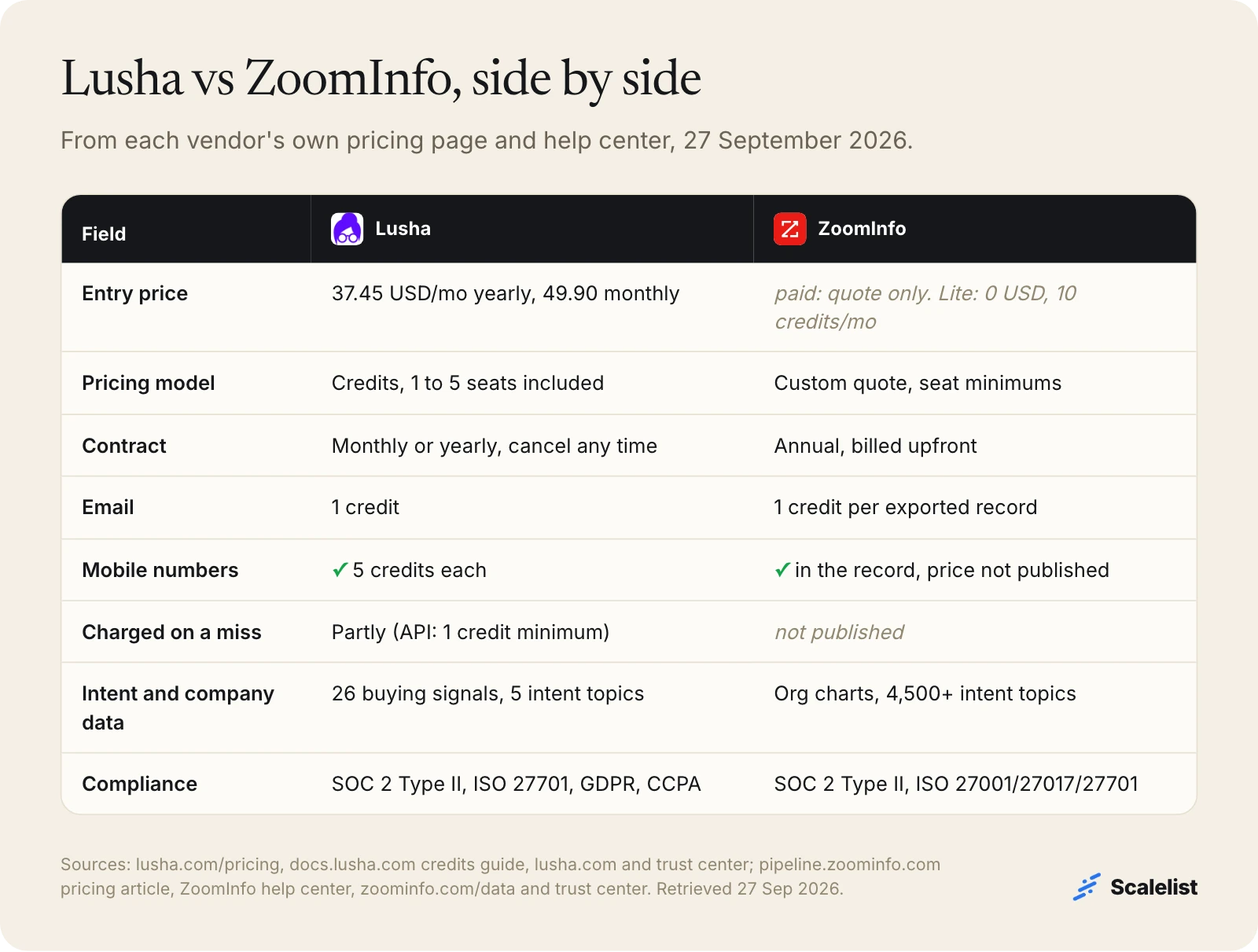
Lusha vs ZoomInfo at a glance
Lusha is a self-serve contact data tool priced in credits; ZoomInfo is a quote-only enterprise data platform. Here are the same 11 fields for each.
| Field | Lusha | ZoomInfo |
|---|---|---|
| What it is | Self-serve B2B contact data: web app, browser extension, API, MCP | Enterprise B2B data platform: contacts, companies, intent |
| Best for | Individual reps and small teams, month to month | Larger teams buying data, intent and engagement on one contract |
| Entry price | 37.45 USD a month yearly, 49.90 monthly (Starter). Free: 40 credits a month | Paid plans not published. ZoomInfo Lite: 0 USD, 10 credits a month |
| Pricing model | Credits, with 1, 2 or 5 seats included by plan | Custom quote, seat minimums, credits |
| Contracts | Monthly or yearly, cancel any time; teams above 5 users go through sales | Annual, most “billed annually upfront” |
| Email data | 1 credit per email; claims 165M+ emails | 1 credit per exported record; claims 300M+ verified emails |
| Mobile numbers and cost | Yes, 5 credits each (0.47 to 0.62 USD on Starter) | Paid plans, inside the exported record; price per number not published |
| Charged on a miss | Partly: CSV misses free, API requests cost at least 1 credit | Not published |
| Integrations | Salesforce, HubSpot, Pipedrive, Zoho, monday CRM, Outreach, Salesloft, API, MCP | Salesforce, HubSpot, Microsoft Dynamics, Zoho, SugarCRM, Pipedrive, API, MCP |
| Compliance | SOC 2 Type II, ISO 27701, GDPR, CCPA, Do Not Call list listed | SOC 2 Type II, ISO 27001, 27017 and 27701, TRUSTe GDPR and CCPA |
| Where it falls short | API charges on empty results, annual credits reset, 5-user ceiling | No public price, credits expire, renewal can rise |
For each tool on its own, read our Lusha review and our ZoomInfo review.
How are Lusha and ZoomInfo different?
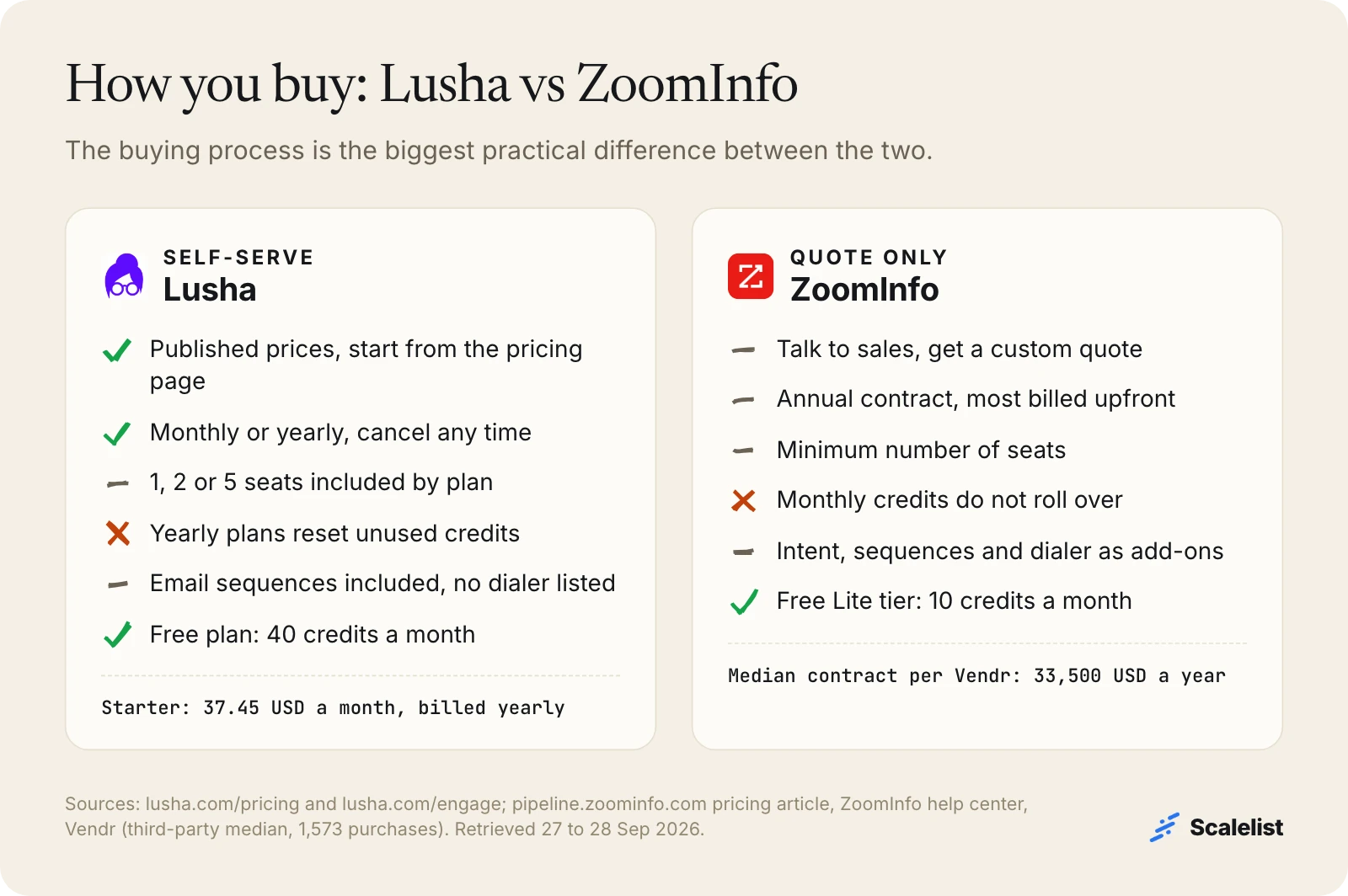
Lusha and ZoomInfo differ most in how you buy, how a contact is charged and how deep the company data goes. These six differences change the bill or the workflow.
- A card against a procurement cycle. Lusha publishes a price for every plan except Scale, and only teams above 5 users are sent to sales. ZoomInfo says paid plans “are not published at a fixed price” and every contract is scoped to your usage.
- Contract length and credit expiry. Lusha bills monthly or yearly and “you can cancel your plan at any time”, effective at the end of the cycle. ZoomInfo paid plans “are annual subscriptions”, monthly credits do not roll over, and bulk credits expire at the end of the contract.
- How a contact is charged. Lusha charges 1 credit to reveal an email and 5 for a phone, and re-viewing a revealed contact is free. ZoomInfo charges one credit per exported record, and two users exporting the same record pay two credits.
- Depth of company data. ZoomInfo claims 500M+ professional profiles, org charts, website visitor data (WebSights) and intent across 4,500+ topics. Lusha claims 29M+ companies “enriched with 26 buying signals refreshed weekly”, with 5 intent topics on Starter and Premium and 25 on Scale.
- API access. Lusha gives every user an API key on every plan, including its 0 USD plan, though an API request costs at least 1 credit even when nothing comes back. ZoomInfo Lite needs a paid plan for tools and integrations, and API customers “purchase credits in bulk on an annual basis,” at 1 bulk credit per new contact record.
- Team size. Lusha’s self-serve plans stop at 5 seats; per-user credit limits and SSO need the Scale plan. ZoomInfo paid plans “include a minimum number of seats and scale with headcount.”
Lusha vs ZoomInfo pricing
Lusha publishes its prices and ZoomInfo does not. Here is everything each one publishes, plus one third-party figure for ZoomInfo.
Lusha pricing
| Lusha plan | Billed yearly | Billed monthly | Credits a month | Seats |
|---|---|---|---|---|
| Free | 0 USD | 0 USD | 40 | 1 |
| Starter | 37.45 USD | 49.90 USD | 400 | 1 |
| Pro | 52.45 USD | 69.90 USD | 600 | 2 |
| Premium | 299.95 USD | 399.90 USD | 3,400 | 5 |
| Scale | Not published | Not published | Custom | Custom |
Monthly Pro and Premium plans roll credits over up to 2x; on yearly plans “Any unused credits will be reset at the end of the annual cycle.” Our Lusha pricing breakdown covers each plan.
ZoomInfo pricing
- ZoomInfo Lite: 0 USD, 10 credits a month (25 with Community Edition), no credit card. A reveal shows a business email and a direct or office phone. Integrations need a paid plan.
- Paid plans: quoted, annual, “Most paid plans are billed annually upfront.” ZoomInfo’s quote drivers are team size, credit volume, features such as intent and WebSights, integrations and API access, and contract length.
- Third-party data: Vendr, a software buying marketplace, reports a median ZoomInfo contract of 33,500 USD a year across 1,573 purchases, from 7,213 to 155,820 USD.
Our ZoomInfo pricing guide turns the Vendr median into a cost per record at different export volumes.
What one phone number costs
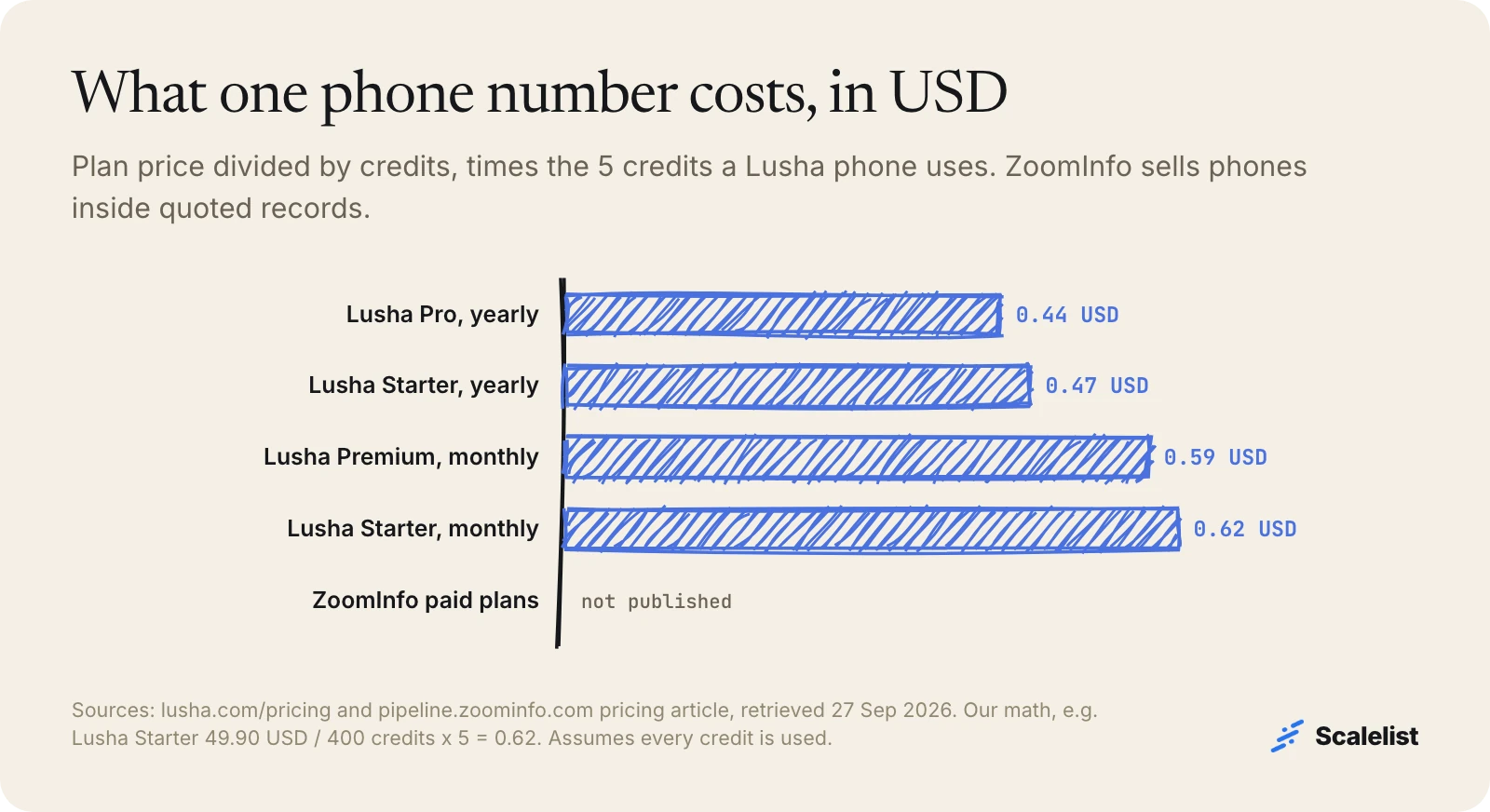
A Lusha phone number costs 0.44 to 0.62 USD at list price if you use all your credits: 0.44 USD on Pro or Premium billed yearly, 0.47 USD on Starter billed yearly and 0.62 USD on Starter billed monthly. ZoomInfo does not publish a price per number.
The closest ZoomInfo figure is our math on Vendr’s median: at 33,500 USD a year, one exported record costs 6.70 USD if you export 5,000 a year and 0.67 USD at 50,000. That is third-party data, not a ZoomInfo price.
Credit rules that change the real price
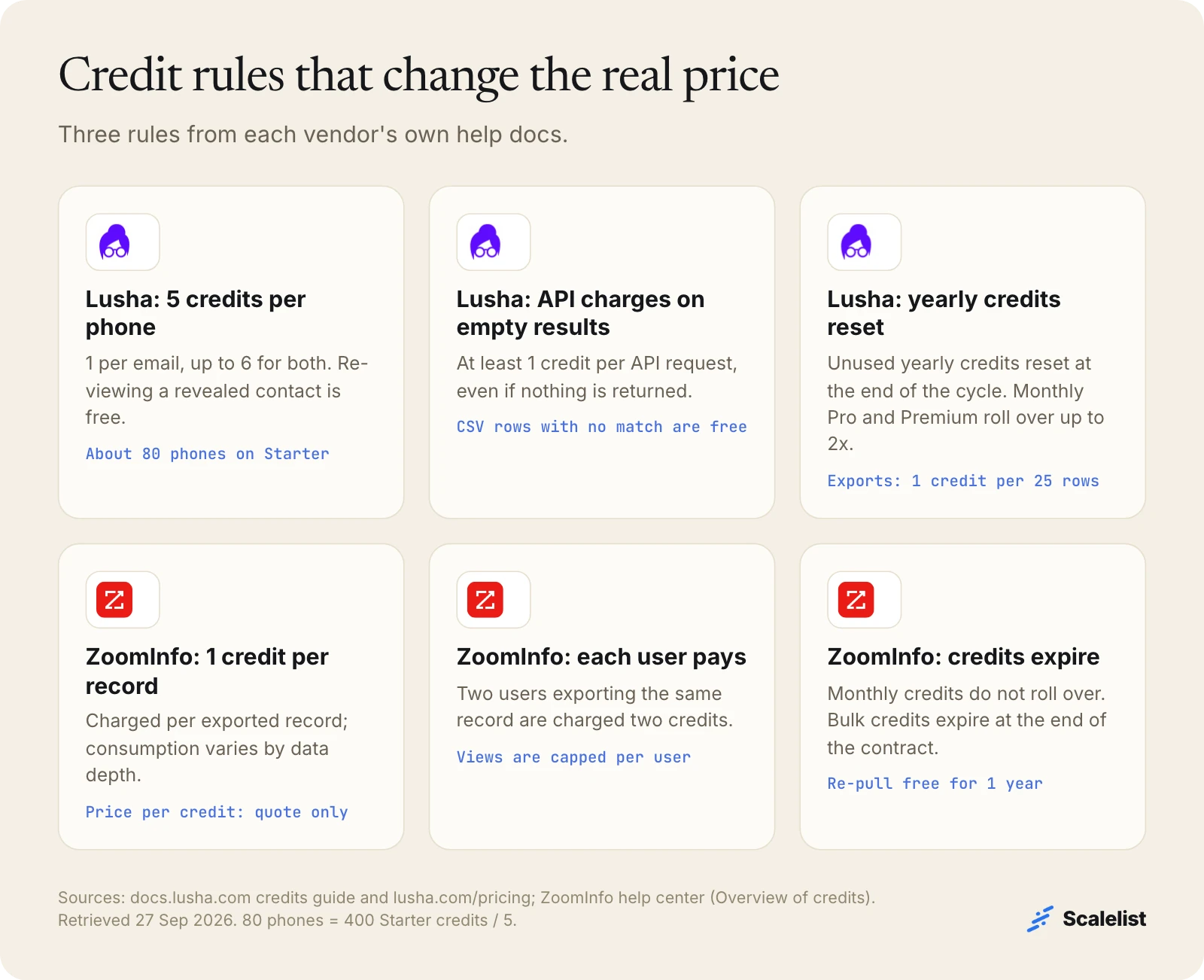
The list price is only half of the cost; the credit rules decide how much of it you use. Here are the same five rules for each tool.
| Credit rule | Lusha | ZoomInfo |
|---|---|---|
| How credits are counted | 1 credit to reveal an email, 5 for a phone, up to 6 for both; CSV export costs 1 credit per 25 rows, even for contacts already revealed | 1 credit per exported record; “Credit consumption varies by data depth”; Monthly, Bulk and AI Action Credits |
| Looking up a contact again | Free: re-viewing an already revealed contact costs 0 credits, and searching is free | Records under management can be re-pulled or re-enriched free for up to 1 year; views are capped per user, and each view of an email or phone uses one, even for the same contact |
| Same record, two users | Not published | Two credits: “if User A and User B both export the same record, two credits will be charged” |
| Unused credits | Monthly Pro and Premium plans roll over up to 2x; yearly plans reset at the end of the annual cycle | Monthly credits cannot be rolled over or transferred; Bulk Credits expire at the end of the contract |
| What a miss costs | Partly charged: CSV rows with no match are free, an API request costs at least 1 credit even with no result, and bulk reveals charge every selected contact, including partial matches | Not published |
Which has better data, Lusha or ZoomInfo?
Neither Lusha nor ZoomInfo was in our benchmark, so any answer on data quality rests on vendor claims until you test them yourself.
- Lusha claims “290M+ verified contacts”, “165M+ emails” and “117M+ direct dials”, and says it verifies each vendor’s data “before and during the engagement.”
- ZoomInfo claims “300M+ Verified Emails”, “135M+ Direct Dial Numbers”, “87% Mobile Number Accuracy” and a “96% Email Deliverability Rate”, with data verified by machine learning, third-party partners and “300+ human researchers.”
For measured coverage on the tools we did test, see our B2B data provider comparison.
A third option: Scalelist, if mobiles are the job
If your reps call as much as they email, a pay-per-result tool may fit better than either. Scalelist is an AI Lead Finder: you describe the people you want in one sentence and get them back with verified work emails and mobile numbers.
- How you pay: 1 credit per lead found, 1 per email found, 20 per mobile found, and nothing when nothing is found. Plans run from 29 USD a month for 500 credits to 649 USD for 20,000, with no seats and no annual contract (Scalelist plans and credits).
- Measured: in our own benchmark, Scalelist found a phone number for 87% of the North America list, 73% in EMEA, 75% in APAC and 85% in Latin America.
- Where it is not the better buy: a mobile costs 0.65 to 1.16 USD at list price, more than a Lusha phone credit. There is no sequencer, dialer, intent data or org chart, and HubSpot is the only native CRM.
The direct matchups are in Scalelist vs Lusha and Scalelist vs ZoomInfo.
Describe the buyers you would look up in Lusha or ZoomInfo and see how many match before you spend a credit.
Describe your buyer in one sentenceHow to choose between Lusha and ZoomInfo
Lusha or ZoomInfo comes down to team size and to how much company data you need beyond contacts.
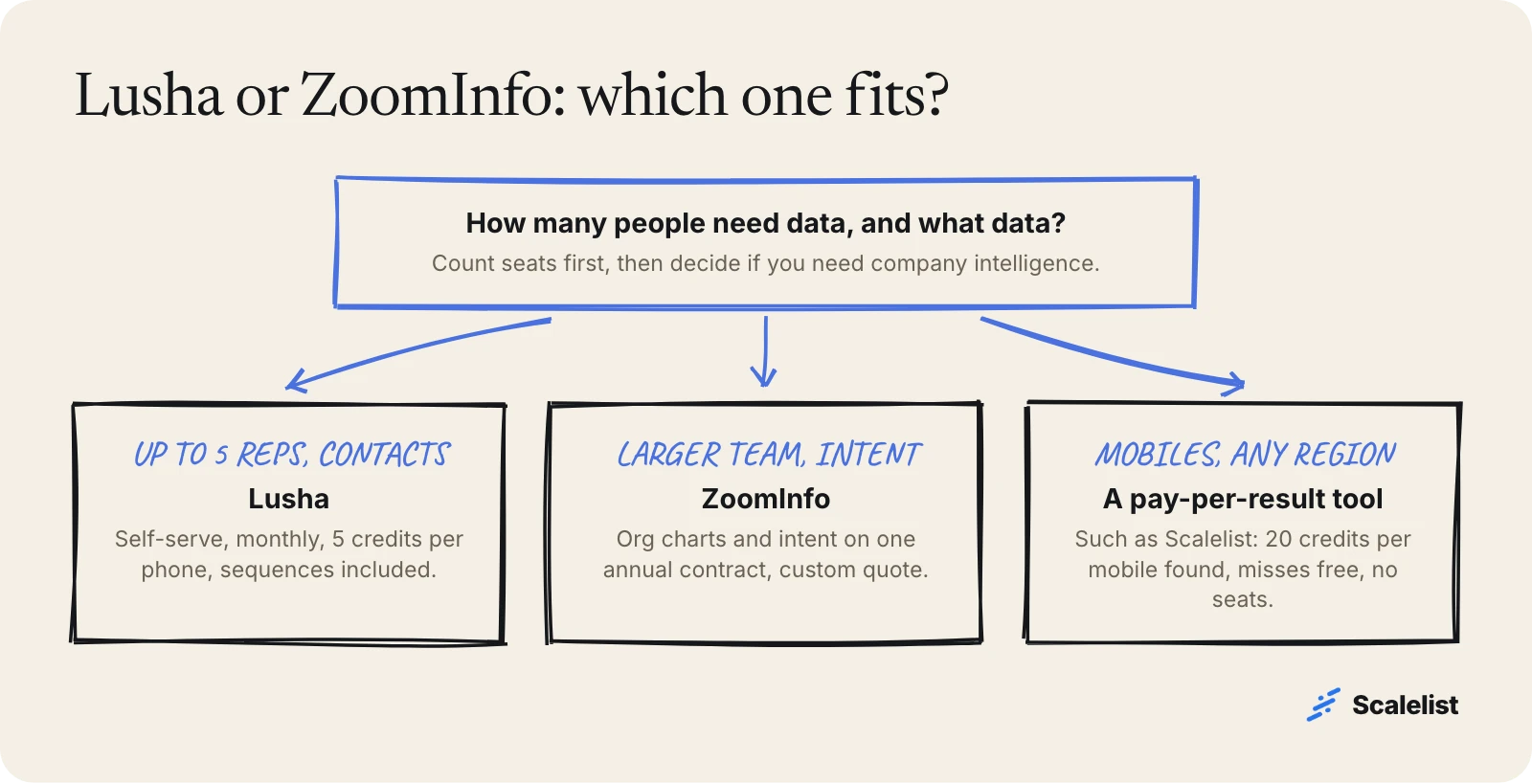
- Count the people who need data. Up to 5, Lusha covers you self-serve. Beyond that, both need a sales conversation.
- Decide if you need company intelligence. Org charts, intent across thousands of topics and website visitor data point to ZoomInfo. Contact details alone point to Lusha.
- Ask ZoomInfo the questions Lusha answers on its website. Credits per seat, credits per record with a mobile, whether an empty record costs a credit, rollover and the renewal cap.
- Check your workflow. If you pull data through an API, Lusha charges at least 1 credit per request. If several reps export the same accounts, ZoomInfo charges each of them.
- Test on your own accounts in the regions you sell into before you commit a year.
Still deciding? Compare Lusha alternatives and ZoomInfo competitors, or read ZoomInfo vs Apollo, Apollo vs Lusha, Cognism vs ZoomInfo, ZoomInfo vs LeadIQ and, for workflow tools, Clay vs ZoomInfo and Clay vs Apollo. The Scalelist blog has more matchups.
FAQ
Is Lusha better than ZoomInfo?
For individual reps and teams of up to 5, usually yes: Lusha publishes its prices, bills monthly, charges 5 credits per phone and gives every user an API key. ZoomInfo is the better fit for larger teams that need company data, org charts and intent signals under one annual contract. Neither was in our benchmark, so test data quality on your own accounts.
ZoomInfo vs Lusha: which is cheaper?
Lusha, at the entry level: Starter costs 37.45 USD a month billed yearly or 49.90 monthly. ZoomInfo does not publish paid prices; Vendr, a buying marketplace, reports a median ZoomInfo contract of 33,500 USD a year. ZoomInfo Lite is free with 10 credits a month, and Lusha’s free plan gives 40 credits a month.
Can you try Lusha and ZoomInfo before you pay?
Yes. ZoomInfo Lite is a permanent free tier with 10 credits a month (25 with Community Edition), no credit card and no contract. Each reveal shows a business email and a direct or office phone. Lusha’s free plan gives 40 credits a month and 1 seat. Integrations on ZoomInfo need a paid plan.
How much does a phone number cost on Lusha and ZoomInfo?
On Lusha, 5 credits, which is 0.44 to 0.62 USD at list price depending on plan and billing. An email costs 1 credit, and both together cost up to 6. ZoomInfo does not publish a price per phone number: it charges one credit per exported record and says consumption varies by data depth.
Which has more accurate data, Lusha or ZoomInfo?
Neither has been tested by us, so we cannot rank them. ZoomInfo claims 87% mobile number accuracy and 135M+ direct dials; Lusha claims 117M+ direct dials and 290M+ verified contacts. Both are vendor claims. Test each on contacts you already know, then on a paid month of your real list, and count connected calls.
Is there an alternative to Lusha and ZoomInfo for mobile numbers?
Yes. Scalelist, an AI Lead Finder, returns verified work emails and mobile numbers from a one-sentence description, charges 20 credits per mobile found and nothing for a miss, with no seats and no annual contract. Its phone credit costs more than Lusha’s at list price, and it has no sequencer or intent data. New accounts get 20 free credits.


