Call reluctance is fixable, and it shows up in a rep’s activity data long before anyone says the word “fear”. Reps who avoid the phone are rarely lazy: they dial late, research too long and stop after the first rude answer.
This page shows how to spot call reluctance in a dialer report, the causes behind it, a daily routine a rep can run alone, what a manager can do with the team, and how many cold calls per day to aim for, using published benchmarks only. It comes from 75,000+ recorded cold calls over 11 years in sales.
What is call reluctance?
Call reluctance is the habit of delaying or avoiding sales calls, especially cold calls, because picking up the phone feels uncomfortable. The rep wants the result and knows the calls work, yet finds other tasks to do first.
It is close to fear of cold calling, but it is measured by behavior, not feelings. Some reps feel nervous and dial anyway; others feel calm and still dial late. For a manager, the useful question is not “are you afraid?” but “when was your first dial?”
What call reluctance looks like in a rep’s day
Call reluctance leaves a pattern in the dialer and the CRM: the calls happen late, in small numbers, and stop early. You can see it in a week of activity data without a single awkward conversation.
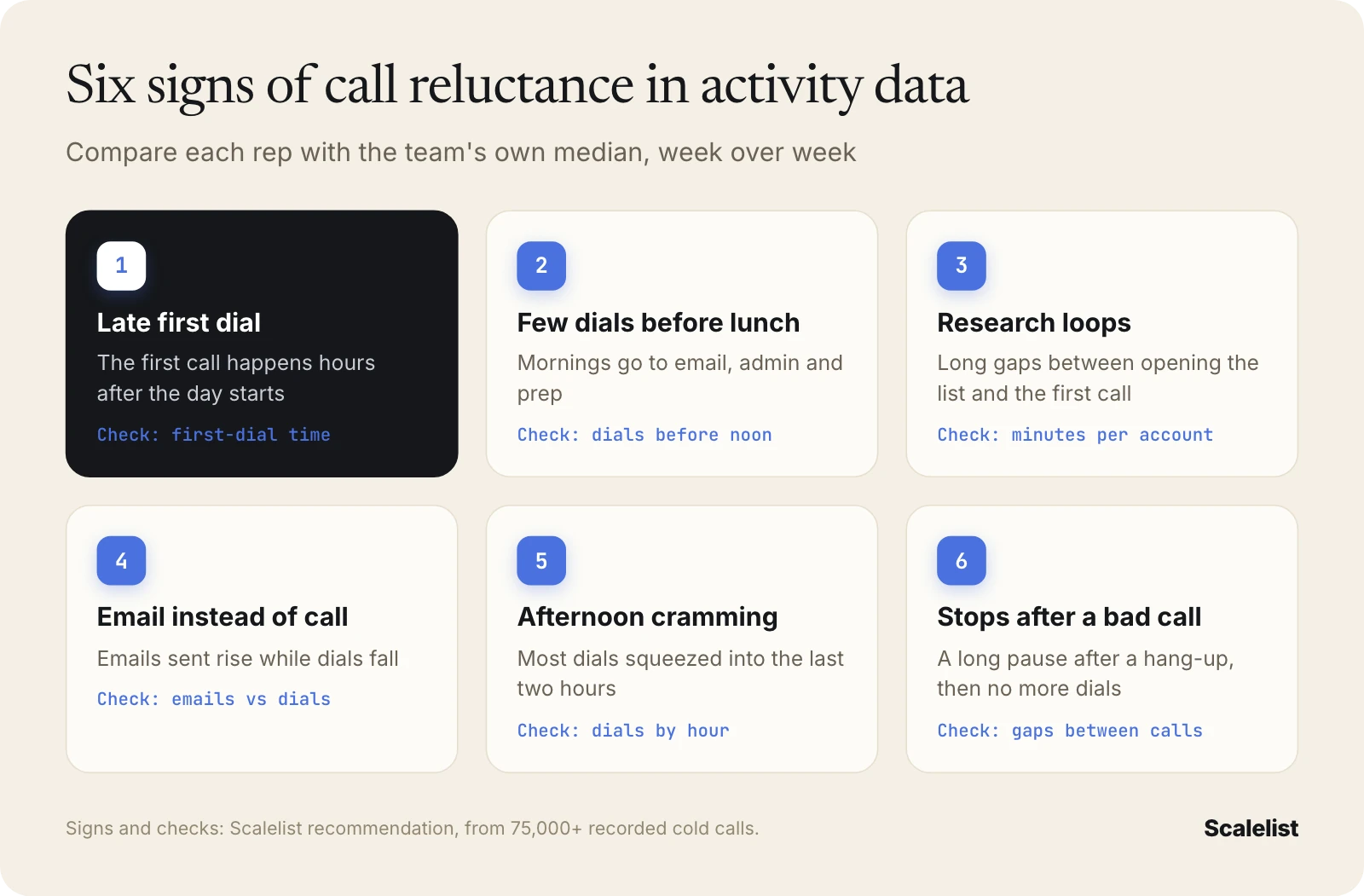
Here is a typical day. Jordan Mills, an SDR at Brightwell, a payroll software company in Denver, has 40 accounts assigned for the week.
- 8:30. Opens the list, then spends 35 minutes on the first prospect’s website and news.
- 9:30. Writes three “warm-up” emails instead of calling.
- 11:40. First dial. Six dials before lunch.
- 3:00 to 4:30. Most of the day’s 22 dials, then stops after a prospect hangs up.
Nothing in that day looks like avoidance on its own. Together, it is the classic pattern. Compare each rep against the team’s own median, not against a stranger’s benchmark.
Why reps avoid the phone: the causes of cold calling anxiety
Most cold calling anxiety comes from a handful of concrete causes, and each one has its own fix. Rejection tops the list: 44% of sales pros who cold call daily say overcoming initial rejection is their biggest challenge (HubSpot, 2025 survey of 379 sales professionals).
Rejection feels personal
A hang-up lands as a verdict on the rep, not on the timing. The fix is to know the math (below) and to count attempts, not wins.
The first 10 seconds are not scripted
Reps who improvise the opener dread the moment the buyer says “Who is this?” A written first line removes the hardest part of the call.
Research becomes a hiding place
Research feels like work, so it expands. Cap it: our pre-call planning in 60 seconds gives a rep three facts to find, then dial.
The list is bad
Switchboards, wrong numbers and people who left the company make every block feel pointless. Mobile numbers connect 45% more often than other numbers (Nooks, 2025, nearly 3 million dials).
No protected time
If calls fit “between other things”, other things win. Calls need a calendar block like a meeting.
Judged on meetings too early
A new rep judged on meetings in week 2 learns that every call is a test. Judge activity and rates first.
How to overcome call reluctance: a rep’s daily routine
The routine below works because it removes decisions: when to start, who to call and what to say first are settled the day before. Run it for two weeks before judging it.
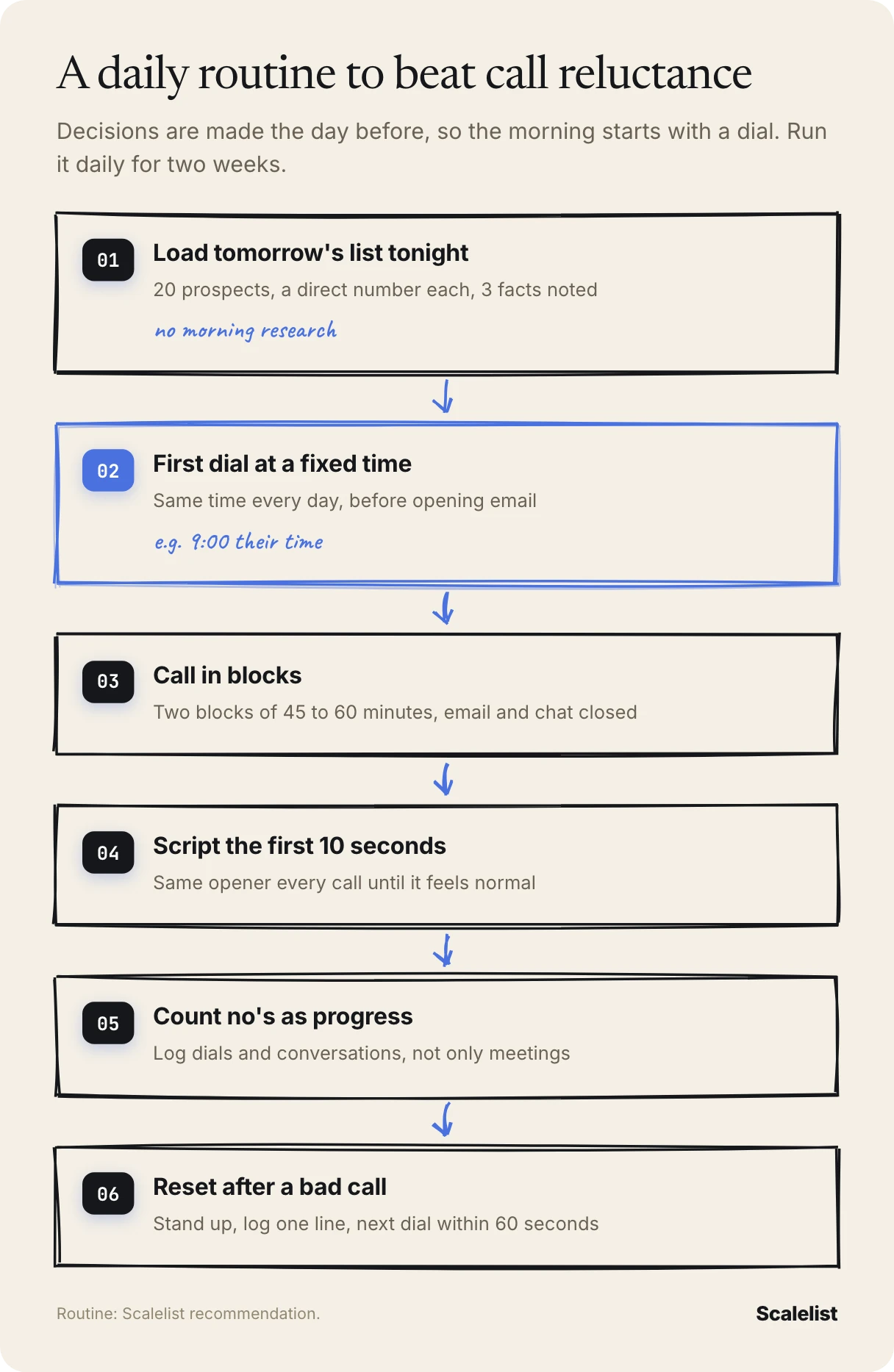
1. Load tomorrow’s list tonight
Pick 20 prospects before you log off, with a direct number for each. No research the next morning beyond the three facts you noted.
2. Make the first dial at the same time every day
Choose a fixed time, for example 9:00 in the prospects’ time zone, and dial before opening email. The first dial is the hardest one; make it a habit, not a decision. The best windows by region are in the best time to cold call.
3. Call in blocks, not between tasks
Two blocks of 45 to 60 minutes beat a full day of “I’ll call later”. Close email and chat. Stand up if it helps your voice.
4. Script the first 10 seconds
Say the same opener every time until it stops feeling scary. Here is one to adapt; more options are in our cold call openers that earn 30 seconds.
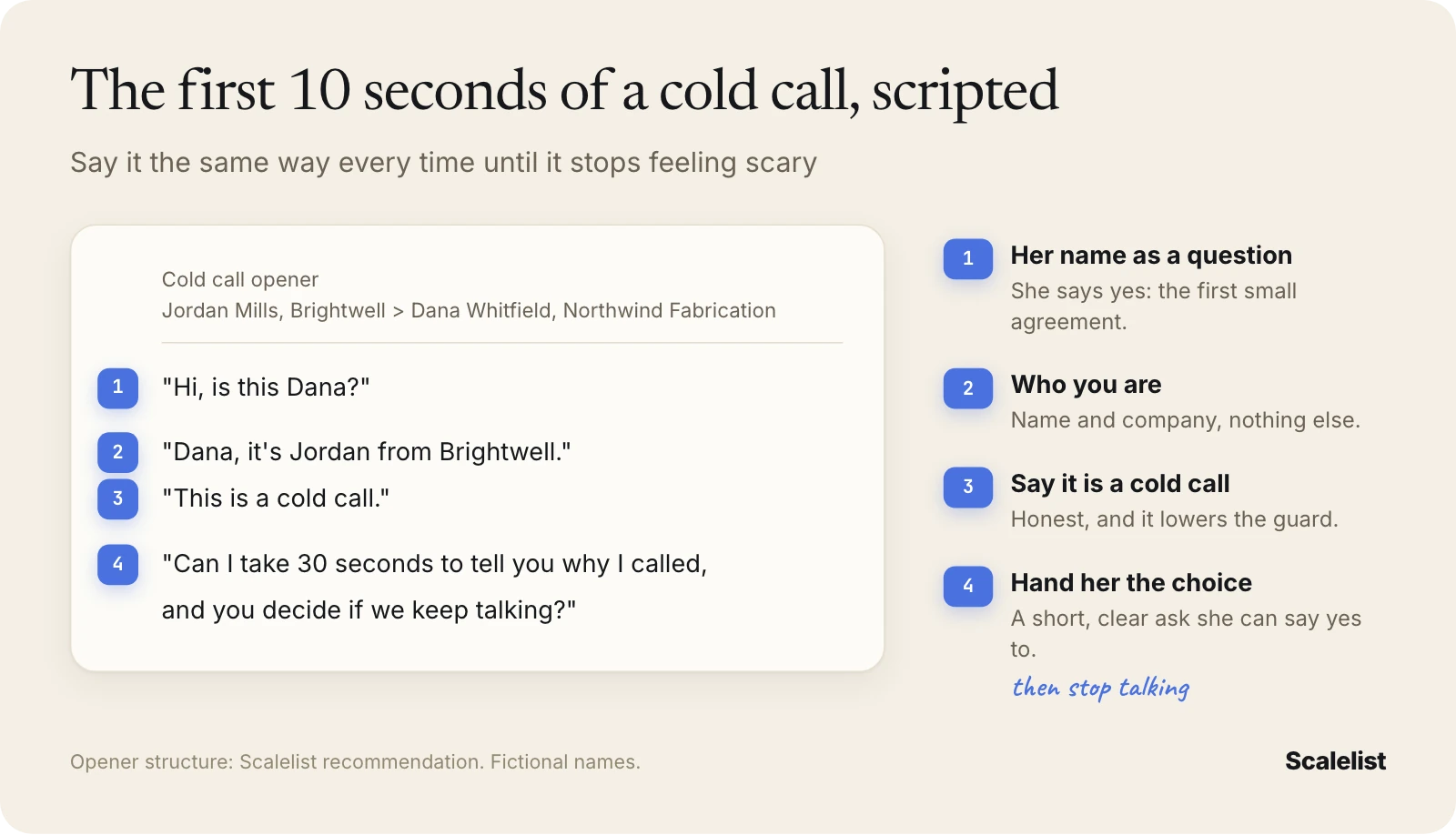
(wait for "Yes")
"Dana, it's Jordan from Brightwell. This is a cold call.
Can I take 30 seconds to tell you why I called,
and you decide if we keep talking?"
5. Count no’s as progress
Track dials and conversations on a sticky note or the dialer’s daily view. Every no moves you closer to the next yes, and the next section shows by how much.
6. Reset after a bad call
After a hang-up, stand up, log the outcome in one line and dial the next number within 60 seconds. The longer the pause, the bigger the next call feels.
How many no’s come before a meeting?
At Gong’s average rates, a rep hears about 21 no’s for every meeting booked from connected calls. The average rep books on 4.6% of connects and the top quartile on 16.7% (Gong, 2024, 300M+ calls). That is about 22 conversations per meeting for the average rep and about 6 for a top rep (our arithmetic).
Counted per dial, the gap is bigger, because most dials never connect.
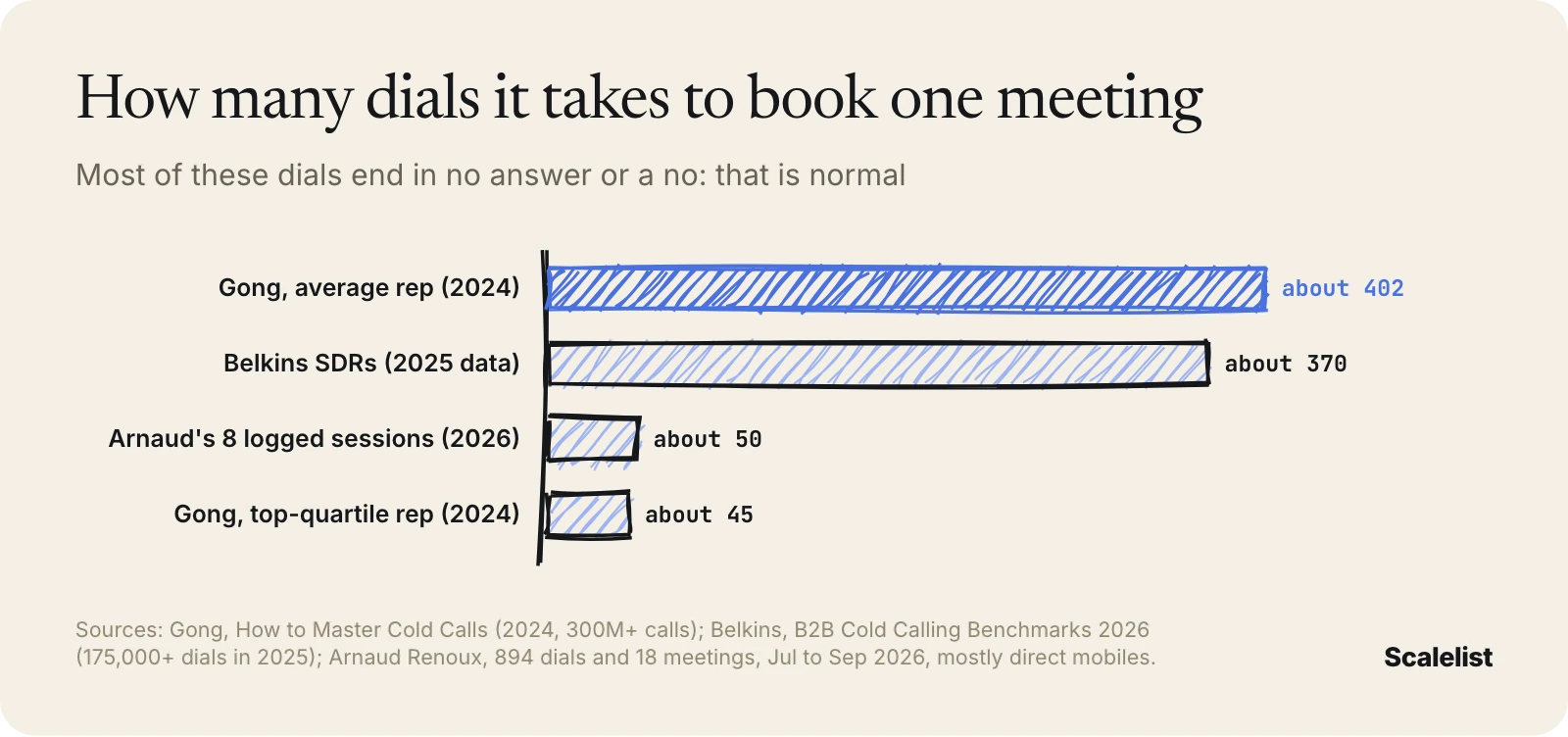
- Gong, average rep: about 402 dials per meeting (Gong guide, 2024).
- Belkins SDRs: about 370 dials per meeting across 175,000+ dials in 2025 (Belkins).
- Gong, top quartile: about 45 dials per meeting.
- My own logged sessions: 894 dials across 8 recorded sessions between July and September 2026, mostly to direct mobiles, booked 18 meetings, about one per 50 dials.
Read those numbers as permission. If a meeting takes 22 conversations, then conversation 9 going badly is normal, not a signal to stop. More benchmarks, with their definitions, are in our cold calling statistics.
How many cold calls per day should you make?
Phone-centric SDR teams average 56 dials and 4.6 quality conversations a day, and the median across all SDR teams is 44 phone activities a day (The Bridge Group, 2025 survey of 351 B2B companies). That is a fair target for a rep whose main job is the phone.
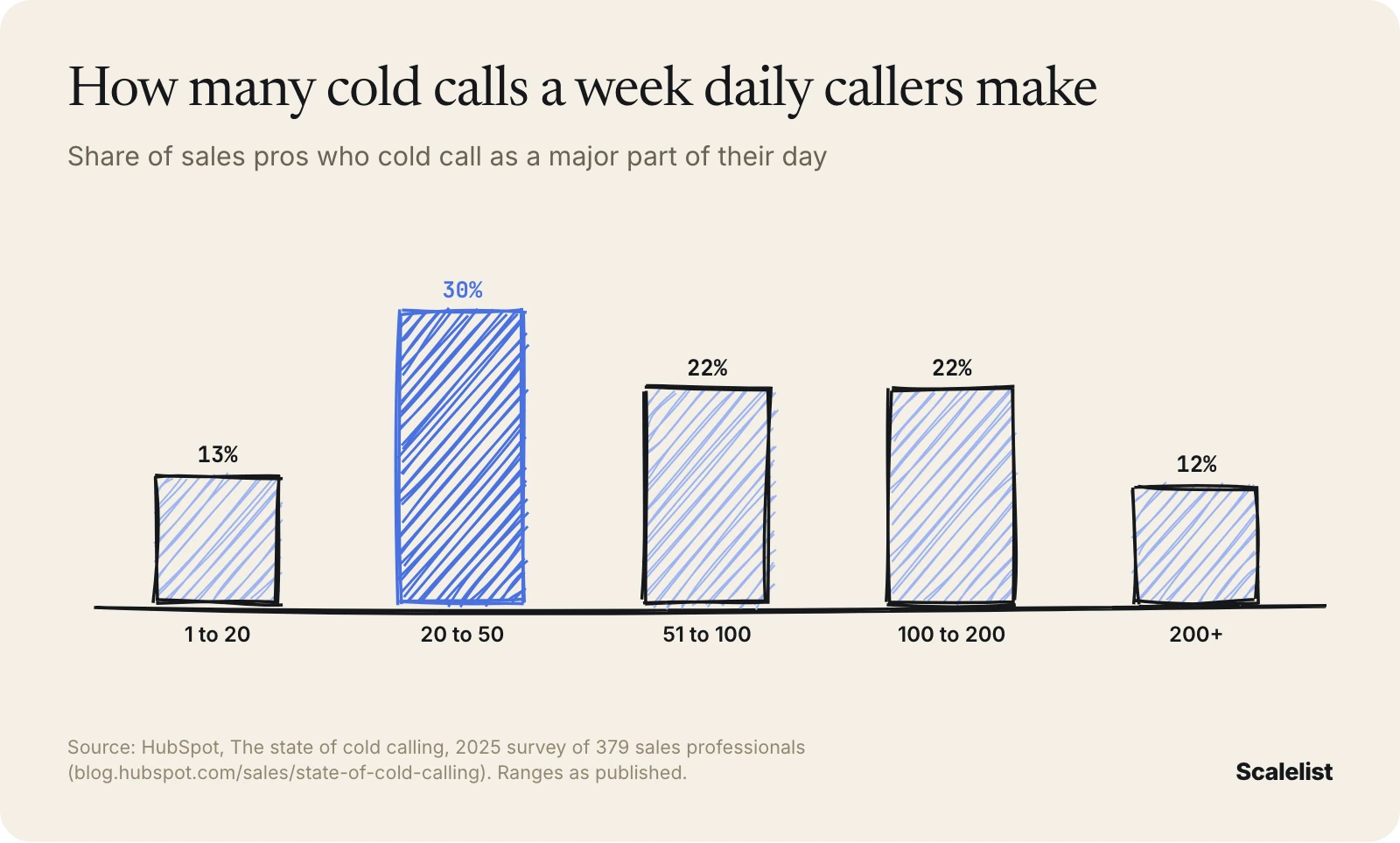
Volume varies a lot. Among sales pros who cold call daily, HubSpot’s 2025 survey found this weekly spread:
| Question | Published answer |
|---|---|
| Dials a day, phone-centric SDR team | 56 (The Bridge Group, 2025) |
| Phone activities a day, all SDR teams (median) | 44 (The Bridge Group, 2025) |
| Dials per hour on a dialer | 30 to 40, Gong’s working assumption (2024) |
| Attempts per prospect | 93% of conversations happen by call 3 (Cognism, 2025 report) |
At 30 to 40 dials an hour, 56 dials is about 1.5 to 2 hours of calling: two focused blocks, not a whole day (our arithmetic). At Gong’s average rate of 402 dials per meeting, that volume books about one meeting every 7 working days; at the top-quartile rate of 45, more than one a day. Skill moves the result more than volume.
What a manager can do about call reluctance
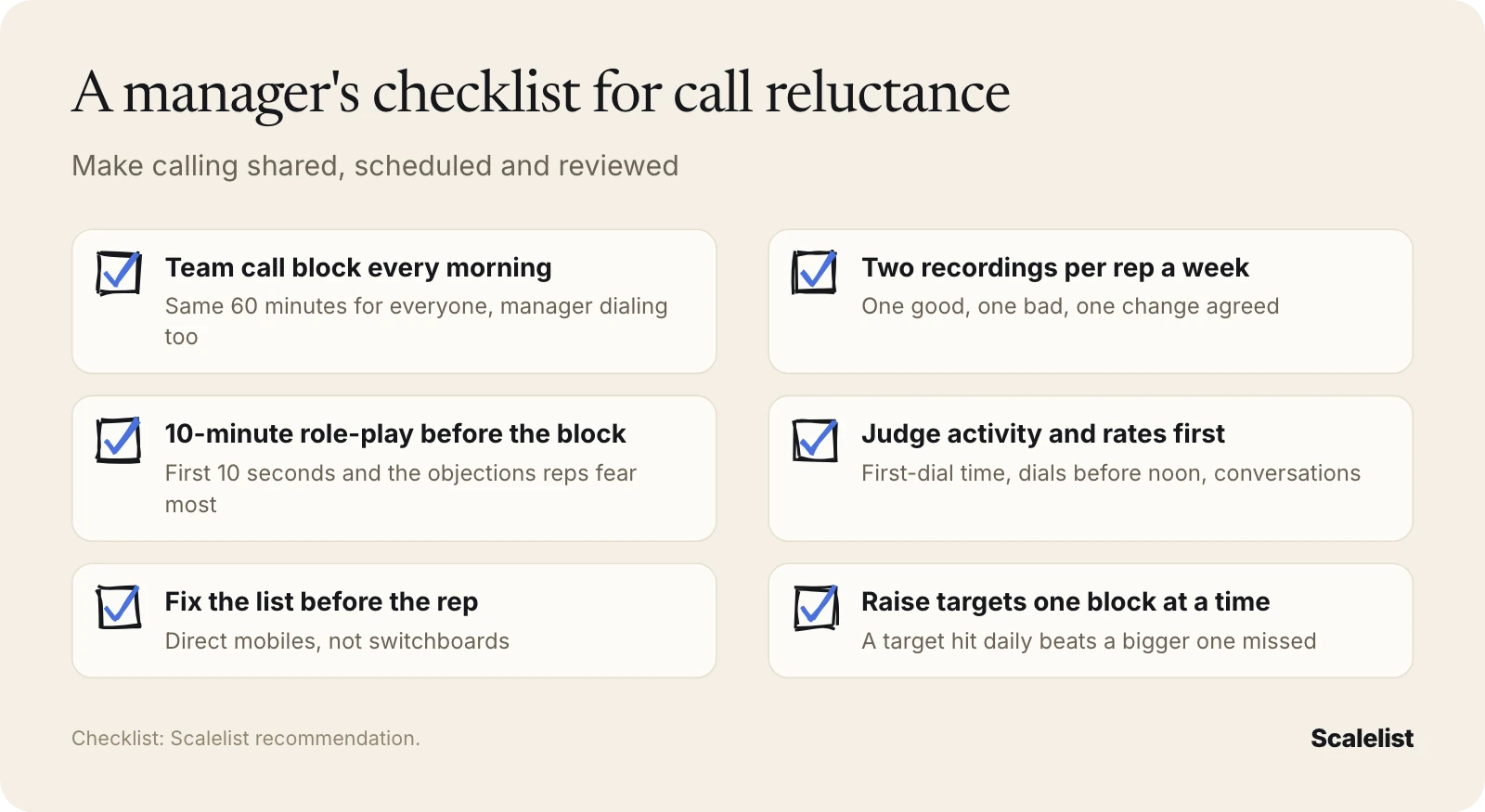
A manager fixes call reluctance by making calling shared, scheduled and reviewed, so no rep faces the phone alone. These four moves work on any team size.
Run call blocks with the team
Book the same 60-minute block for the whole team, every morning, with the manager dialing too. Silence in the room when nobody calls is uncomfortable in a useful way.
Review real calls every week
Play two recordings per rep each week, one good and one bad, and agree on one change. Reluctant reps are often better than they think, and hearing it helps. Our guide to cold call coaching with scorecards has a full review format.
Role-play the first 10 seconds and the top objections
Ten minutes before the block: the manager plays the buyer and fires the objections reps fear most. The answers to practice are in our 40 cold call objections. New reps can follow the full 30-day cold calling training plan.
Judge activity and rates before meetings
In the first weeks, measure first-dial time, dials before noon and conversations, not meetings. Fix the list before blaming the rep: a block of switchboards teaches avoidance.
Calling rules differ by country and number type; we keep them on our B2B cold calling laws page.
If a rep’s anxiety is severe or lasting, beyond normal nerves, point them to a qualified mental health professional.
Common mistakes when fixing call reluctance
Most attempts to fix call reluctance fail because they target motivation instead of the routine. These are the four we see most.
Pep talks instead of a schedule
Motivation fades by Wednesday. A fixed first-dial time and a calendar block do not.
Raising the dial target overnight
Doubling targets for a reluctant rep adds pressure to the exact thing they avoid. Build up one block at a time.
Unlimited research time
“Personalize every call” turns into 35 minutes per prospect. Three facts, then dial.
Treating every no as a lost deal
At 21 no’s per yes on average, each no is part of the path. Show reps the math on day one, and show them why cold calling still works.
For the wider skill set behind these fixes, read our cold calling tips and techniques and the complete guide to B2B cold calling.
How Scalelist helps reps pick up the phone
Scalelist, an AI Lead Finder, removes one of the main causes of call reluctance: a list where the phone does not ring the buyer. You describe the people you want in one plain-English sentence, and Scalelist returns matching people with verified work emails and mobile numbers.
My own block setup is simple: Scalelist AI lead finder pulls the list with direct mobiles, Claude preps every call, Flunter dials and logs everything. New accounts get 100 free credits for 7 days.
Load tomorrow’s call block tonight: 20 prospects with direct mobiles, 10 credits per mobile found, nothing for a miss.
Find your first 20 contactsFAQ
How do you conquer call reluctance?
Replace decisions with a routine. Load tomorrow’s list the night before, make the first dial at the same time every day, call in protected blocks of 45 to 60 minutes, and use a scripted first 10 seconds. Count conversations, not meetings, and remember that an average rep hears about 21 no’s per meeting (Gong, 2024).
Is call reluctance the same as fear of cold calling?
Not exactly. Fear of cold calling is the feeling; call reluctance is the behavior, like a late first dial, long research loops and few dials before lunch. Some reps feel nervous and still dial on time. Managers should work on the behavior, because it is visible in activity data and can be changed with a routine.
Is there a test for call reluctance?
Yes. Behavioral Sciences Research Press offers a trademarked assessment under the name Call Reluctance®. This page is not affiliated with it. For day-to-day coaching, activity data is a simpler first check: first-dial time, dials before noon and conversations per block, compared with the team’s own median.
Is telephobia rare?
Phone anxiety is common in sales, though we found no reliable published figure for how many reps have it. Telephobia is the informal name for fear of making or taking phone calls. Most reps improve with practice, scripts and shared call blocks; if the anxiety is severe or lasting, a qualified professional can help.
What is the 3-3-3 rule in sales?
There is no single standard definition. Sales trainers use the name for different routines, and most describe a follow-up cadence of three touches, such as three calls, three emails and three other touches over a few weeks. Check which version your team means before adopting it.
How many cold calls per day should an SDR make?
About 56 dials a day is the average on phone-centric SDR teams, and 44 phone activities is the median across all SDR teams (The Bridge Group, 2025). At 30 to 40 dials an hour, that is about two focused blocks. A reluctant rep should start at 20 dials before 10 AM and add a block each week.
How many no’s does it take to get a yes on a cold call?
About 21 no’s per meeting for an average rep, counting connected calls, because 4.6% of connects book a meeting (Gong, 2024). Top-quartile reps book on 16.7% of connects, about 5 no’s per yes. Counted per dial, an average rep needs about 402 dials per meeting, and a top rep about 45.
Sources
- HubSpot: The state of cold calling (2025 survey of 379 sales professionals)
- Gong: The hidden power of cold calling, insights from 300M calls (2024)
- Gong: How to Master Cold Calls (PDF, 2024)
- Belkins: B2B Cold Calling Benchmarks 2026 (2025 data)
- The Bridge Group: SDR Models, Motions and Metrics, 2025 Research Report
- Cognism: The State of Cold Calling in 2025 (WHAM data)
- Nooks Insights: Here’s who picks up the most (2025)
- Behavioral Sciences Research Press: Call Reluctance® assessment site