


Call coaching for a cold calling team works as a weekly routine: pick 3 or 4 conversations per rep, score them on one scorecard, give one fix with the exact words to say, and let AI check that fix on the calls in between. Run that way, it costs a manager about 30 minutes per rep per week.
Below: which calls to review, a time-boxed review, a cold call scorecard template, feedback reps act on, and a sample prompt for daily AI reviews of call transcripts, with the limits of AI feedback.
What is call coaching?
Call coaching is the practice of reviewing a rep’s recorded calls, scoring them against a shared standard and agreeing on specific changes for the next calls. In sales, it focuses on the moments that decide whether a call earns a next step: the opener, the reason for calling, the first objection, the questions and the ask.
Contact-center coaching targets service quality. Sales call coaching for an outbound team targets more meetings per conversation. The average rep books a meeting on 4.6% of connected calls and the top quartile on 16.7% (Gong, 2024). That gap is what call coaching works on.
How to run call coaching every week
Run call coaching as a fixed weekly rhythm: pick calls on Monday, review with AI after every block, hold a 30-minute 1:1 midweek, rehearse the fix, and check rates on Friday. It sits inside the routine in our complete guide to B2B cold calling.
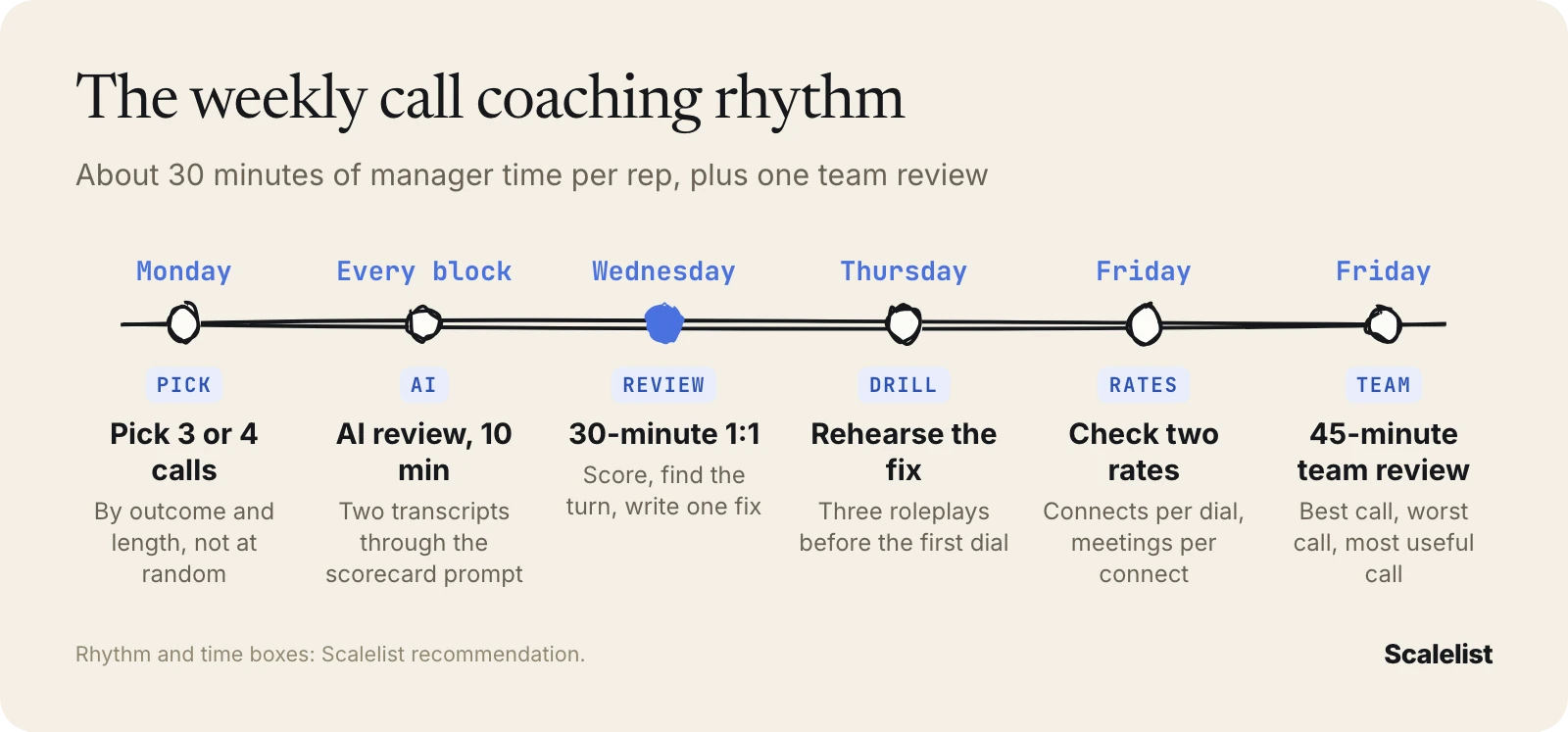
For a manager with six SDRs, that is about 3 hours 45 minutes a week: six 30-minute reviews plus a 45-minute team session (our arithmetic).
1. Pick which calls to review
Review conversations, not dials, and pick them by outcome so each call teaches something different. SDRs on phone-centric teams average 56 dials and 4.6 quality conversations a day (The Bridge Group, 2025), so a rep has about 23 conversations a week to choose from.
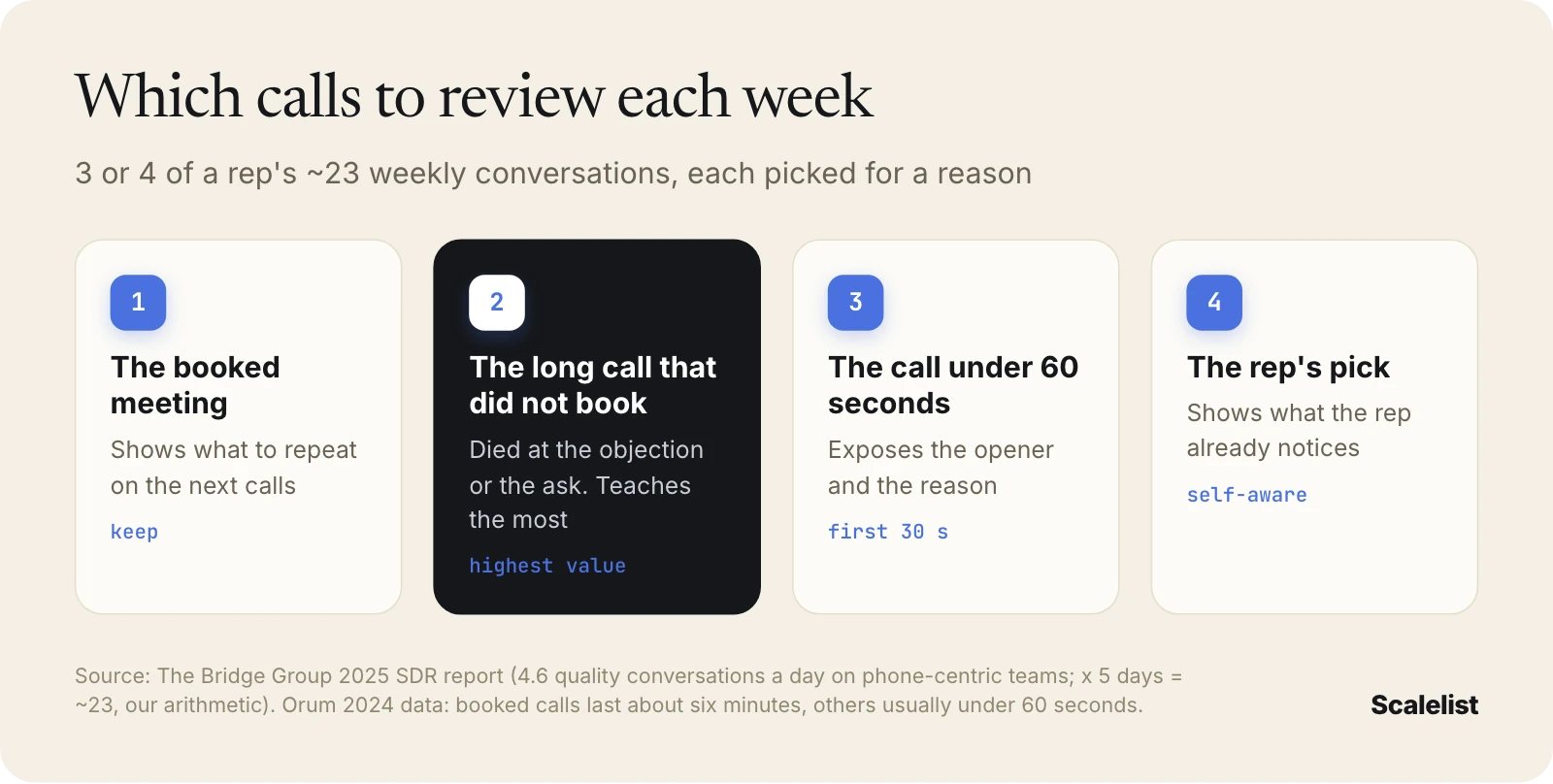
- The booked meeting: what to repeat.
- The long call that did not book: it died at the objection or the ask, and usually teaches the most.
- The call under a minute: calls that book last about six minutes on average, while the rest usually end in under 60 seconds (Orum, 2024 data). Short calls expose the opener and the reason.
- The rep’s pick: it shows what the rep already notices.
Sort the dialer’s call log by outcome and duration to find them. Skip voicemails and wrong numbers: those are list problems.
2. Review each call in a 30-minute 1:1
A call review works when it has a fixed agenda and ends with one change, not a list of ten. Use the same five time boxes every week.
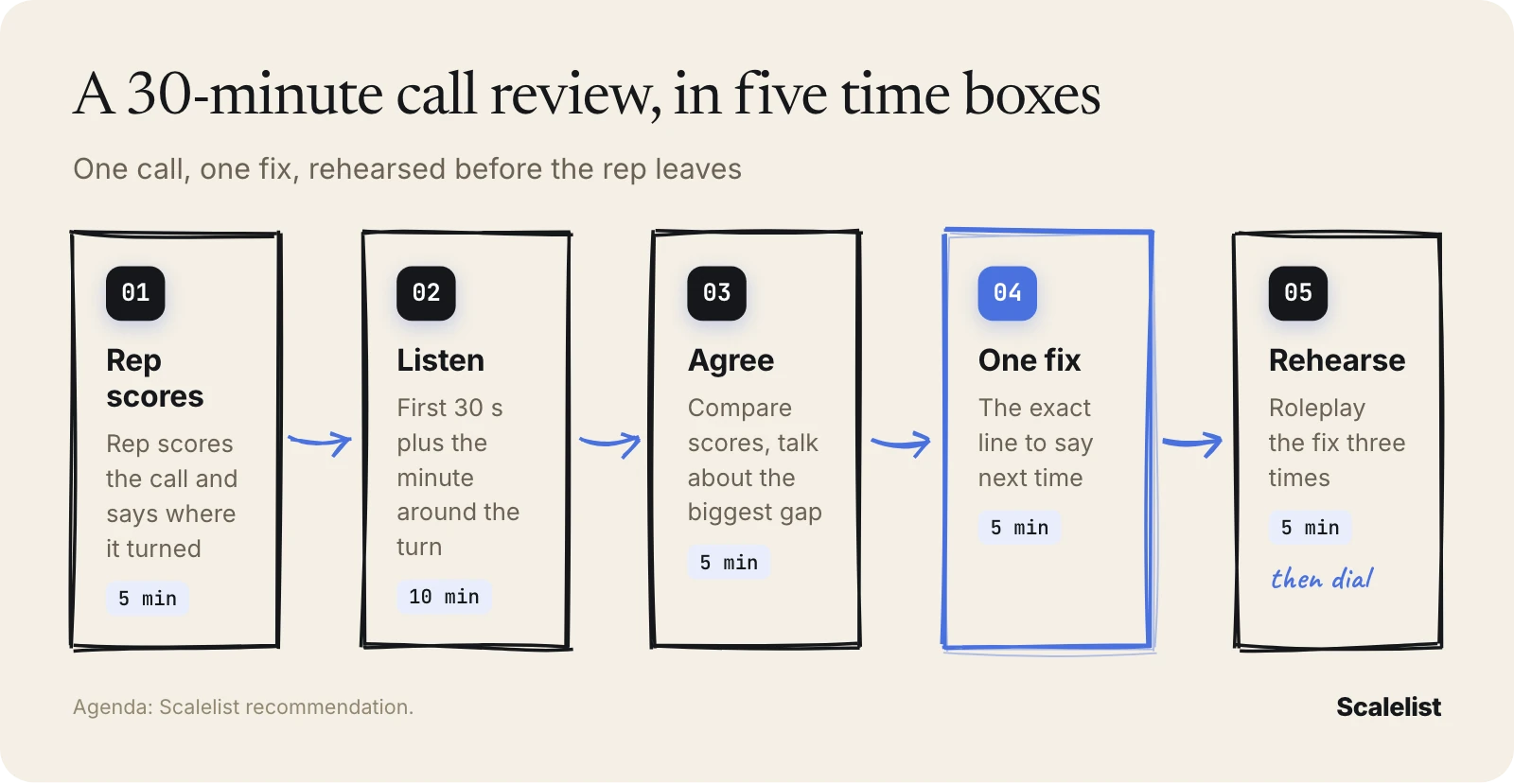
The rep scores the call before the meeting. You listen only to the first 30 seconds and the minute around the moment the call turned, never the whole call. Then agree the score, write one fix as an exact line, and roleplay it three times with you playing the buyer.
3. Score the call on one scorecard
Use the same scorecard on every call, for every rep, so an 11 means the same thing in March as in May. The template is in the next section.
4. Give feedback the rep can act on
Feedback a rep can act on names one moment of the call, what it cost, and the exact words to use instead. “Be more confident” gives the rep nothing to say on the next dial.
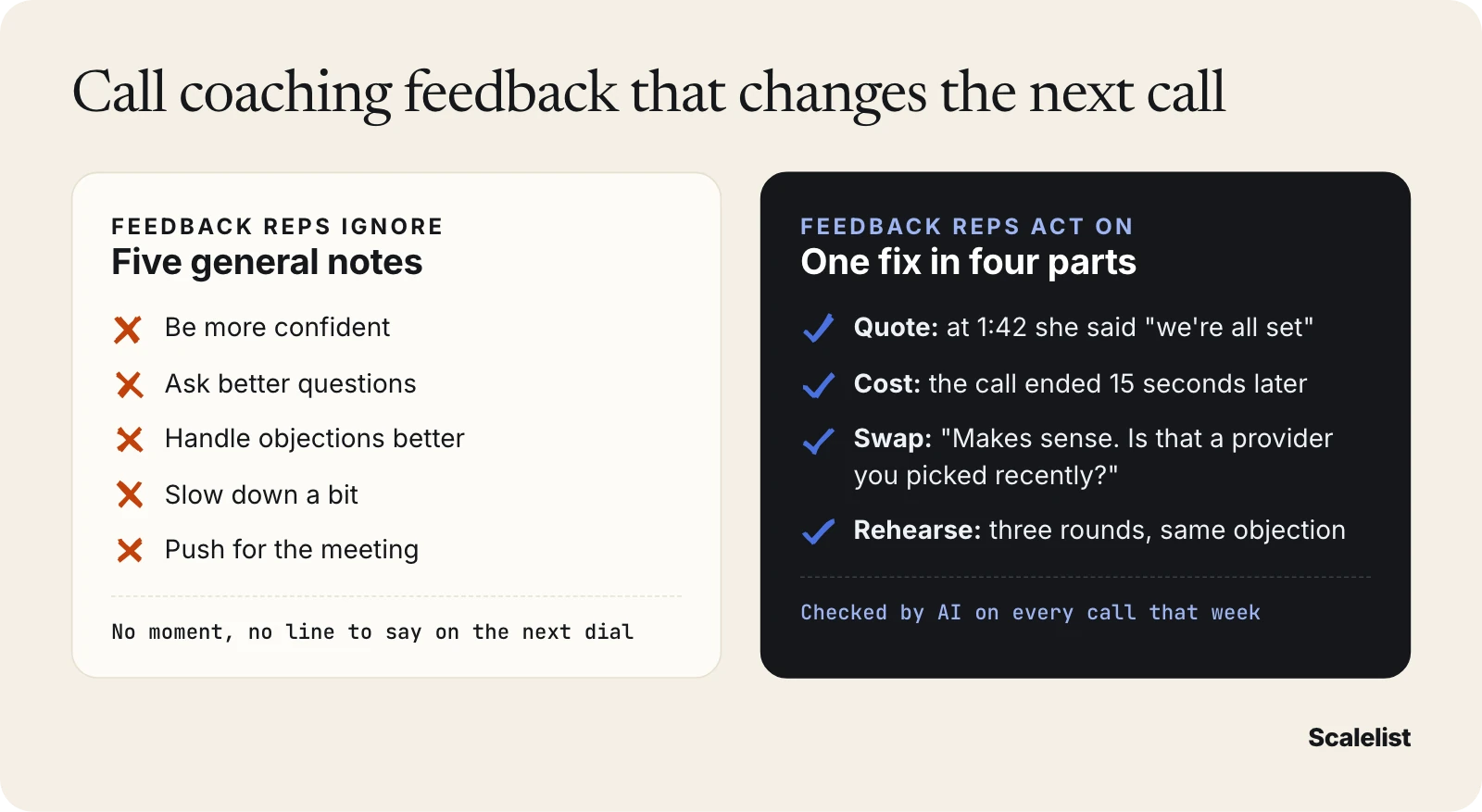
Use four parts, in this order:
- Quote. “At 1:42 she said ‘we’re all set’ and you said ‘no problem, I’ll send an email.'”
- Cost. “The call ended 15 seconds later, before you asked one question.”
- Swap. “Next time: ‘Makes sense. Is that a provider you picked recently, or one you’ve had for years?'”
- Rehearse. Three rounds now, same objection.
Give one fix a week, because a rep who gets five notes changes none of them. Replacement lines for the most common brush-offs are in our guide to sales objection handling: 40 objections.
5. Close the loop daily with AI
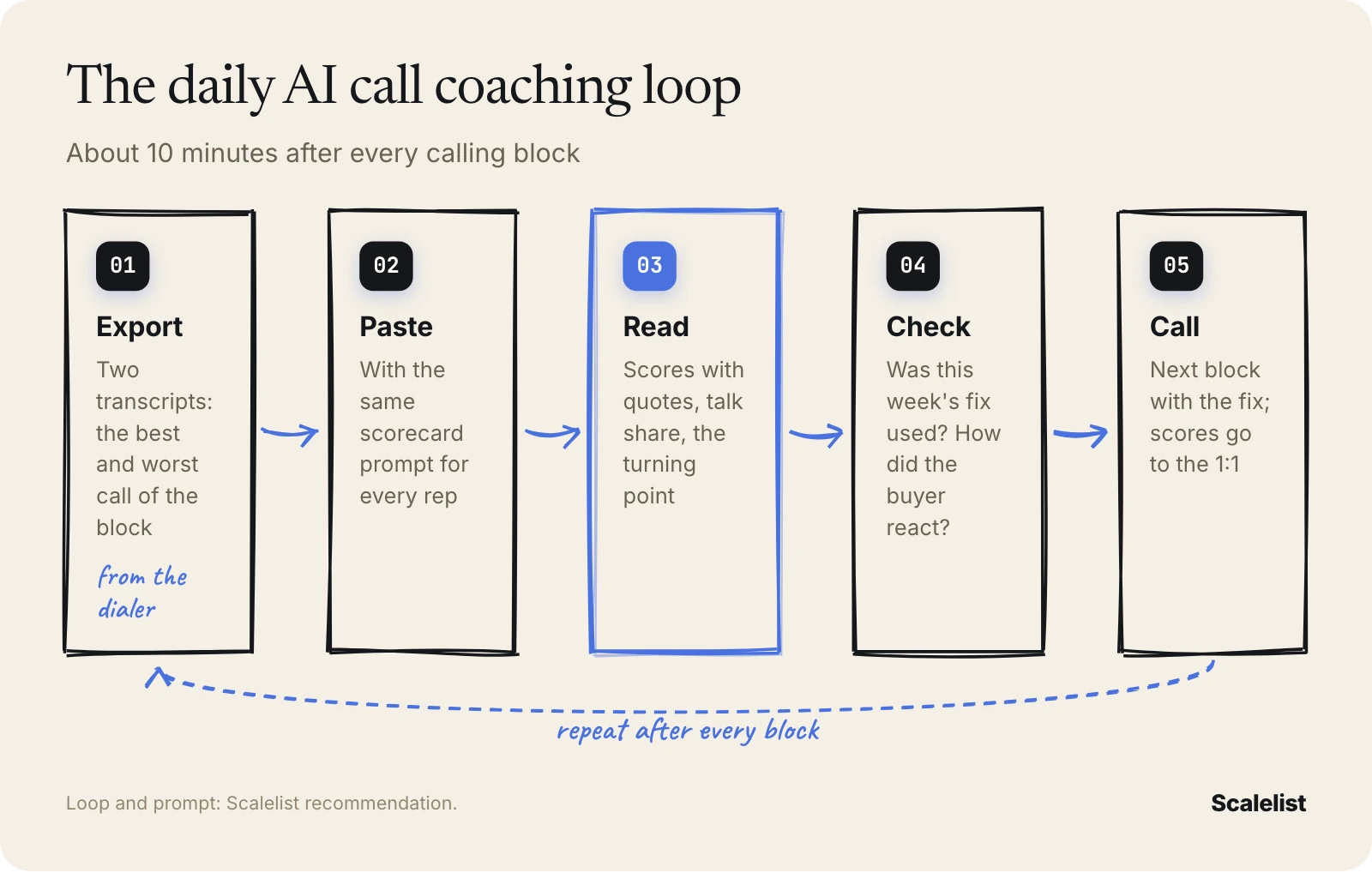
After each calling block, the rep runs two transcripts through an AI assistant with the scorecard prompt below and checks one thing: did this week’s fix happen? About 10 minutes.
6. Check the rates on Friday
On Friday, look at two rates per rep: connects per dial and meetings per connect. A low connect rate is a list, number type or timing problem; benchmarks are in cold call connect rates by number type. A low meeting rate is a skill problem, and that is what the scorecard works on.
Judge reps on scores and rates, not one week of meetings. My own 894 logged dials across 8 sessions (July to September 2026, mostly Australian tech prospects on mobiles) booked 18 meetings, about one per 50 dials. Then close the week with a 45-minute team review of the best, worst and most useful calls.
Cold call scorecard template
A cold call scorecard lists the stages of a call, what good sounds like at each one and a simple score, so the rep and the manager judge a call against the same standard. It is the same 8-stage scorecard as in our 30-day cold calling training plan.
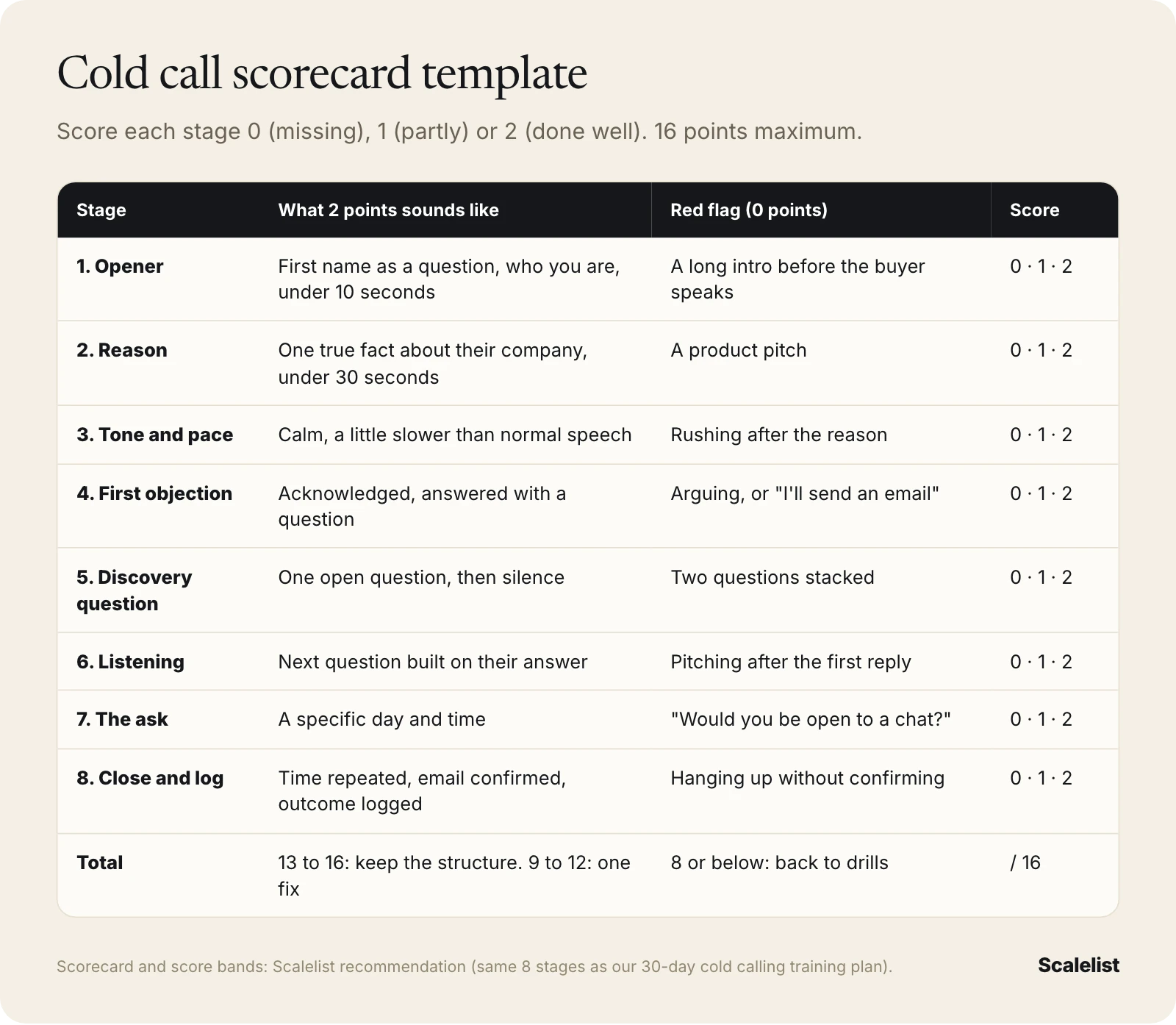
Score each stage 0, 1 or 2, for 16 points. If the buyer hung up before a stage, mark it n/a: a call that ended after the first objection is scored out of 8. Our recommended bands:
- 13 to 16. The structure works. Coach volume, timing and harder objections.
- 9 to 12. Pick the lowest stage and make it this week’s one fix.
- 8 or below. Back to daily drills on the opener and reason, using cold call opening lines.
Copy this into a doc or sheet, one per reviewed call.
Outcome: Meeting / Follow-up / Not interested / Hung up
Score: 0 = missing, 1 = partly, 2 = done well, n/a = not reached
1. Opener (first 10 seconds) ……………. __
2. Reason for the call (under 30 seconds) … __
3. Tone and pace ………………………. __
4. First objection ……………………… __ Their words: "________"
5. Discovery question …………………… __
6. Listening (next question uses the answer) __
7. The ask (a specific day and time) …….. __
8. Close and log ……………………….. __
Total: __ out of __ points possible
Where the call turned (timestamp and what was said): ________
One fix for next week (the exact line): ________
Rep score: __ Manager score: __ Gap: __
The gap between the two scores shows what the rep cannot hear yet. For stage 5, see sales discovery questions for a cold call.
AI sales coaching: a daily loop on call transcripts
AI sales coaching on cold calls means pasting a call transcript into an AI assistant with your scorecard and asking it to score the call, quote the moments that decided it and suggest one fix. The rep gets feedback the same day instead of at the next 1:1.
99% of BDRs report using AI in 2026, but the most common use, content generation, is not linked to better performance (6sense, 2026). Call reviews point the tool at the skill itself.
Rules on recording calls exist and differ by state and country, so check B2B cold calling laws before you turn recording on, and your company’s policy before pasting transcripts into an AI tool.
What to ask the AI to look for
- Talk share. The rep’s rough share of words spoken. On successful cold calls, reps talked about 55% of the time in Gong’s research (Gong, first published 2018). A rep at 80% is pitching, not asking.
- Questions. Every question asked, and whether the next one used the buyer’s answer.
- Objection and ask. The buyer’s exact objection, the reply, and whether a specific time was offered.
- The turning point and the fix. The line where the call turned, and whether this week’s line was used.
Sample AI call coaching prompt
Paste this into Claude, ChatGPT or any AI assistant and fill the brackets once.
I sell [product] to [job title] at [type of company]. The goal of the call
is a [15]-minute meeting.
Score the call on this scorecard. For each stage give 0 (missing),
1 (partly), 2 (done well) or n/a (the call never reached it), and quote
the rep's exact words as evidence:
1. Opener 2. Reason for the call 3. Tone and pace 4. First objection
5. Discovery question 6. Listening 7. The ask 8. Close and log
Then:
– Estimate the rep's share of the words spoken and list their questions.
– Name the moment where the call turned, with the timestamp.
– Check whether the rep used this week's fix: "[paste the line]".
– Give ONE fix: the exact line to say next time.
Quote only what is in the transcript. If you cannot judge a stage from
text (tone, pace), write "cannot tell from transcript". Under 250 words.
Transcript:
[paste the transcript]
The limits of AI feedback
AI feedback on a transcript is good enough for a daily check, but it misses things a manager hears in seconds.
- It cannot hear the call. Tone, pace and pauses do not survive a transcript.
- Transcripts make mistakes. Swapped speaker labels wreck the talk share and the quotes.
- It only knows what you tell it. Your buyer, offer and fix must be in the prompt.
- It always finds a fix, even on a strong call. Check it against the outcome.
- Scores drift between runs. Compare trends over weeks, not single scores.
- It cannot spot a list problem. A wrong person or a switchboard reads like a bad call.
So the manager still listens to at least one call per rep per week.
Example: one week of call coaching for an SDR
A fictional example: Jordan Ellis, an SDR at Keelson Payroll, calls HR directors at Ohio manufacturers with 200 to 1,000 employees.
| Day | What happens | Output |
|---|---|---|
| Monday | Manager picks 3 of Jordan’s 21 conversations: one booked, a 4-minute call that did not book, a 40-second call | 3 calls to review |
| Every block | Jordan runs two transcripts through the prompt | AI flags no specific ask on 3 of 4 long calls |
| Wednesday | Review of the call with Karen Mitchell, HR Director at Lakeview Plastics, Akron. Jordan scores it 11, the manager 9 | Turn at 2:05: “we switched providers last year”, and Jordan pitches |
| Wednesday | Fix: “Makes sense. What made you switch?” Rehearsed three times | One line for next week |
| Friday | Team review plays the Karen call; rates checked | The fix carries into next week’s AI checks |
If the line gets used and those calls get longer, the next lowest stage becomes the focus.
Sales coaching beyond the call review
Sales coaching is broader than call reviews: it covers how a rep plans the day, prepares each call, handles rejection and grows in the role. For SDR coaching, keep four things in view.
- Preparation. One true fact about the company lifts the reason score. Teach 60-second pre-call planning.
- Volume. A rep who dials 20 times when the plan says 50 needs a different talk. Start with why reps avoid the phone.
- The list. Reps cannot practice conversations on numbers that reach a switchboard.
- The window. The average SDR ramps in 3.0 months and stays 1.9 years in the role (The Bridge Group, 2025), so coach weekly.
In every 1:1, let the rep do most of the talking. A common coaching rule of thumb, often called the 70/30 rule, has the rep talk about 70% of the time and the coach about 30%. If you are unsure who owns this work in your team, see SDR manager vs SDR team lead.
Common call coaching challenges
Most call coaching programs stall for one of four reasons, and each has a simple fix.
Only booked calls get reviewed
Booked calls feel good to review, but they teach the least. Always include the long call that did not book: that is where the next meeting is hiding.
The rep argues with the score
Let the rep score first, then point to the quote in the transcript. Arguing about a number goes nowhere; a quote ends the debate.
Coaching the rep when the list is the problem
If a rep reaches switchboards and wrong people all day, no scorecard fixes it. Mobile numbers connect 45% more often than other numbers (Nooks, 2025), so fix the list before you coach the rep. Scalelist helps here: it returns verified mobile numbers for the people you describe.
No time to review calls
Cap every review at 30 minutes, listen to turning points only, and let the AI loop cover the daily checks. Coach within 48 hours, while the rep still remembers the call.
What to look for in a call coaching tool
The routine matters more than the tool, but you need recording and transcription on every call, a call log you can sort by outcome and duration, scorecards you can edit, and transcript export so reps can run your AI prompt. Here is what several tools publish, as of September 2026:
| Tool | What it is | Coaching features (as published) | Price |
|---|---|---|---|
| Gong | Revenue AI platform that records and analyzes calls | Conversation intelligence and coaching | Not published: per-user license plus a platform fee |
| Orum | Parallel and power dialer | Call recordings included; AI Coaching add-on with roleplay, scorecards and a coaching portal | Not published; 9-seat minimum |
| Nooks | Parallel dialer platform | AI Coaching module with automatic recording, transcription and a call library | Not published |
| Dialpad Sell | Power dialer and business phone | Recording and transcription on Essentials; AI Scorecards on Premium | 39 to 150 USD per user per month, billed annually |
| JustCall | Cloud phone and dialer | Unlimited AI transcription; AI call scoring on Pro Plus | 29 to 89 USD per user per month, billed annually; 2-license minimum |
| Claude | AI assistant | Scores pasted transcripts with your own prompt | Pro 20 USD per month (17 billed annually) |
| ChatGPT | AI assistant | Scores pasted transcripts with your own prompt | Plus 20 USD per month |
More dialers are compared in our cold calling software guide.
How Scalelist helps call coaching
Scalelist, an AI Lead Finder, makes sure the calls you coach are real conversations with the right buyer, so coaching time goes into skill instead of wrong numbers. You describe the people you want in one plain-English sentence, such as “HR directors at Ohio manufacturers with 200 to 1,000 employees”, and Scalelist returns matching people with verified work emails and mobile numbers.
Sizing a search is free in the Scalelist Lead Finder, and new accounts get 100 free credits for 7 days. Have the names already? Add mobiles with the Mobile Finder. Reviewing transcripts in Claude? The Scalelist MCP server builds the next call list in the same chat.
My own setup: Scalelist AI lead finder pulls the list with direct mobiles, Claude preps every call, Flunter dials and logs everything.
Give your reps a call list where the phone rings the buyer: 10 credits per mobile found, nothing for a miss.
Describe your buyer in one sentenceFAQ
What does call coaching mean?
Call coaching means reviewing a rep’s recorded calls, scoring them against a shared scorecard and agreeing on specific changes for the next calls. In sales, it focuses on the opener, the reason, the first objection, the questions and the ask. In contact centers the term covers service quality rather than meetings booked.
What is the 70/30 rule in coaching?
The 70/30 rule is a coaching rule of thumb: the person being coached talks about 70% of the time and the coach about 30%. In a call review, the rep scores the call and explains where it turned before the manager speaks. It is a guideline, not a measured benchmark; some sales trainers apply it to the prospect’s share of a sales call.
How many calls should a manager review per rep each week?
Three or four conversations per rep per week: one booked call, one long call that did not book, one that ended in under a minute, and the rep’s own pick. AI reviews of two transcripts per calling block cover the rest. More calls rarely help when the rep works on one fix a week.
What should a call scorecard include?
A call scorecard should list the stages of the call (opener, reason, tone, first objection, discovery question, listening, the ask, close and log), what good sounds like at each, and a simple score such as 0 to 2 per stage, 16 in total. Add the moment the call turned, one fix and both the rep’s and manager’s scores.
Can AI replace a sales coach?
No. AI is useful for daily checks on call transcripts: it quotes the rep’s words and flags whether this week’s fix was used. But it cannot hear tone or pace, knows your buyer only if told, and cannot tell a list problem from a skill problem. Use AI sales coaching between 1:1s and keep a manager listening every week.
What is SDR coaching?
SDR coaching is coaching built for sales development reps, who make many short first calls and book meetings for account executives. It focuses on the opener, objections, the ask, calling volume and preparation, with small weekly fixes. With a 3.0-month ramp and 1.9 years in the role on average (The Bridge Group, 2025), it needs a weekly rhythm.
How long should a call coaching session be?
About 30 minutes per rep per week: 5 minutes of rep self-scoring, 10 listening to the turning points, 5 agreeing the score, 5 writing one fix and 5 rehearsing it. Add a 45-minute team review on Friday for the best, worst and most useful calls.
Sources
- Gong: The hidden power of cold calling, insights from 300M calls (2024)
- Gong: 9 Secret Elements of Highly Effective Cold Calls (PDF, 2022; research first published 2018)
- Orum: Half a million meetings booked through Orum in 2024
- The Bridge Group: SDR Models, Motions and Metrics, 2025 Research Report
- 6sense: 2026 State of BDR Report, press release
- 6sense: State of the BDR 2026, deep dive
- Nooks Insights: Here’s who picks up the most (2025)
- Gong pricing
- Orum pricing
- Nooks pricing
- Dialpad pricing
- JustCall pricing
- Claude pricing
- OpenAI Help Center: What is ChatGPT Plus?


