An outsourced SDR beats an in-house hire on cost only if the agency delivers enough held meetings to undercut what your own rep costs per meeting. With 2025 and 2026 benchmark inputs, one in-house SDR costs about 144,600 USD in year one and about 1,380 USD per held meeting at full quota.
Most pages that rank for this question are written by agencies that sell SDR outsourcing. This one is the buyer’s math: every input is sourced or labeled as an example you replace with your own, so you can redo it with your own numbers and a real agency quote.
Is an outsourced SDR cheaper than hiring in-house?
An outsourced SDR is cheaper than an in-house hire only when the agency’s total cost per held meeting is lower than yours. For one in-house SDR at the median quota, that bar is about 1,380 USD per held meeting in year one and about 1,160 USD in year two, before attrition.
The answer moves with output. If your rep reaches 60% of quota, in-house cost rises to about 2,080 USD per held meeting in year one. If the agency delivers 5 held meetings a month on a 6,000 USD retainer, its cost rises too. So the real question is not “agency or hire”, it is “who delivers more held meetings per dollar for my market”.
What one in-house SDR really costs
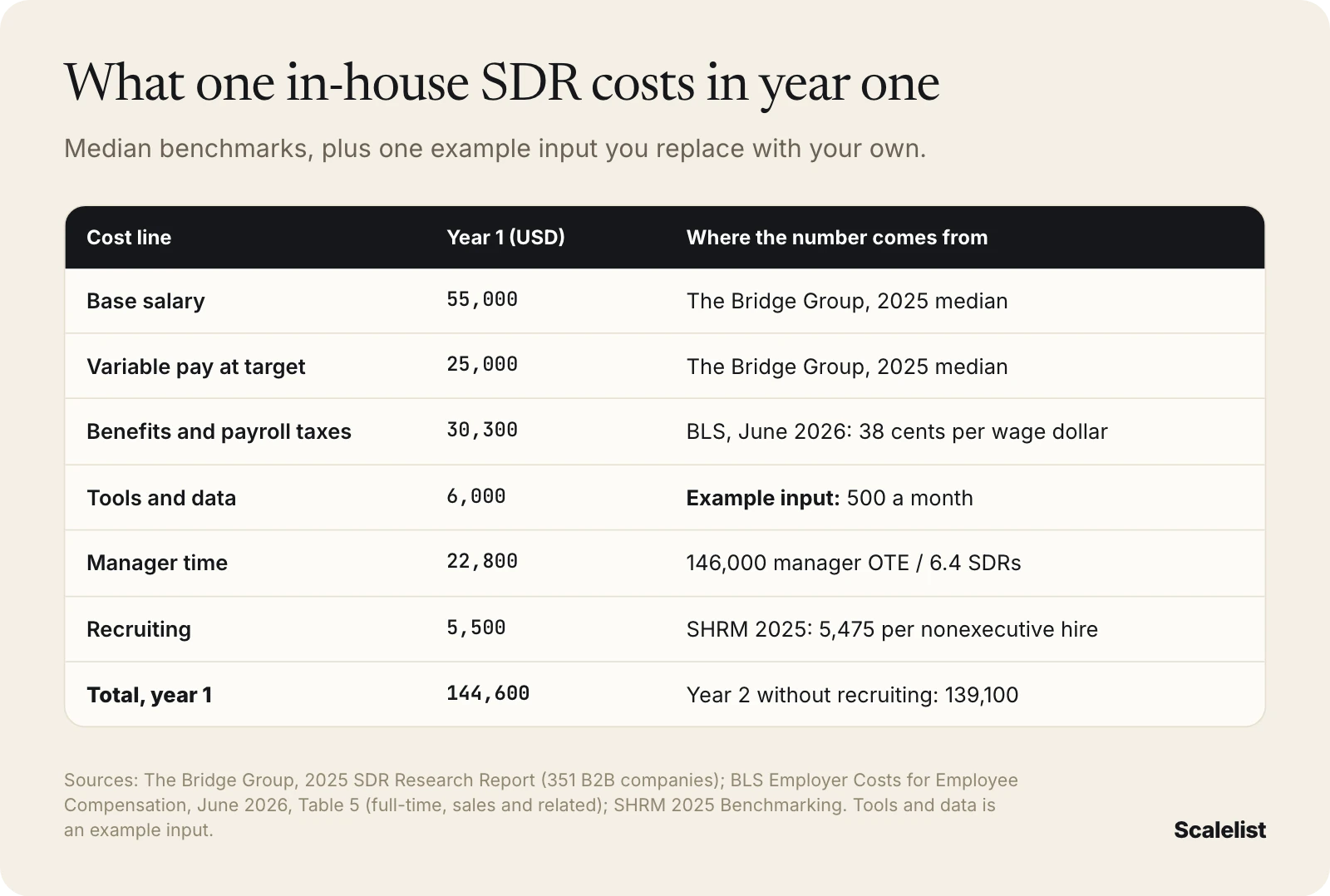
The full cost of one in-house SDR has six lines, and only two of them are on the offer letter. The table uses the median figures from The Bridge Group’s 2025 survey of 351 B2B companies, plus BLS and SHRM data for overhead.
Base and variable pay
Median SDR on-target earnings are 80,000 USD: 55,000 USD base and 25,000 USD variable (The Bridge Group, 2025). Our SDR compensation guide explains how the variable part is tied to meetings.
Benefits and payroll taxes
For full-time private-industry workers in sales occupations, benefits were 27.5% of total compensation in June 2026 (BLS). That is about 38 cents on top of every wage dollar, or about 30,300 USD on 80,000 USD of pay. We apply the ratio to the whole on-target figure, which is a simplification.
Tools and data
A dialer, a sequencer, a CRM seat and contact data with direct mobiles. We use 500 USD a month as an example input: replace it with your own invoices.
Manager time
SDR managers earn a median 146,000 USD on-target and lead 6.4 SDRs on average (The Bridge Group, 2025). One rep’s share is about 22,800 USD a year, before the manager’s own benefits.
Recruiting
SHRM’s 2025 benchmarking survey puts the average cost per hire for nonexecutive roles at 5,475 USD. If you use an external recruiter, replace it with their fee.
How long before an in-house SDR books meetings?
An in-house SDR takes about four months from the day you open the role to a full month of quota. Hiring takes a median 39 calendar days for nonexecutive roles (SHRM, 2026), and a new SDR then ramps for an average of 3.0 months (The Bridge Group, 2025).
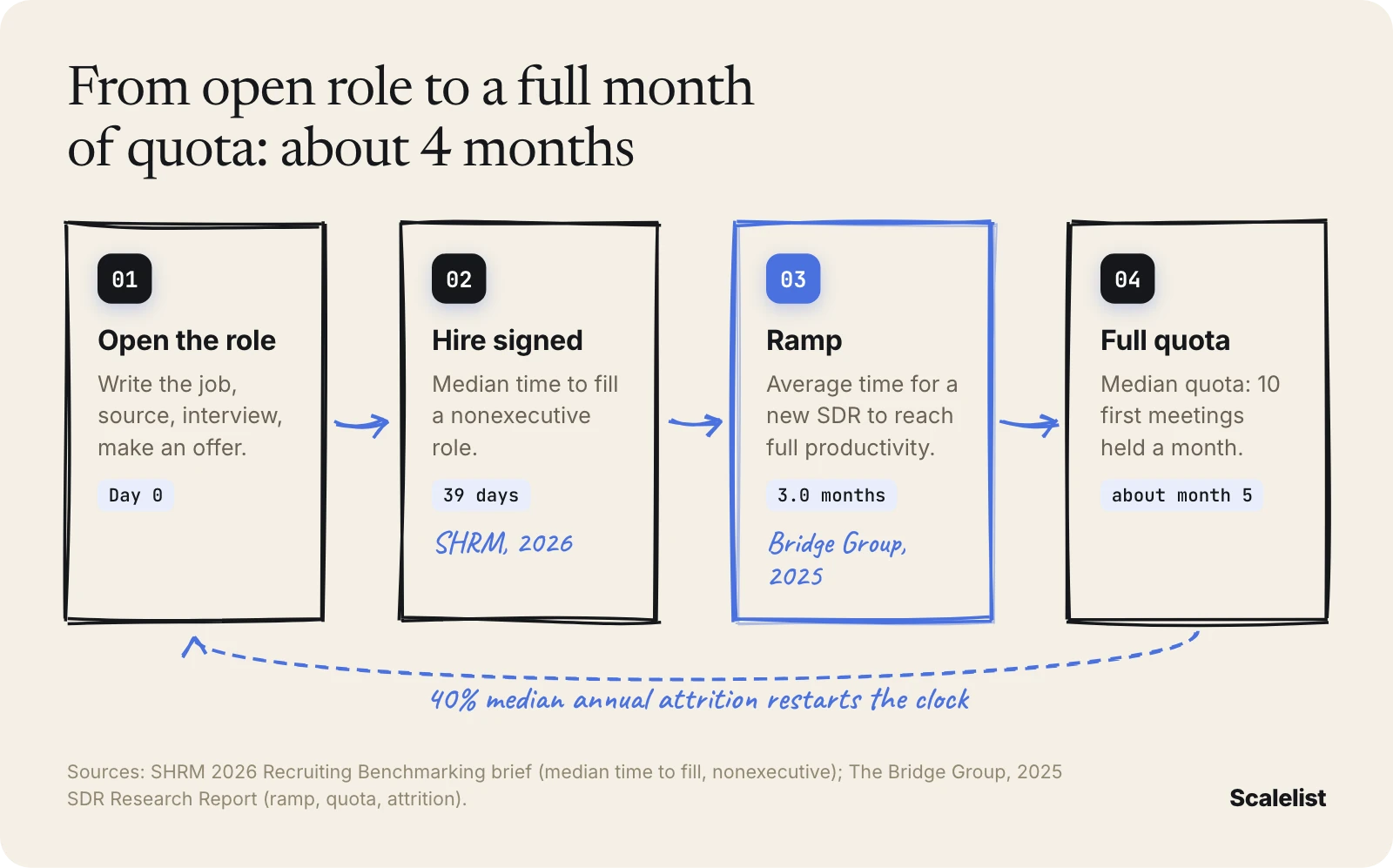
The ramp is where most of the year-one gap comes from. In our model the rep books half of quota during the three ramp months, an example assumption, then full quota for nine months: 105 held meetings in year one. A 30-day cold calling training plan shortens the ramp only if a manager runs it.
Then there is attrition. Median annual SDR attrition was 40% in 2024, of which 16 points were promotions (The Bridge Group). On a team of five, plan for two replacements a year, each with a new hiring cycle and a new ramp.
In-house SDR cost per held meeting
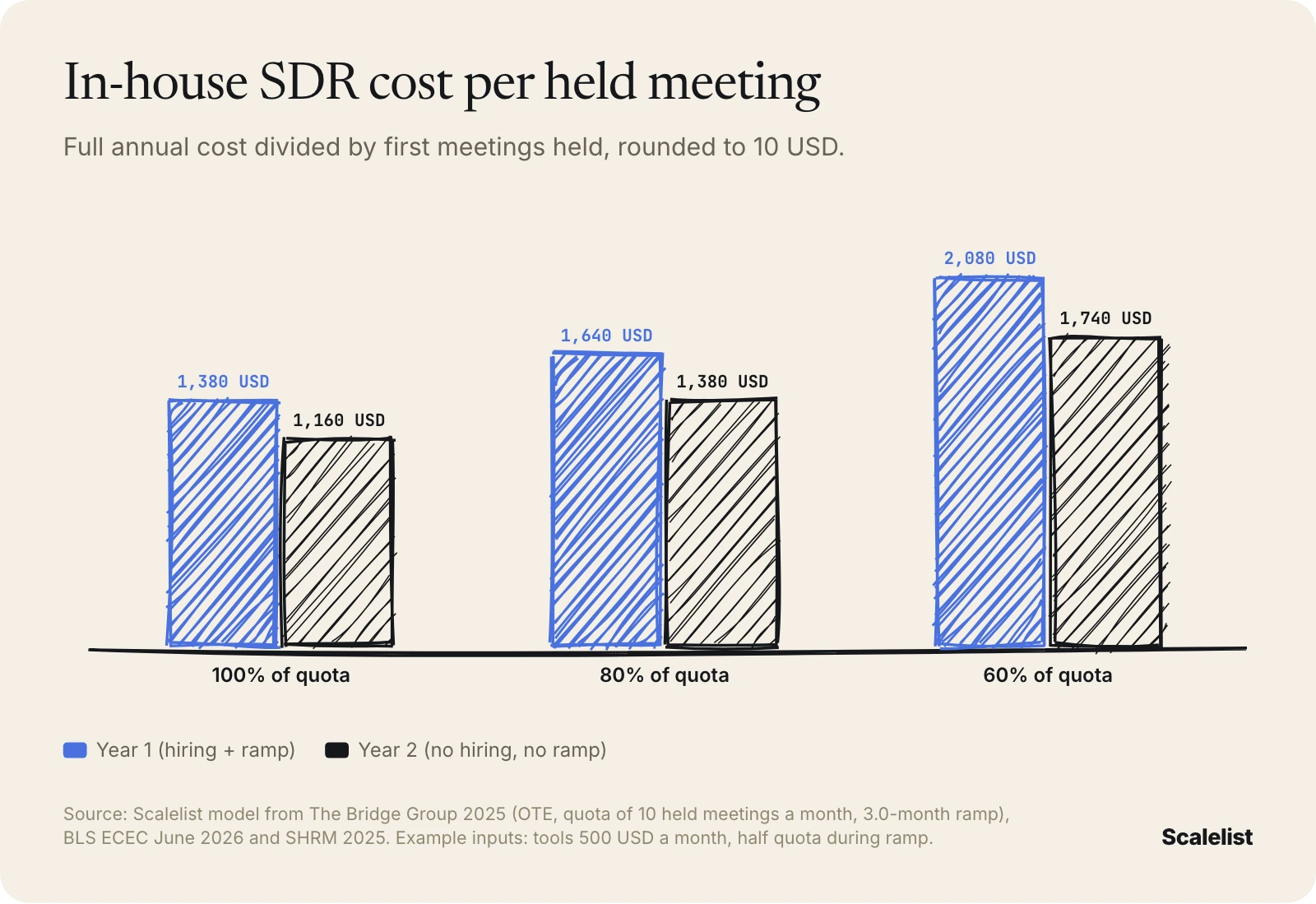
In-house cost per held meeting is the full annual cost divided by the meetings that actually took place. With the inputs above, it ranges from about 1,160 USD to 2,080 USD depending on the year and how close the rep gets to quota.
| Scenario | Annual cost | Held meetings | Cost per held meeting |
|---|---|---|---|
| Year 1, 100% of quota | 144,600 USD | 105 | about 1,380 USD |
| Year 2, 100% of quota | 139,100 USD | 120 | about 1,160 USD |
| Year 1, 80% of quota | 137,700 USD | 84 | about 1,640 USD |
| Year 1, 60% of quota | 130,800 USD | 63 | about 2,080 USD |
The quota line matters more than any cost line. Only 60% of SDRs hit quota in The Bridge Group’s 2025 survey, the lowest in the study’s history. Variable pay and benefits fall with attainment in the lower rows, but fixed costs do not.
How outsourced SDR pricing works
Outsourced SDR pricing follows three models: a monthly retainer, a fee per meeting, or a hybrid of both. Each puts the risk of a slow month on a different side of the table.
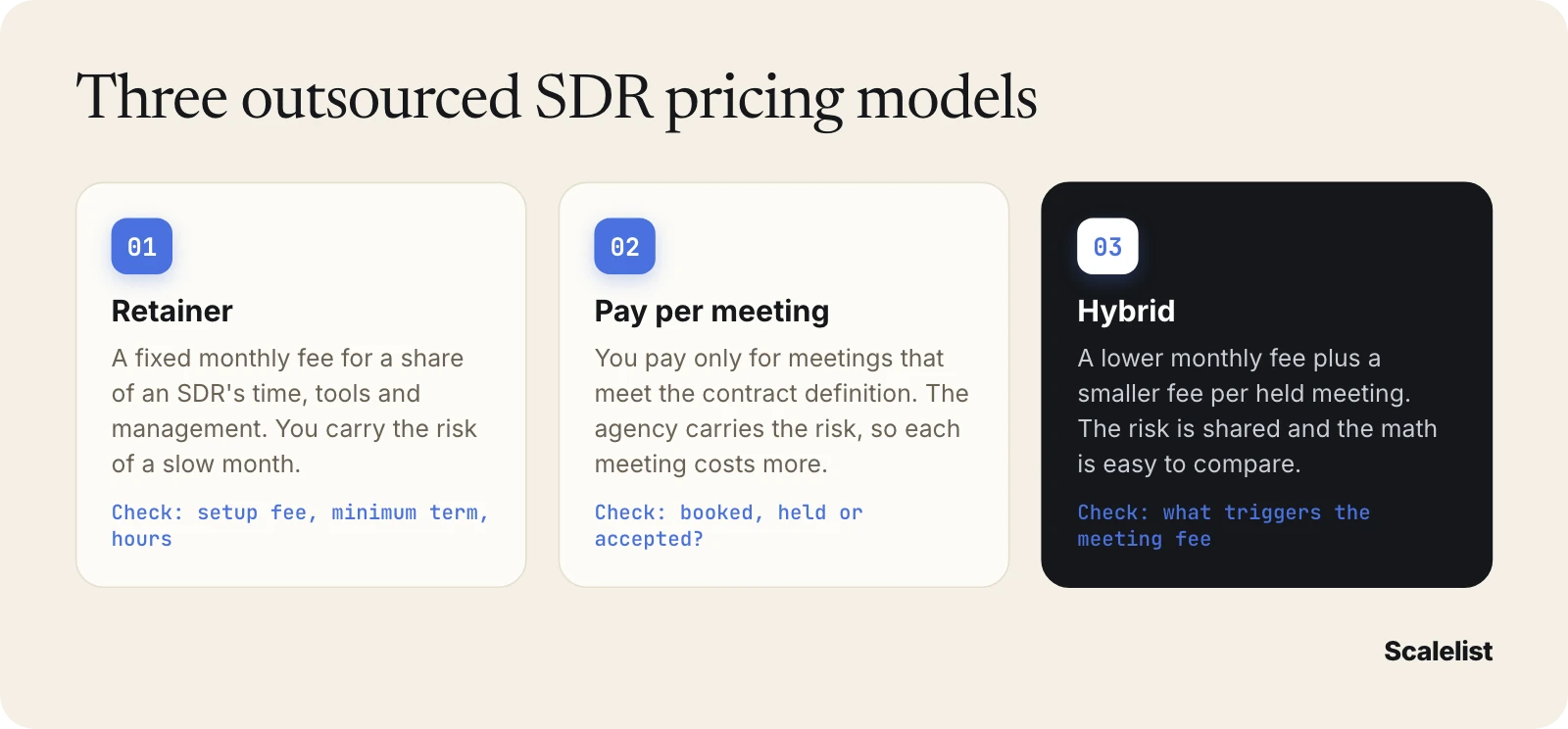
Retainer
You pay a fixed monthly fee for a share of an SDR’s time, usually with the agency’s tools, data and management included. Your cost per meeting falls when they deliver and rises when they do not. Ask about setup fees and the minimum term before you compare.
Pay per meeting
You pay only for meetings that meet an agreed definition. The risk sits with the agency, so the price per meeting is higher and the qualification rules are tighter. The definition decides everything: booked, held, or held and accepted by your account executive are three different prices.
Hybrid
A lower monthly fee plus a smaller fee per held meeting. For example, 4,000 USD a month plus 300 USD per held meeting costs 950 USD per meeting at 8 meetings, once you add 1,200 USD a month of your own oversight (all example inputs). It shares the risk and is easier to compare with an in-house number.
The break-even: how many meetings must an agency deliver?
An outsourced SDR breaks even with your in-house rep when its monthly cost, including your oversight, divided by your in-house cost per held meeting, equals the held meetings it delivers. Below that number, your own hire is cheaper.
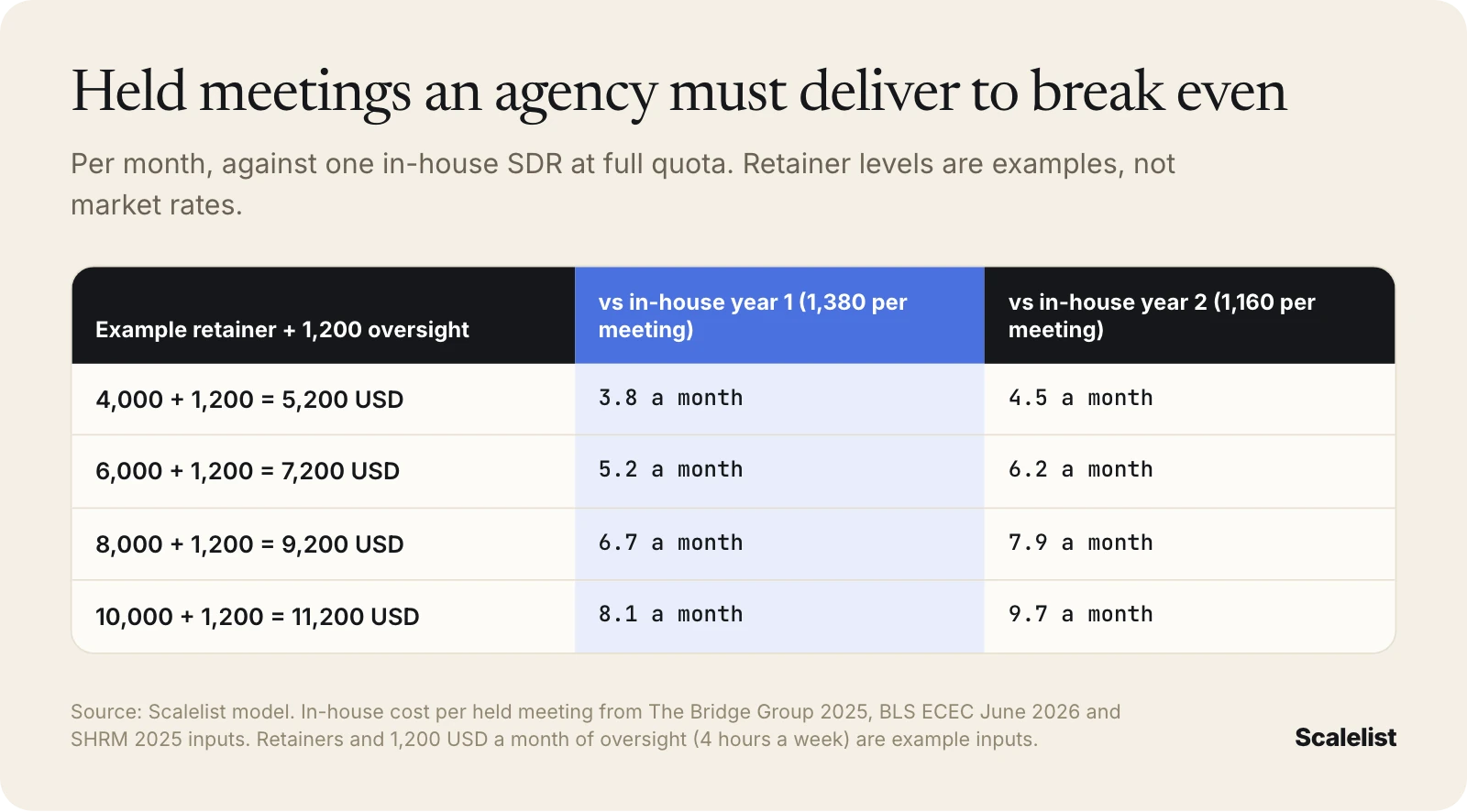
On a 6,000 USD retainer, the agency must deliver 5.2 held meetings a month to beat a year-one hire and 6.2 to beat a rep in year two.
Oversight is real time. Someone approves the target list, reviews call notes and fixes the messaging. We count 4 hours a week of a manager at 70 USD an hour, about 1,200 USD a month, as an example input.
For a fair comparison, measure the agency the way The Bridge Group measures quota: first meetings that were held, not booked. Our outbound sales metrics guide defines each stage.
Worked example: a retainer quote vs a first hire
Marcus Reyes runs sales at Brightline Logistics Software, a fictional 60-person company in Austin, Texas. He has one agency quote and an approved headcount, and wants to know which buys more meetings in the next 12 months.
The agency quote (example inputs): 1,500 USD setup, 6,000 USD a month, one onboarding month without meetings, then a forecast of 8 held meetings a month.
- Agency cost: 1,500 + (12 x 6,000) + 14,600 of Marcus’s oversight = 88,100 USD.
- Agency meetings: 11 months x 8 = 88 held meetings, so about 1,000 USD per held meeting.
- In-house, year 1: about 1,380 USD per held meeting at full quota.
At 8 meetings a month, the agency wins year one by a wide margin. At 5 a month, it delivers 55 meetings and costs about 1,600 USD each, worse than a rep at full quota. Marcus’s next step is not to sign. It is to ask the agency for its held-meeting numbers on similar clients.
Base salary: ______
Variable at target: ______
Benefits and payroll taxes: (base + variable) x 0.38 = ______
Tools and data: monthly cost x 12 = ______
Manager time: manager OTE / SDRs per manager = ______
Recruiting: ______
Total A = ______
Held meetings: (3 ramp months x half quota) + (9 months x quota) = ______
In-house cost per held meeting = A / held meetings = ______
OUTSOURCED
Setup fee: ______
Monthly fee x 12 = ______
Per-meeting fees: price x held meetings = ______
Your oversight: hours per week x hourly cost x 52 = ______
Total B = ______
Held meetings after onboarding: ______
Outsourced cost per held meeting = B / held meetings = ______
- Fill both halves with the same definition of a meeting, or the comparison is meaningless.
- Rerun it at 60% of the forecast. The option that survives the bad case is the safer one.
Hidden costs of each option
Both options carry costs that never show up on the quote or the offer letter.
| Hidden cost | In-house SDR | Outsourced SDR |
|---|---|---|
| Time to first meeting | 39 days to hire + 3.0 months ramp | Agency onboarding: ask |
| Turnover | 40% median annual attrition | Rep changes inside the agency: ask |
| Management | 1 manager per 6.4 SDRs | Your oversight hours each week |
| Meeting quality | You set and enforce the bar | Depends on the contract definition |
| What you keep | Playbook, call notes, a future AE | Only what the contract hands back |
In-house: the vacancy and the restart
Every departure restarts the clock: a new hiring cycle, a new ramp, and months of lower output. A rep who leaves in month 12 means year two looks like year one again.
Outsourced: the definition and the exit
The biggest hidden cost is a meeting that counts for the invoice but not for your pipeline. The second is the exit: if call notes, recordings and lists stay with the agency, you restart from zero when the contract ends.
When outsourcing wins, and when in-house wins
Outsourcing wins when you need meetings soon or need to test before you commit. In-house wins when sales development is a long-term engine you want to own.
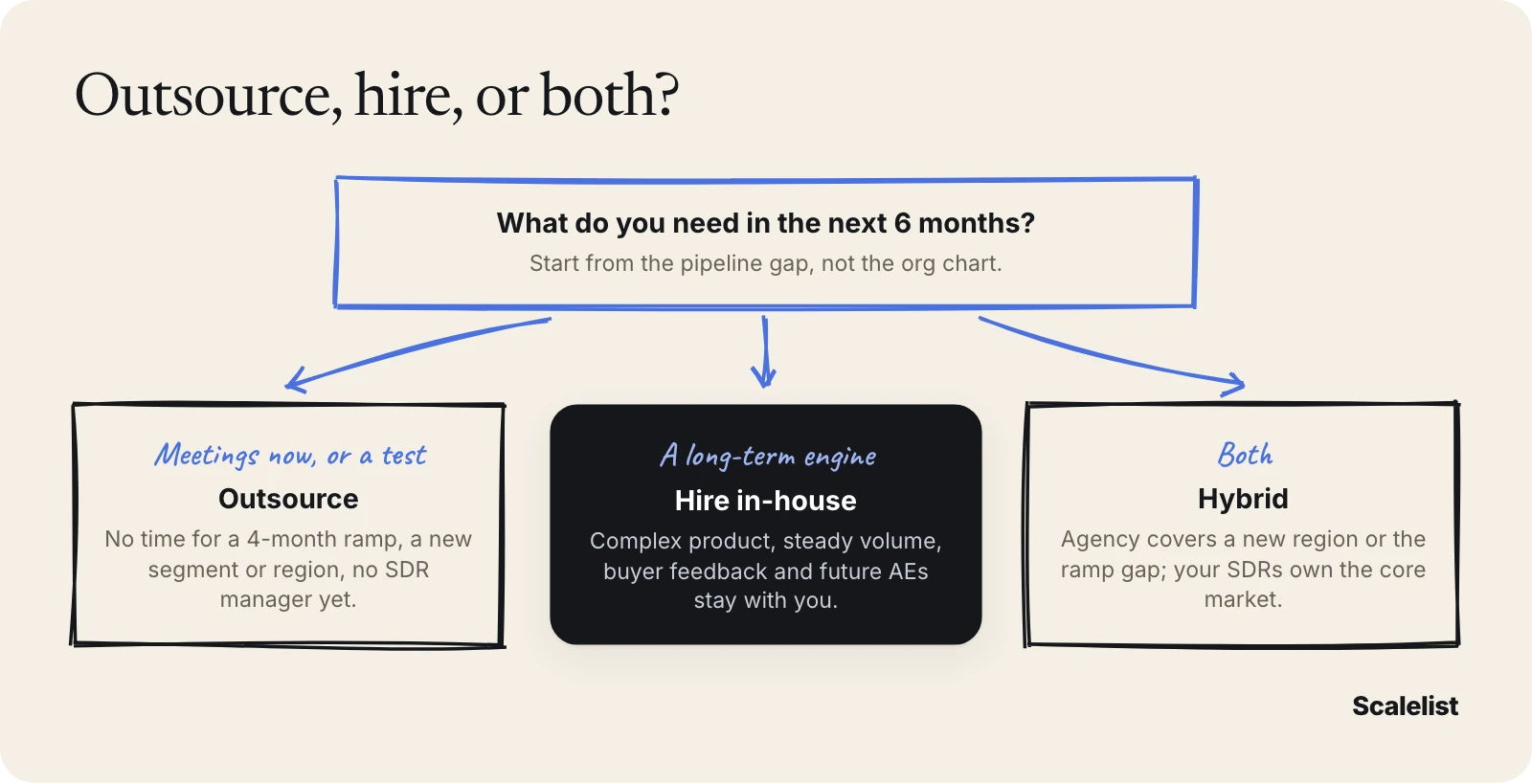
Outsource when
- You need meetings this quarter and cannot wait about four months for a hire to reach quota.
- You are testing a new segment, region or time zone before committing headcount.
- You have no one to manage SDRs. A single rep still needs a manager.
- Founders are still the best sellers and want calendars filled while they close. Our founder-led sales guide covers when to hire the first rep.
Keep it in-house when
- The product is complex and calls need deep context.
- You want the objections and buyer language to flow back into product and messaging every week.
- You want a bench of future account executives. 16% of SDR attrition is promotion (The Bridge Group, 2025).
- Volume is steady, so the year-two cost per meeting applies.
Hybrid models
Hybrid setups split the work by market or by time. Three common splits: the agency covers a new region while your team runs the core market; the agency fills the gap while your first hire ramps; or your SDRs own top accounts and the agency covers the long tail. Run the worksheet on each part separately.
Questions to ask an outsourced SDR agency
Ask these before you sign, and get the answers in the contract.
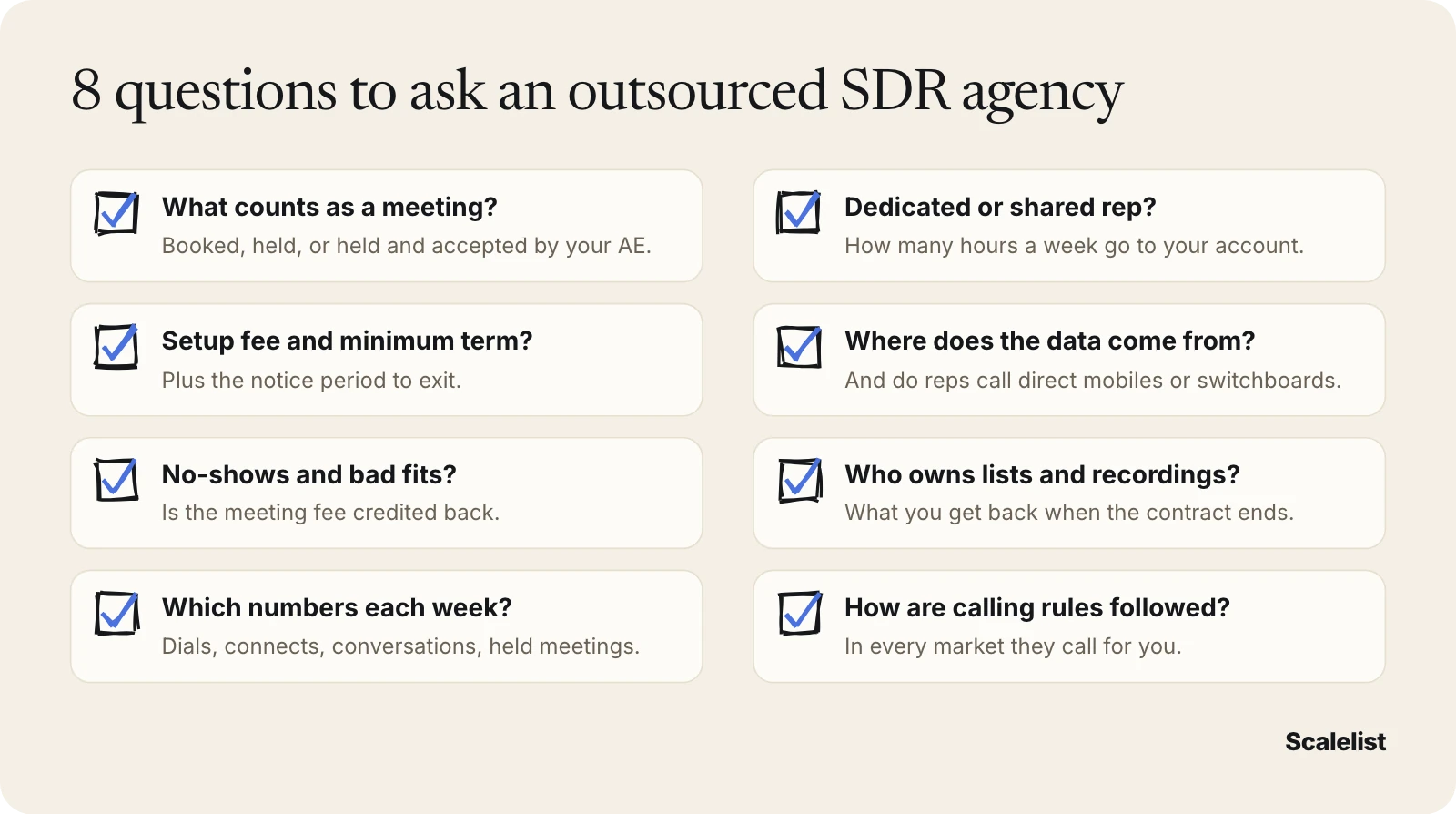
Two answers deserve extra attention. First, the data: ask where the numbers come from and whether reps call direct mobiles, because number type changes cold call connect rates more than any script. Second, rules: calling and email rules exist in the US and abroad, so ask how the agency follows them and read our B2B cold calling laws overview.
If you want a list of firms to send this to, start with our list of top cold calling agencies.
What both teams need: a list worth calling
Whoever dials, the list sets the ceiling: it is the first step of B2B sales prospecting, and the one you can check before you sign anything. A rep calling switchboards spends the day on gatekeepers; a rep calling direct mobiles spends it in conversations. Our complete guide to cold calling covers the rest of the motion.
What good contact data looks like for an SDR team, in-house or outsourced:
- Direct mobile numbers, not just company lines.
- Verified work emails with a clear status, for the same-day follow-up email.
- A count before you pay, so you know a segment is big enough for a quarter of calling.
- No charge for misses, so the data line scales with what you actually use.
How Scalelist helps
Scalelist is not an agency and does not provide SDRs. It is an AI Lead Finder: the data an in-house team or an agency calls from. You describe the people you want in one sentence, and Scalelist returns them with verified work emails and mobile numbers.
- Describe, then size for free. Type “VPs of Operations at US logistics companies with 200 to 1,000 employees” into Scalelist’s Lead Finder. It shows what it understood and how many people match before you spend a credit.
- Pay only for what is found. 1 credit per lead, 1 per email found (Valid or Risky), 10 per mobile found, nothing for a miss.
- Budget the data line. A fully enriched lead costs at most 12 credits. 200 new prospects a month for one SDR is at most 2,400 credits, which fits the Scaler 5K plan at 199 USD a month on Scalelist pricing.
For context on what direct mobiles do on the phone: across 894 dials in 8 recorded sessions between July and September 2026, mostly to Australian mid-market tech prospects on direct mobiles, Arnaud booked 18 meetings, about one per 50 dials.
Size your target market for free, then pull the people with direct mobiles your SDRs, in-house or outsourced, will call.
Get 100 credits to test itFAQ
How much does an outsourced SDR cost?
There is no standard price. Agencies charge a monthly retainer, a fee per meeting, or a hybrid, and terms such as setup fees and minimum contracts vary. Turn any quote into a cost per held meeting, including your own oversight time, and compare it with your in-house number: about 1,380 USD in year one at the median quota on 2025 benchmark inputs.
Is an outsourced SDR cheaper than an in-house SDR?
Sometimes. It is cheaper when the agency’s fees plus your oversight, divided by held meetings, come in under your in-house cost per held meeting. On median benchmarks, that bar is about 1,380 USD in year one and 1,160 USD in year two. An agency that delivers few held meetings can cost more per meeting than a rep at full quota.
How much does an in-house SDR cost per year?
About 144,600 USD in year one in our worked example: 80,000 USD median on-target pay (The Bridge Group, 2025), about 30,300 USD of benefits and payroll taxes (BLS ratio), 6,000 USD of tools and data (example), 22,800 USD of manager time and 5,475 USD of recruiting (SHRM, 2025). Year two drops to about 139,100 USD without recruiting.
What is a good cost per meeting for SDRs?
There is no universal benchmark, because meeting definitions and deal sizes differ. Calculate your own: full cost divided by held first meetings. On median 2025 inputs, an in-house SDR at quota lands near 1,160 to 1,380 USD per held meeting. What you can afford depends on your win rate and deal size, so work back from closed revenue.
How long does it take an in-house SDR to start booking meetings?
About four months to a full month of quota. SHRM’s 2026 data puts the median time to fill a nonexecutive role at 39 calendar days, and The Bridge Group’s 2025 survey reports an average SDR ramp of 3.0 months. A new rep books some meetings during ramp, but well below quota, so plan cash and pipeline for it.
What is SDR outsourcing best for?
SDR outsourcing works best for speed and tests: filling calendars while a first hire ramps, testing a new segment or region before adding headcount, or covering a market you have no one to manage. It is weaker when calls need deep product context, or when you want buyer feedback and future account executives to stay in-house.
Can you combine in-house and outsourced SDRs?
Yes. Common hybrid setups give the agency a new region or the long tail of accounts, while in-house SDRs own the core market and top accounts. Another option is to use an agency only while your first hire ramps. Run the cost per held meeting for each part separately so one does not hide the other.