SDR compensation is usually a fixed base salary plus variable pay for qualified meetings that actually happen. The most-cited benchmark, The Bridge Group’s 2025 survey of 351 B2B companies, puts median on-target earnings at $80K, split 68:32 into a $55K base and $25K variable.
This guide is for the manager writing the plan. You will set the OTE and the split, choose what the variable pays on, build the SDR quota from your own funnel, price each meeting, and add accelerators, a ramp and no-show rules. A worked example plan shows every number, so you can swap in your own.
What is SDR compensation?
SDR compensation is the total cash a sales development representative earns: a fixed base salary plus variable pay (commission or bonus) tied to the meetings or pipeline the SDR creates. It is usually quoted as on-target earnings (OTE), what the rep earns at exactly 100% of quota.
The plan has four moving parts: the OTE, the base-to-variable split, the metric the variable pays on, and the quota. Everything else (accelerators, ramp, spiffs, no-show rules) adjusts those four. Get the metric and the quota right and the rest is detail.
How much do SDRs make? SDR salary benchmarks for 2025
The median SDR earns $80K OTE: a $55K base salary plus $25K variable, according to The Bridge Group’s SDR Models, Motions & Metrics 2025 report. The survey covered 351 B2B companies (78% in North America, 83% B2B SaaS, $47M median revenue) and was published on February 6, 2025.
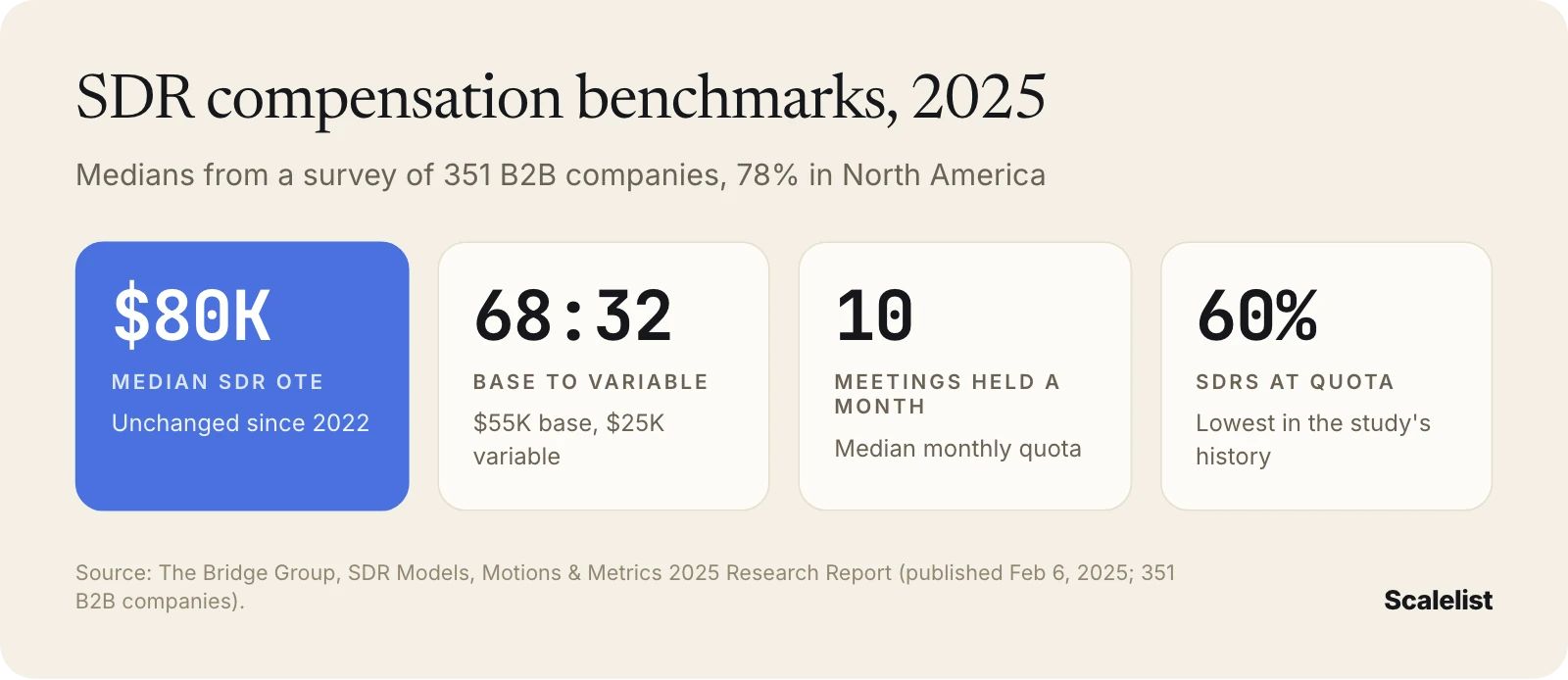
Three more numbers from the same report matter when you design a plan:
- OTE has barely moved. It is unchanged since 2022 and grew 0.56% a year over the past decade, well below inflation.
- Only 60% of SDRs hit quota, the lowest share in the study’s history. A rep at 70% of quota on this split earns closer to $72.5K than $80K.
- The career path pays. Median OTE is $146K for an SDR manager, $189K for a director and $240K for a VP of sales development.
The Bridge Group’s public findings do not break pay out by city, seniority or company size. Treat $80K as a reference point for a US B2B SaaS team, then check live job postings in your own market before you set a number.
How to design an SDR compensation plan in 8 steps
An SDR compensation plan works when the rep can see, every week, how their own activity turns into pay. These eight steps build that line of sight, in order.
1. Set the OTE from your market and your budget
Start with the total, not the split. Use the $80K median as an anchor, then adjust for your city, the seniority you hire, and what competitors in your area post. If you hire SDRs to grow into AEs, a slightly higher OTE buys you retention: The Bridge Group reports a median annual SDR attrition of 40%.
2. Choose the base-to-variable split
The median split is 68:32. Most plans sit near 70:30, which keeps the base high enough that a new rep is not anxious about rent in month one, and the variable big enough to matter.
- More base (75:25 or higher): fits long sales cycles, complex buyers, or SDRs who also handle inbound.
- More variable (60:40): fits high-volume, short-cycle outbound where the rep controls most of the result.
3. Pick what the SDR commission pays on
Pay on one primary metric the SDR controls and that the AE trusts. For most teams that is the qualified meeting held: the prospect shows up and the AE confirms the meeting met the written criteria.
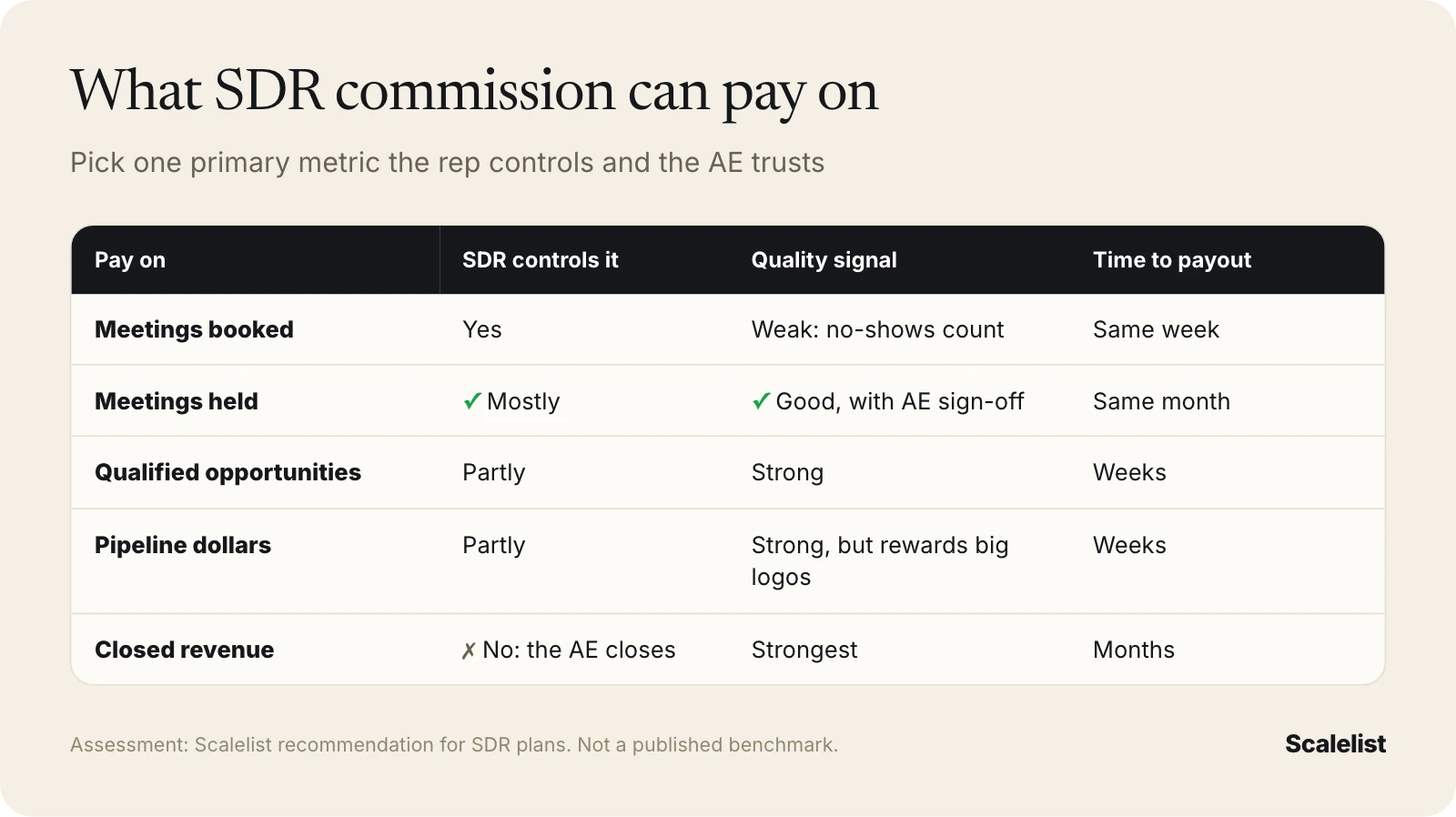
The Bridge Group’s 2025 data shows the norm: the median monthly quota is 10 Stage 0 meetings held. Counted as converted opportunities (Stage 1) instead, the median quota is 6. Some teams add a small kicker on pipeline or closed revenue the SDR sourced. Keep it small, because the rep has no control over the AE’s close.
4. Set the SDR quota from your own funnel math
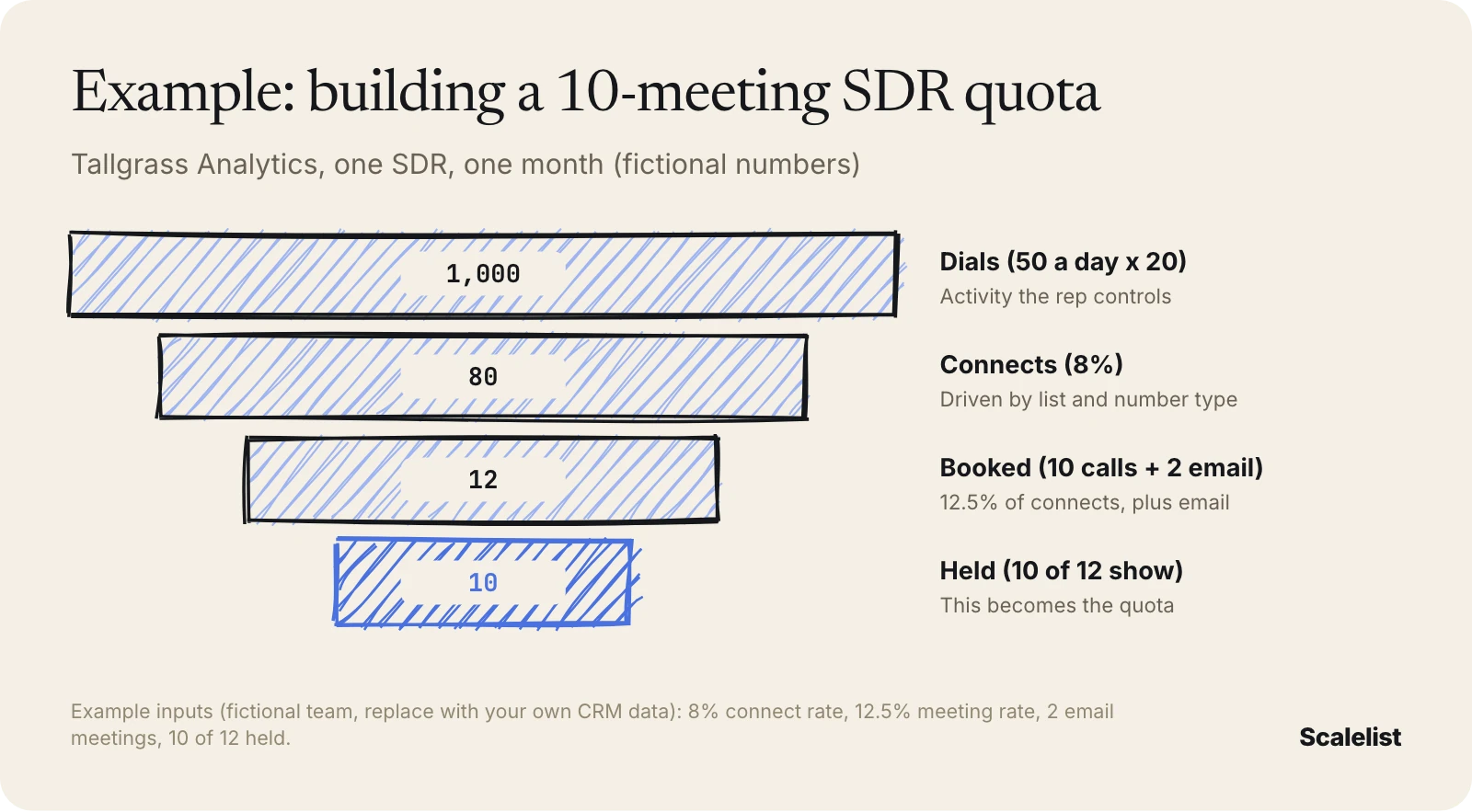
Your SDR quota should come from what one rep can produce on your list, at your rates. Work backward from activity:
- Dials a month: dials a day x selling days. Phone-centric SDR teams average 56 dials a day (The Bridge Group, 2025).
- Connects: dials x your connect rate.
- Meetings booked: connects x your meeting rate, plus meetings booked by email.
- Meetings held: booked x your show rate.
Benchmarks are a poor substitute for this. Gong’s analysis of 300M+ cold calls (2024) found the average rep needs 402 dials to book a meeting and a top-quartile rep needs 45. Our own recorded sessions came out at about one meeting per 50 dials (894 dials, 18 meetings, July to September 2026, mostly Australian mid-market tech prospects on direct mobiles).
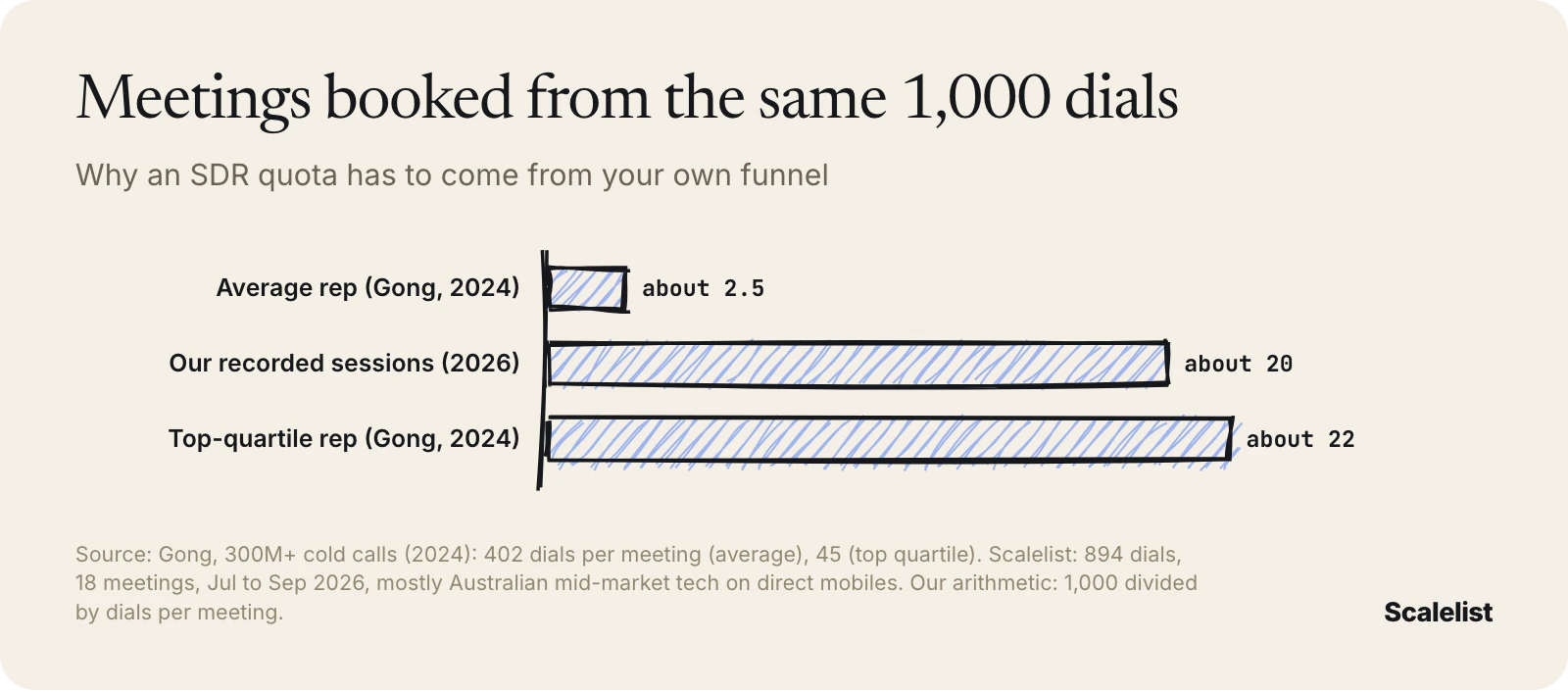
Same dials, a 9x gap. Copy a quota from a benchmark and you either pay for nothing or set a target nobody can hit. Pull three months of your own data first; the outbound sales metrics guide lists what to track.
5. Price each held meeting
Divide the annual variable by 12, then by the monthly quota. That is what one held meeting is worth to the rep.
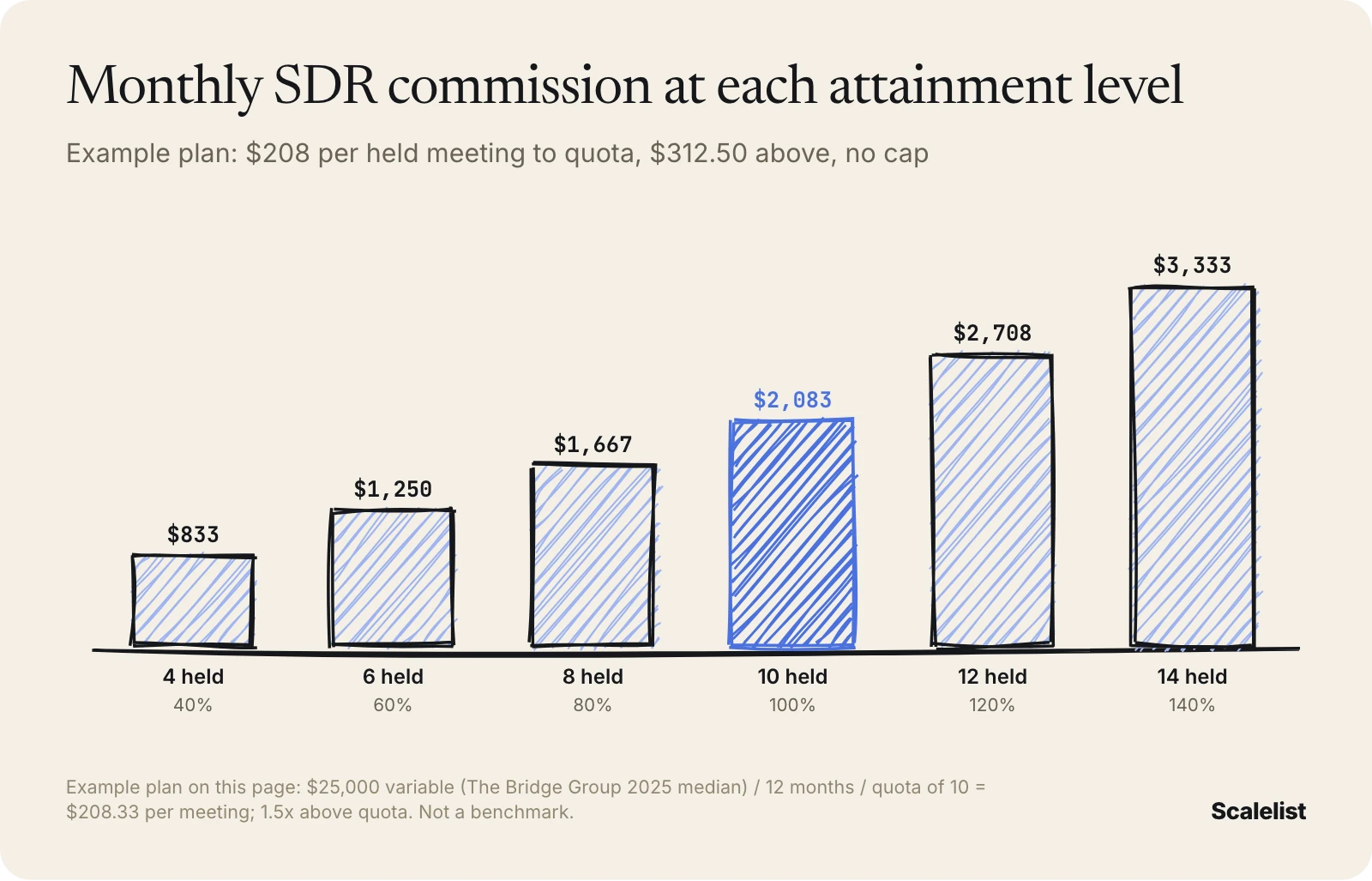
With the median numbers: $25,000 / 12 = $2,083 a month. At a quota of 10 held meetings, each one pays $208. Reps think in meetings, not percentages, so print the per-meeting rate on the plan.
6. Add accelerators, and do not cap
An accelerator raises the rate above quota; a cap stops pay at a ceiling. Pay a higher rate for every held meeting above quota (1.5x is a common choice) and leave the plan uncapped. A cap tells your best rep to stop dialing on the 20th of the month.
If you worry about runaway payouts, the fix is the meeting definition and the AE sign-off, not a cap. Some teams also set a threshold, for example no variable below 50% of quota. That protects the budget but punishes a new rep on a bad list, so use it only after ramp.
7. Ramp the quota for new hires
New SDRs need time to learn the pitch and build a pipeline of follow-ups. The Bridge Group’s 2025 average ramp time is 3.0 months, the shortest since 2010. Ramp the quota over that window and protect the variable in month one.
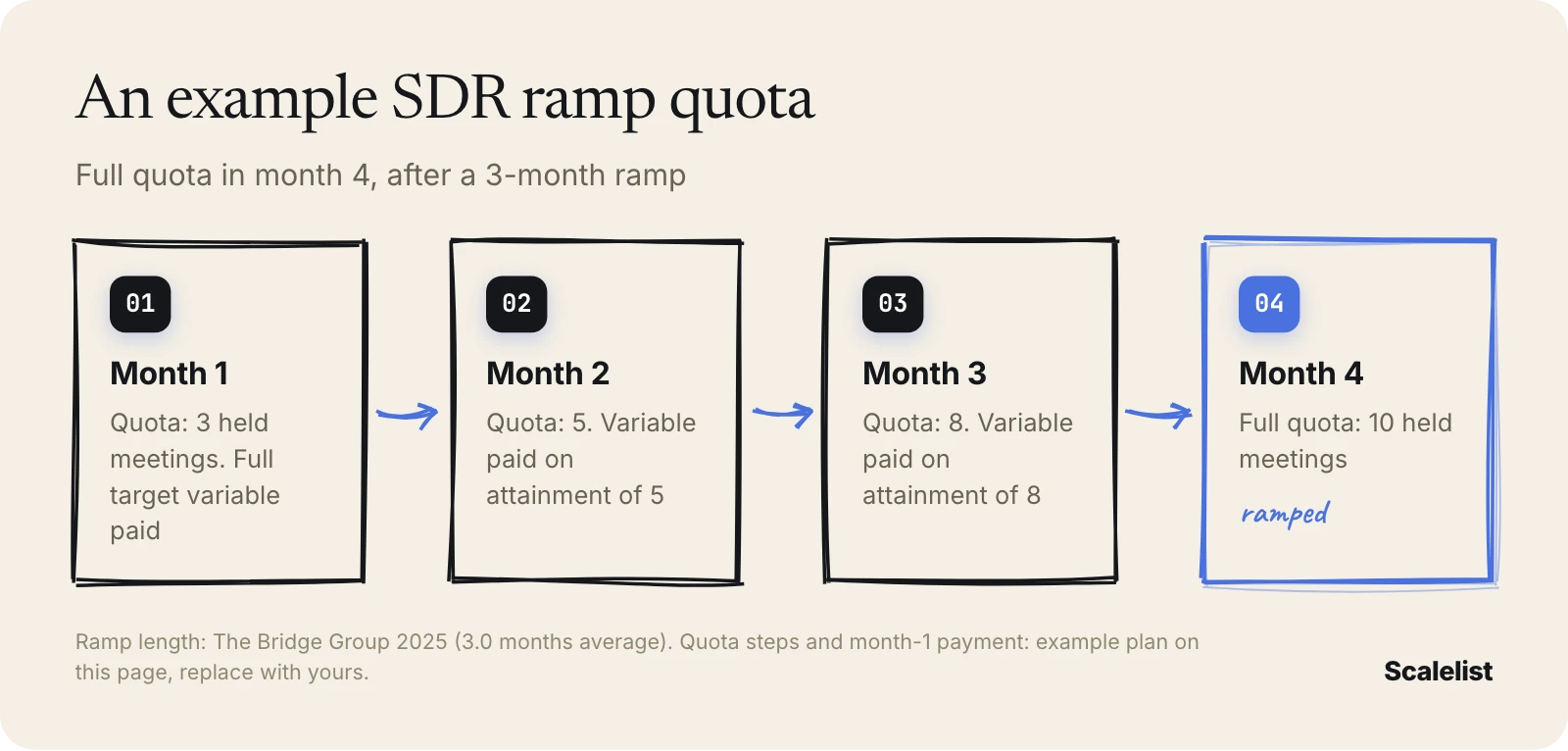
Pair the ramp with real training, not just a lower number. The 30-day cold calling training plan gives you the drills and dial targets for the first month.
8. Write the rules for no-shows, clawbacks and spiffs
Disputes come from vague rules, so write them down before the first payout.
- No-shows: a meeting counts only when held. A reschedule counts in the month it happens.
- Clawbacks: if you credit on booked meetings, state when a no-show is reversed and from which payout. Crediting on held meetings removes most clawbacks.
- Disqualification: the AE has a fixed window, such as 2 business days, to reject a held meeting against the written criteria.
- Spiffs: short, specific and dated. For example, $100 per held meeting with a named target account during a two-week push.
Employment and pay rules vary by state and country, so have your HR or legal team review the final plan document before anyone signs it.
Give your SDRs a list with direct mobiles so the quota math holds: 10 credits per mobile found, nothing for a miss.
Find your first 20 contactsSDR compensation plan example: a worked plan
Here is a full plan for a fictional team. Every number is either a sourced median or an example you replace with your own.
Tallgrass Analytics, a 120-person B2B SaaS company in Austin, Texas, is hiring its second SDR, Maya Patel. The team calls operations leaders at US manufacturers, like Dana Whitfield, Head of Operations at Northwind Fabrication in Columbus, Ohio.
| Input | Value | Where it comes from |
|---|---|---|
| OTE | $80,000 | Bridge Group 2025 median |
| Base / variable | $55,000 / $25,000 | Bridge Group 2025 median split |
| Dials a month | 1,000 (50 a day x 20 days) | Example: replace with yours |
| Connect rate | 8% (80 connects) | Example: Tallgrass CRM |
| Meeting rate | 12.5% of connects (10 booked) | Example: Tallgrass CRM |
| Email meetings | 2 a month | Example: Tallgrass CRM |
| Show rate | 10 of 12 booked are held | Example: Tallgrass CRM |
| Monthly quota | 10 held meetings | Result of the funnel above |
At $208 per held meeting to quota and $312.50 per meeting above it, Maya’s monthly variable looks like this:
Plan period: January 1 to December 31, paid monthly
OTE: $80,000 = $55,000 base + $25,000 variable at 100% of quota
Quota: 10 qualified meetings held per month (ramp: 3, 5, 8, then 10)
Rate: $208.33 per held meeting up to quota; $312.50 per held meeting above quota; no cap
Qualified meeting: a decision maker at a company with 200+ employees in the US,
with a stated problem we solve, attends a 30-minute call with an AE
Credit: counted when held; AE may reject within 2 business days against the criteria above
Reschedules: counted in the month the meeting is held
Spiffs: announced in writing with start date, end date and amount
Disputes: raised within 5 business days of the payout statement, decided by the SDR manager
Common SDR compensation mistakes
Most broken SDR plans fail in one of five ways. Each has a simple fix.
Paying on meetings booked
Booked meetings are easy to inflate: a rep can book a curious prospect who never shows. Pay on held meetings with AE sign-off, and you stop paying for calendar invites.
Paying only on closed revenue
Closed-won deals land months after the meeting, and the AE controls the close. The rep stops seeing the link between today’s dials and their pay. Keep revenue as a small kicker at most.
Copying a quota from a benchmark
A 10-meeting quota is a median across 351 companies, not a target for your list. If your reps cannot hit it, measure the funnel before you blame the reps. Our guide to connect rates by number type shows where the gap usually is.
Setting quota on a list without direct numbers
Connect rate drives every number below it. Nooks’ analysis of nearly 3 million dials (2025) found mobile numbers connect 45% more often than non-mobile numbers. A team dialing switchboards needs a lower quota or a better list. You cannot coach your way out of a list problem.
Freezing OTE for years
Median OTE has not moved since 2022, while The Bridge Group reports 40% median annual attrition. Review the OTE every year against live postings. Replacing a ramped SDR costs you another 3-month ramp.
SDR compensation best practices
Before you publish the plan, check it against this list.
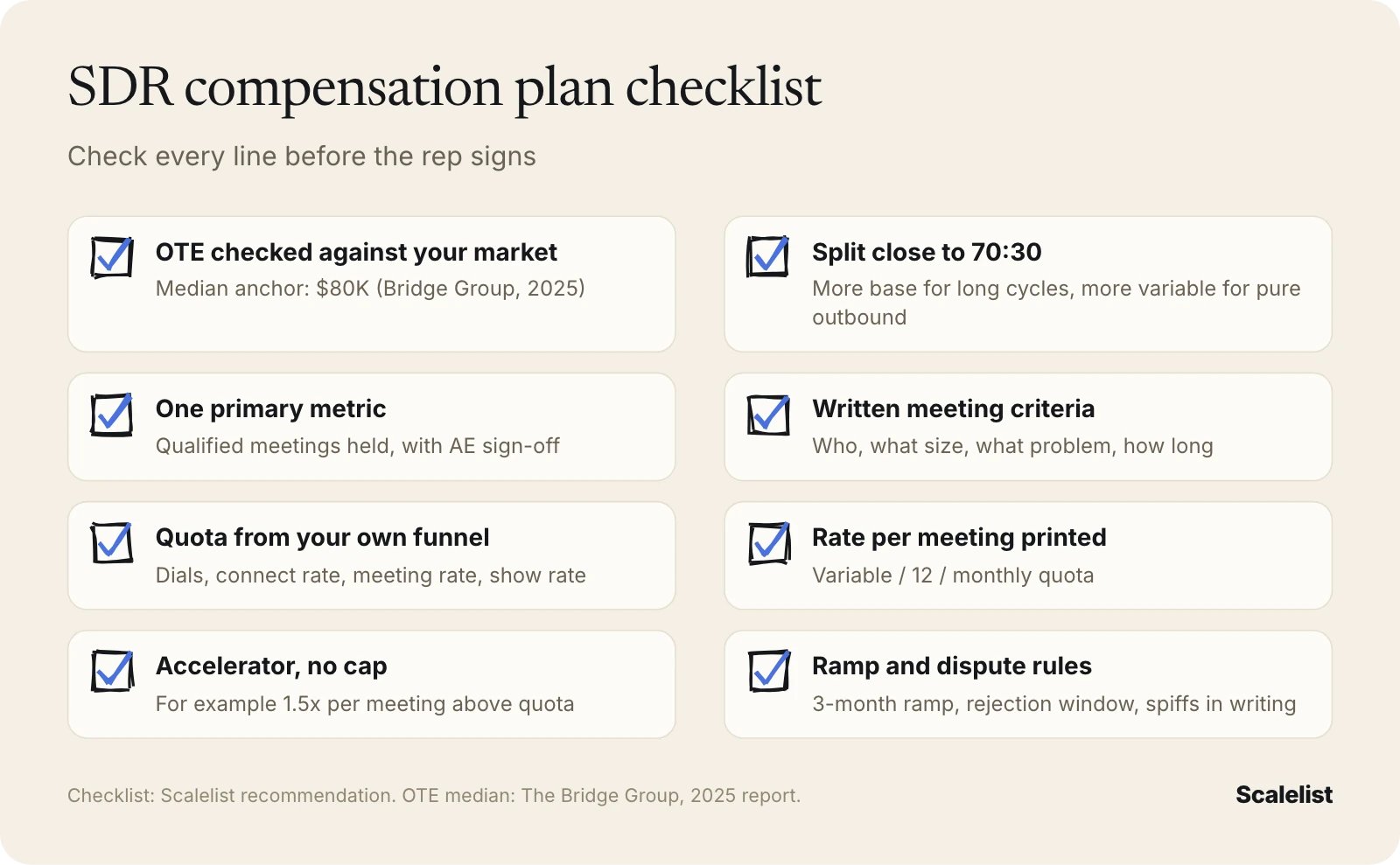
Two more habits make the plan last. Show each rep a live dashboard of held meetings and pay to date. And change the plan only at the start of a quarter, with a written note on why.
If you are still deciding whether to build the team at all, compare in-house vs outsourced SDR costs per meeting, or keep prospecting yourself a little longer with a founder-led sales motion.
When you do hire, use these SDR interview questions and mock call to test the skills the plan pays for. For the career step after the SDR seat, see how a sales development manager differs from a team lead.
How Scalelist helps SDR teams hit quota
Scalelist, an AI lead finder, gives SDRs the list the quota math assumes: the right people, with verified work emails and mobile numbers. You describe the buyers in one sentence, for example “Heads of Operations at US manufacturers with 200 to 1,000 employees”, and Lead Finder shows what it understood and how many people match before you spend a credit.
For the full calling method behind the funnel, read our cold calling guide built from recorded calls, and see where SDR work sits in the wider sales prospecting process.
Build your SDR’s first call list with verified emails and direct mobiles: 1 credit per email, 10 per mobile, only when found.
Describe your buyer in one sentenceFAQ
How much does an SDR get paid?
Median SDR compensation is $80K in on-target earnings: a $55K base salary plus $25K variable pay at 100% of quota. That comes from The Bridge Group’s 2025 survey of 351 B2B companies, mostly North American SaaS. Actual pay depends on attainment, and only 60% of SDRs hit quota in the same survey, so many earn less than OTE.
Do SDRs make good money?
It depends on attainment and the career path. At the median, an SDR earns $80K at quota, and that figure has not moved since 2022. The bigger payoff is the next role: The Bridge Group reports median OTE of $146K for SDR managers, $189K for directors and $240K for VPs. Reps who hit quota and get promoted earn far more than the SDR median.
How much do entry-level SDRs make?
No primary source we could open publishes a separate entry-level SDR figure. The Bridge Group’s 2025 median of $80K OTE ($55K base) is a company-level median across SDR teams, not an entry-level rate. Use it as a reference point, then compare live job postings in your city for the seniority you are hiring.
What is the average salary for an SDR in New York City?
No primary source we could open publishes a New York City SDR figure. The Bridge Group’s 2025 report gives national medians ($80K OTE, $55K base) for a sample that is 78% North American, without a city breakdown. For a New York number, compare current job postings that list pay ranges for SDR roles in the city.
What is a typical SDR quota?
The median SDR quota is 10 meetings held per month, according to The Bridge Group’s 2025 report. It varies by meeting type: 16 for introductory meetings, 10.4 for semi-qualified and 9 for fully qualified. Counted as converted opportunities, the median is 6. Set your own SDR quota from your dials, connect rate, meeting rate and show rate.
How does SDR commission work?
SDR commission is usually a fixed amount per qualified meeting held, paid monthly. You divide the annual variable by 12, then by the monthly quota: $25,000 variable and a 10-meeting quota pays $208 per held meeting. Many plans pay a higher rate above quota, such as 1.5x, and leave the plan uncapped so top reps keep booking.
What is a good base-to-variable split for SDRs?
A 68:32 split is the median in The Bridge Group’s 2025 data, so most plans sit near 70:30. Choose more base when cycles are long or the SDR also works inbound. Choose more variable, up to about 60:40, for high-volume outbound where the rep controls most of the result. Keep the variable large enough to matter each month.
Sources
- The Bridge Group: SDR Models, Motions & Metrics 2025 Research Report, findings and methodology
- The Bridge Group: Sales Development Research Report download page
- Gong: The hidden power of cold calling, insights from 300M calls (2024)
- Gong: How to Master Cold Calls, data-backed guide (PDF, 2024)
- Nooks Insights: Here’s who picks up the most (2025)