


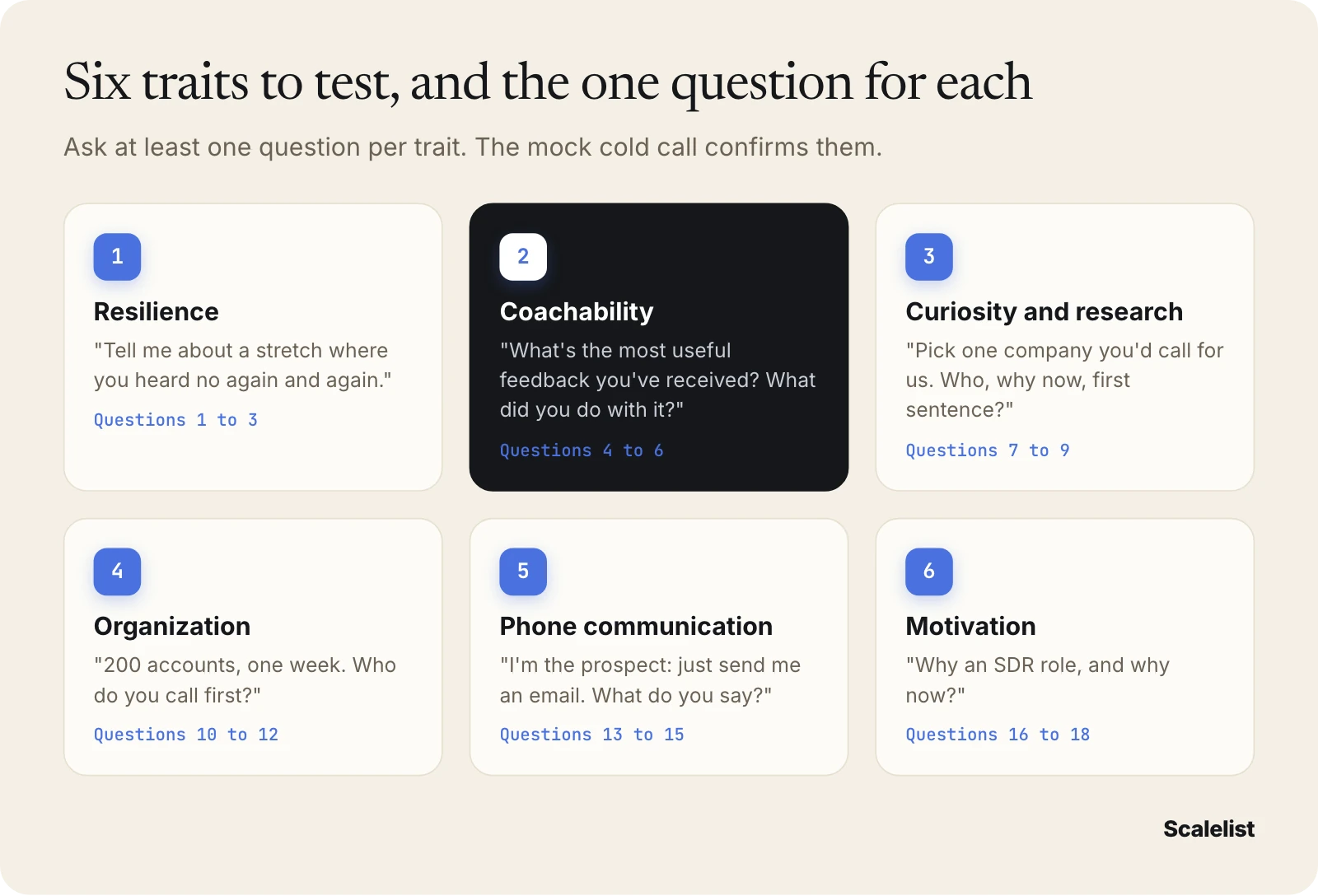
The best SDR interview questions test six things a resume can’t show: how a candidate handles rejection, takes coaching, researches, organizes a day, sounds on the phone and why they want the job. Then a scored mock cold call shows you all six in 25 minutes.
This page is for the person doing the hiring: a sales leader, an SDR manager or a founder hiring a first rep. You get the interview loop, 18 questions grouped by what they reveal, what strong and weak answers sound like, the red flags, and a mock cold call with the prospect brief, the objections to throw and a scoring rubric.
What should SDR interview questions test?
SDR interview questions should test behavior you will see on the job: hearing “no” all day, changing after feedback, finding a reason to call, running a high-activity day and holding a conversation with a stranger. Product knowledge and sales jargon can be taught in the first month. Those five habits mostly can’t.
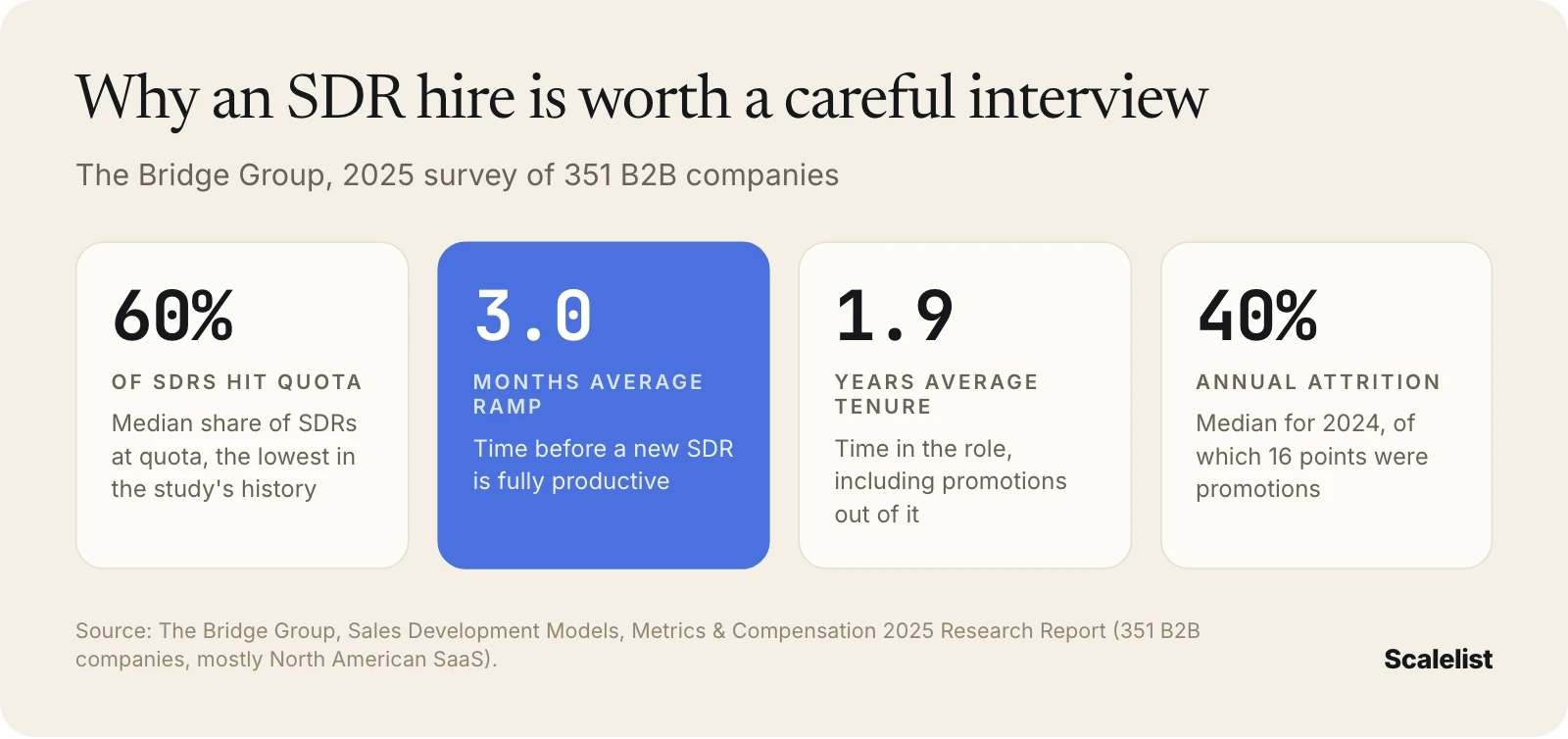
The sixth test is motivation, because the role is hard and short. In The Bridge Group’s 2025 survey of 351 B2B companies, a median of 60% of SDRs hit quota, average tenure was 1.9 years and median annual attrition was 40%. Every miss in the interview costs you a ramp.
How to hire SDRs: the interview loop
Hiring SDRs works best as a short loop of five steps that each test something different, with the mock cold call as the deciding step. Keep it to about two hours of the candidate’s time.
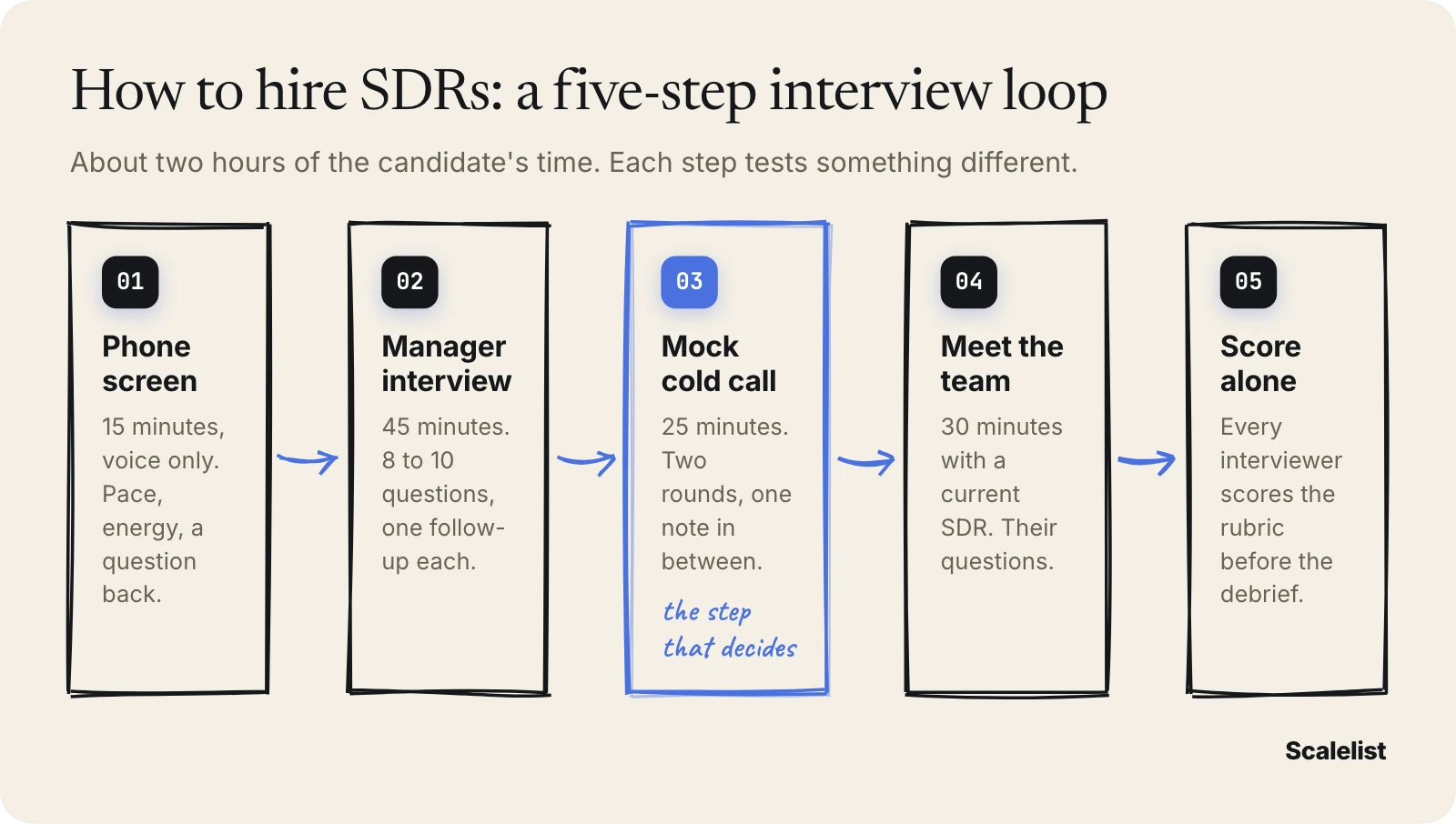
- Phone screen (15 minutes). Call them, don’t video them. You hear what a prospect will hear: pace, energy, whether they ask a question back.
- Hiring manager interview (45 minutes). Pick 8 to 10 of the 18 questions below, at least one per group.
- Mock cold call (25 minutes). Two short rounds on the same prospect, with one piece of feedback in between. This is the step that decides.
- Meet the team (30 minutes). The candidate talks with a current SDR and asks their own questions.
- Independent scoring. Every interviewer scores alone, then the team compares notes.
How to use these SDR interview questions
Each question below comes with a follow-up, then what a strong answer and a weak answer sound like. Ask the question, ask the follow-up, then stay quiet. The follow-up is where rehearsed answers fall apart.
- Score answers 1 to 4 and write down one piece of evidence for each score. A real example beats a smooth one.
- Ask for the last time, not the usual way. “Tell me about the last time” gets a story. “How do you usually” gets a theory.
- Ask the same core questions to every candidate for the same role, so the scores compare.
- Check your final list with your HR team before you use it.
Questions that test resilience and rejection
Resilience questions show whether rejection is a data point for the candidate or a verdict. On my own recorded sessions, 894 dials across 8 sessions from July to September 2026, mostly to Australian mid-market tech prospects on direct mobiles, it took about 50 dials to book one meeting. Most of a rep’s day is “no”.
Question 1: The ten-no question
Follow up: What did you change, if anything, and did it work?
- Strong answer: a specific stretch, like retail card signups, fundraising calls or a walk-on tryout, with numbers and one change they made.
- Weak answer: “I don’t take it personally,” with no story behind it.
- What it reveals: whether they adjust or just endure.
Question 2: The 3 p.m. question
Follow up: And if tomorrow looks the same?
- Strong answer: keeps dialing, but checks something first: the list, the hour, the opener. Names one thing to test.
- Weak answer: “Switch to email for the rest of the day,” or blames the leads with no plan.
- What it reveals: whether a bad day turns into a diagnosis or an excuse.
Question 3: The missed-goal question
Follow up: Who did you tell, and what did you say?
- Strong answer: owns the miss, explains the cause plainly and describes what they did differently the next week.
- Weak answer: a fake weakness (“I worked too hard”), or a story where the miss was someone else’s fault.
- What it reveals: honesty about results, which you need when you review their numbers every week.
Questions that test coachability
Coachability questions predict how fast a rep ramps, because most of SDR training is feedback on recorded calls. The questions below open the topic; the mock cold call confirms it.
Question 4: The best-feedback question
Follow up: How long did it take before it stuck?
- Strong answer: specific feedback, a specific change, and an honest “it took a few weeks.”
- Weak answer: can’t recall any, or names praise instead of feedback.
- What it reveals: whether they look for coaching or just tolerate it.
Question 5: The disagreed-feedback question
Follow up: Looking back, who was right?
- Strong answer: tried it anyway, then came back with evidence. Can say when the other person was right.
- Weak answer: “I’ve never disagreed with a manager,” or a story that ends with ignoring the advice.
- What it reveals: whether they can push back with data and still be coached.
Question 6: The working-on-it question
Follow up: How will you know it's working?
- Strong answer: one skill, a practice routine and a way to measure it.
- Weak answer: a list of books with nothing they practiced.
- What it reveals: whether improvement is a habit or a talking point.
Questions that test curiosity and research
Research questions show whether a candidate can find a real reason to call someone. Send them your website and one target account a day ahead, so the answer reflects effort, not luck.
Question 7: The pick-an-account question
Follow up: Where did you find that reason?
- Strong answer: a named company that fits your buyer, a named title, a dated reason like a new site or a job post, and a short first line.
- Weak answer: a famous brand that doesn’t fit, or “the CEO, because they decide everything.”
- What it reveals: whether they connect research to a reason, which is the core of a cold call opener that earns 30 seconds.
Question 8: The three-minute research question
Follow up: What do you skip, and why?
- Strong answer: a short, ordered routine: the company site, recent news or job posts, the person’s role, then one note to use on the call.
- Weak answer: 20 minutes of reading, or nothing at all.
- What it reveals: whether they can balance research against a day of 50-plus dials.
Question 9: The buyer’s Monday question
Follow up: How would you check whether you're right?
- Strong answer: a specific guess about the buyer’s job, then a plan to test it on calls.
- Weak answer: repeats your homepage back to you.
- What it reveals: curiosity about the buyer, not just the product.
Questions that test organization and activity
Organization questions show whether a candidate can run a day with a lot of volume. On phone-centric SDR teams, reps average 56 dials and 4.6 quality conversations a day (The Bridge Group, 2025).
Question 10: The 200-accounts question
Follow up: What would make you move an account up the list?
- Strong answer: a simple rule, like accounts with a recent change first, then fit, then the rest, and a plan to call each one more than once.
- Weak answer: alphabetical, or “I’d research all 200 first.”
- What it reveals: whether they think in priorities or in lists.
Question 11: The plan-my-day question
Follow up: The 11 a.m. callback doesn't pick up. Then what?
- Strong answer: dial blocks at set times, callbacks protected, emails batched, and a retry for the missed callback.
- Weak answer: “I’d just get through it,” with no order.
- What it reveals: whether they protect calling time, which is where most of the meetings come from.
Question 12: The system question
Follow up: What broke, and how did you fix it?
- Strong answer: a tracker, a spreadsheet or a routine they kept using for months, and a fix they made.
- Weak answer: “I keep it all in my head.”
- What it reveals: whether CRM notes will get logged after every call.
Cold calling interview questions: communication on the phone
These cold calling interview questions test how the candidate talks to a stranger: clear, short and willing to stop talking. Ask them on the phone screen or out loud in the interview, never in writing.
Question 13: The 20-second pitch question
Follow up: Now say it in one sentence.
- Strong answer: the buyer’s problem first, then what you do, in plain words, ending with a question.
- Weak answer: a feature list, or 60 seconds of buzzwords.
- What it reveals: whether they can earn the next 30 seconds of a call.
Question 14: The just-send-an-email question
Follow up: I say: "We already have a vendor for that."
- Strong answer: agrees, then asks one question that makes the email useful, or asks for a short call instead.
- Weak answer: “Sure, what’s your email?” and the call ends, or a long argument.
- What it reveals: the objection reflex. Our list of 40 sales objections and replies shows what good looks like.
Question 15: The explain-and-interrupt question
Follow up: (Interrupt after 20 seconds with a question that changes direction.)
- Strong answer: stops, answers the interruption, then picks the thread back up.
- Weak answer: talks over you to finish the script.
- What it reveals: listening under pressure, which is most of a real call.
Questions that test motivation
Motivation questions show why the candidate wants a job where most of the day is rejection. The best answers are specific about the next 18 months, not vague about “sales.”
Question 16: The why-SDR question
Follow up: What do you expect to find hardest?
- Strong answer: a concrete reason (a path to closing deals, a market they like) and a realistic view of the hard part: the phone and the “no.”
- Weak answer: “I’m a people person,” or no idea what the job involves day to day.
- What it reveals: whether they will still want the job in week six.
Question 17: The 18-months question
Follow up: What would make you leave before then?
- Strong answer: a next role, like account executive, with the skills and numbers they’d need to get there.
- Weak answer: a job that has nothing to do with sales.
- What it reveals: fit with your promotion path. The average SDR stays in the role 1.9 years (The Bridge Group, 2025), so plan for the move.
Question 18: The variable-pay question
Follow up: What would you need from us to feel the target is fair?
- Strong answer: comfortable with it, and asks how the target is set and whether meetings are counted when booked or when held.
- Weak answer: wants no variable pay at all, or ignores the question.
- What it reveals: whether the plan will motivate them. The Bridge Group’s 2025 median is a 68:32 base-to-variable split; see how to structure SDR compensation and quota.
The mock cold call: setup, objections and scoring
The mock cold call is a short role-play where the candidate calls you, playing a prospect, twice, with one piece of feedback in between. It shows research, phone skills and resilience at once, and it is the only live test of coachability in the loop.
The setup
Send the prospect brief and your website 24 hours before. Use your real product and a real-looking buyer, so the call sounds like week one of the job.
You're calling: Mike Delgado, VP of Operations, Ridgeline Distribution, Dallas, Texas. About 400 people, three warehouses.
What's public: Ridgeline opened a fourth warehouse in Fort Worth in September and is hiring two dock supervisors.
Your goal: a 20-minute meeting this week or next.
Format: two calls of about 5 minutes each. I'll give you one piece of feedback in between.
First line: "Mike Delgado." Then wait.
Objection 1 (after the opener): "Who is this? What's this about?"
Objection 2 (after the first question): "We handle that with a spreadsheet and our transportation system. It works."
Objection 3 (when they ask for time): "Just send me an email."
Round 2 only: "Call me next quarter, after Fort Worth settles."
Book the meeting only if: they ask about the new warehouse and propose a specific day and time.
How to run it
- Round 1 (5 minutes). Answer as Mike. Throw objections 1 to 3 in order. Don’t help.
- One note (3 minutes). Give one piece of feedback, the most useful one. For example: “You pitched after his first answer. Ask one more question first.”
- Round 2 (5 minutes). Mike picks up the callback the next morning. Use objections 1 and 2 again so you can compare, then add the round 2 objection.
- Self-review (3 minutes). Ask: “What went well, and what would you change?” Strong candidates spot what you spotted.
- Score alone. Fill in the rubric before you talk to anyone else.
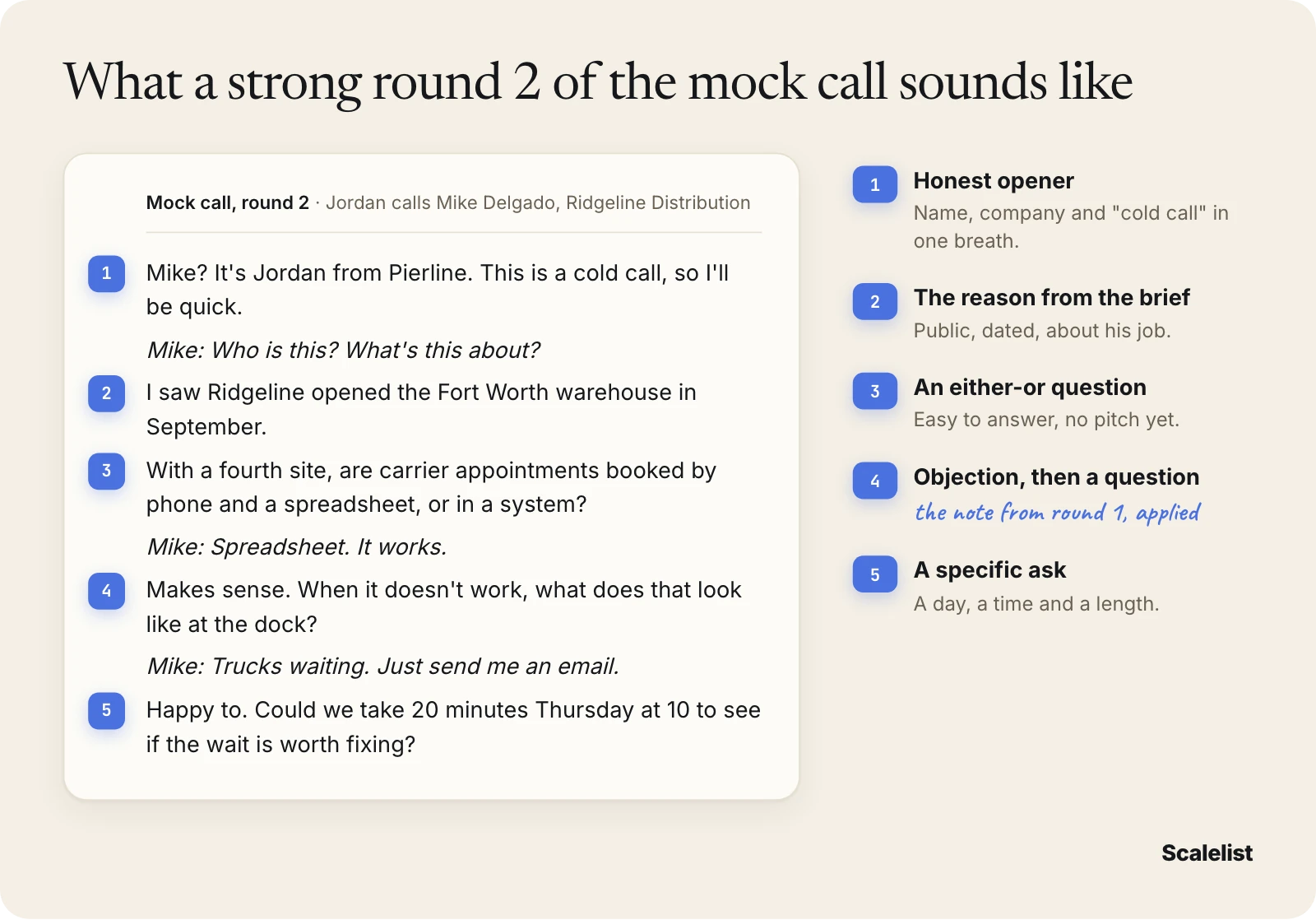
Here is what a strong round 2 sounds like.
The scoring rubric
Score the first five criteria from 1 to 4 on round 2, and score applied feedback on the change between rounds. Applied feedback counts double, so the maximum is 28. Our hire bar is 20 or more, with at least 3 on applied feedback; it is a starting point, not a published benchmark.
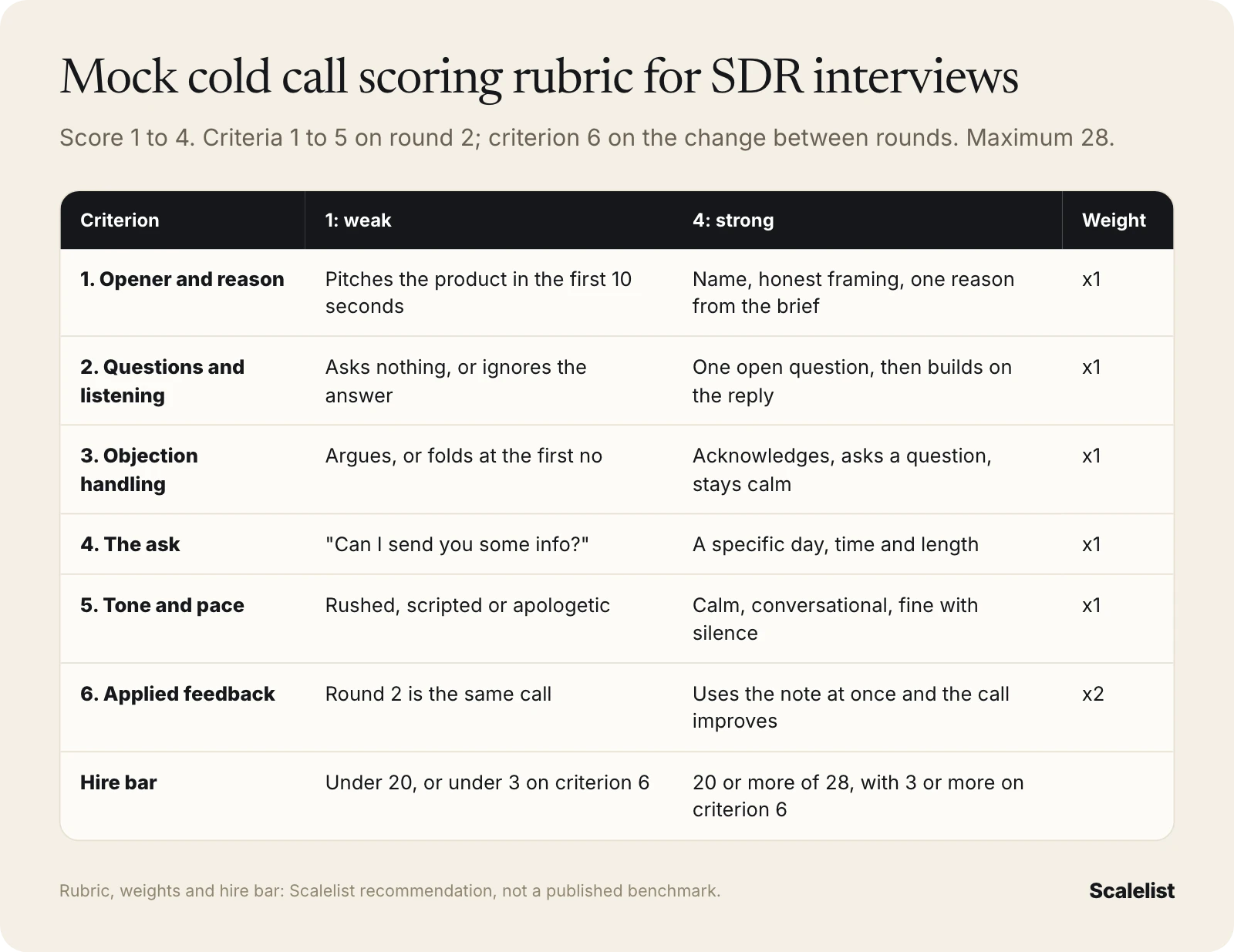
A candidate who starts shaky in round 1 and clearly improves in round 2 is often a better hire than one who gives the same polished call twice. You are hiring the round-2 rep. To keep scoring calls after the hire, use the same habit in your cold call coaching and call reviews.
Give your new SDR a call list on day one: describe the buyer in one sentence and get verified emails and direct mobiles.
Describe your buyer in one sentenceRed flags in an SDR interview
The biggest red flags in an SDR interview are signs the candidate can’t take coaching or won’t pick up the phone. One alone is a reason to dig; two usually mean no.
| Red flag | What it sounds like | What to do |
|---|---|---|
| No feedback story | “I can’t think of any feedback I got” | Ask about a coach, teacher or manager. Still nothing? Weigh it heavily |
| Blames the list or the leads | “The leads were bad, so nothing worked” | Ask what they did about it |
| Phone avoidance | “I’d rather start with email and social” | Ask how many calls a day they’d make by choice |
| Same call twice | Round 2 of the mock call matches round 1 | Score applied feedback 1 |
| No questions for you | “No, I think you covered everything” | A curious SDR always has one |
| Talks over the interviewer | Finishes the script after you interrupt | Rerun question 15 |
Questions SDR candidates should ask
Good SDR candidates ask about ramp, lists, coaching and pay, because those four things decide whether they can hit quota. If you’re the candidate, these are worth asking; if you’re hiring, have honest answers ready.
2. What does a ramped SDR do in a day: how many dials, emails and conversations?
3. Where do the call lists come from, and how many numbers are direct mobiles?
4. What are the targets in months 1, 2 and 3?
5. Is variable pay based on meetings booked or meetings held?
6. How often will someone listen to my calls and give me feedback?
- Question 3 matters more than it looks: a rep calling switchboards all day misses quota for reasons that have nothing to do with skill.
- Question 6 tells you whether there is a real coaching plan, like a 30-day cold calling training plan.
- A company that can’t answer question 1 may not have a path out of the SDR seat.
Mistakes to avoid when hiring SDRs
The most common SDR hiring mistakes are testing the wrong skill and deciding as a group too early. Each one below has a simple fix.
Interviewing a phone job only on video
Video hides what a prospect hears. Run at least the phone screen and the mock call as voice-only calls.
Hiring confidence instead of coachability
A polished round 1 is nice. A clear jump in round 2 predicts the next three months better, because the role is built on weekly feedback.
Testing product knowledge
You will teach the product in the first two weeks. Ask about the buyer’s problem, not your feature list.
Debriefing before scoring
The first strong opinion in the room shapes everyone else’s. Score alone on the rubric, then compare.
Skipping the build-or-hire question
If you have never booked meetings in this market yourself, hire after you know what works. Read founder-led sales before your first SDR, and compare in-house vs outsourced SDR costs before you open the role.
Where Scalelist fits: a list worth calling on day one
A new SDR’s first weeks depend on the list as much as on the rep. The average SDR takes 3.0 months to ramp (The Bridge Group, 2025), and hours spent hunting phone numbers are hours not spent on calls.
Scalelist, an AI lead finder, builds that list from one plain-English sentence. You describe the people you want, like “VPs of Operations at US distributors with 200 to 1,000 employees”, and Scalelist’s Lead Finder shows what it understood and how many people match before you spend a credit.
- Pay on success. 1 credit per lead found, 1 per email found, 10 per mobile found. A miss costs 0.
- Clear statuses. Every email is verified before it is returned and labeled Valid or Risky; misses show as Not found.
- Start small. New accounts get 100 free credits for 7 days, and plans start at 29 USD for 500 credits a month.
Scalelist finds and verifies contact details on demand rather than serving a pre-compiled list. For where calling fits in the whole outbound motion, see our guide to B2B sales prospecting and the complete cold calling guide.
Build your new hire’s first call list with direct mobiles, and pay only for numbers found.
Get 100 credits to test itFAQ
What are the best SDR interview questions?
The best SDR interview questions ask for real past behavior on the job’s hard parts: hearing “no” again and again, acting on feedback, researching a reason to call, planning a high-activity day and explaining something clearly on the phone. Ask “tell me about the last time” rather than “how would you”, and always ask a follow-up. Then confirm the answers with a scored mock cold call.
How do you run a mock cold call in an SDR interview?
Send the candidate a one-paragraph prospect brief 24 hours ahead. Play the prospect for about 5 minutes and throw three objections in a set order. Give one piece of feedback, then run a second 5-minute call on the same prospect. Score both rounds alone on a rubric, with applied feedback counting double. The whole exercise takes about 25 minutes.
Is SDR a difficult job?
Yes. In The Bridge Group’s 2025 survey of 351 B2B companies, a median of 60% of SDRs hit quota, and median annual attrition was 40%, though 16 points of that were promotions. Most of the day is unanswered calls and “no”, which is why resilience and coachability matter more in the interview than sales experience.
What is the 30-60-90 rule in an interview?
It usually means a 30-60-90 day plan: what the candidate would learn and do in their first 30, 60 and 90 days. For an SDR, ask for a one-page version with activity and meeting goals per month. The average SDR ramp is 3.0 months (The Bridge Group, 2025), so 90 days is the right horizon for the plan.
What are the 5 C’s of interviewing?
There is no single standard list. Different hiring guides use different sets of five words. For an SDR hire, a more useful checklist is the six traits on this page: resilience, coachability, curiosity, organization, phone communication and motivation. Each has questions above, and the mock cold call tests most of them in one exercise.
What questions should an SDR candidate ask in an interview?
Ask what the last three SDRs went on to do, what a ramped rep does in a day, where the call lists come from, what the targets are in months 1 to 3, whether variable pay counts meetings booked or held, and how often someone reviews your calls. The answers show whether the role is set up for you to hit quota.
How long should the SDR interview process take?
About two hours of the candidate’s time across five steps: a 15-minute phone screen, a 45-minute hiring manager interview, a 25-minute mock cold call, a 30-minute team conversation and independent scoring. That is our recommended loop. Longer processes rarely add signal, and strong SDR candidates often have other offers.


