Branded caller ID shows your company name, and sometimes your logo and a call reason, on the prospect’s phone instead of a bare number. It helps when a good number lands on a supported mobile. It does not fix a number that analytics engines already score as spam, and it does nothing for a call that rings a switchboard.
This guide shows what the prospect actually sees, why sales numbers get labeled “Spam Likely”, what your team controls, what branded calling costs per call, and when the bigger lever is calling direct mobiles.
What is branded caller ID?
Branded caller ID is a service that displays a business’s verified name, and on enhanced versions its logo and the reason for the call, on the recipient’s mobile phone when that business calls. The brand data travels with the call through the carrier, so the prospect sees “Ridgeline Payroll” instead of “+1 555 0142” or “Unknown”.
It is different from the older Caller ID Name (CNAM), a 15-character name that most US carriers show on landlines by default but only as an opt-in on mobiles (Twilio). Branded calling is built for smartphones, where CNAM often never appears.
What the prospect actually sees on their screen
The prospect sees one of three things: a bare number, a warning label that replaces your caller ID, or your brand. Which one depends on your number’s reputation, their carrier and their phone.
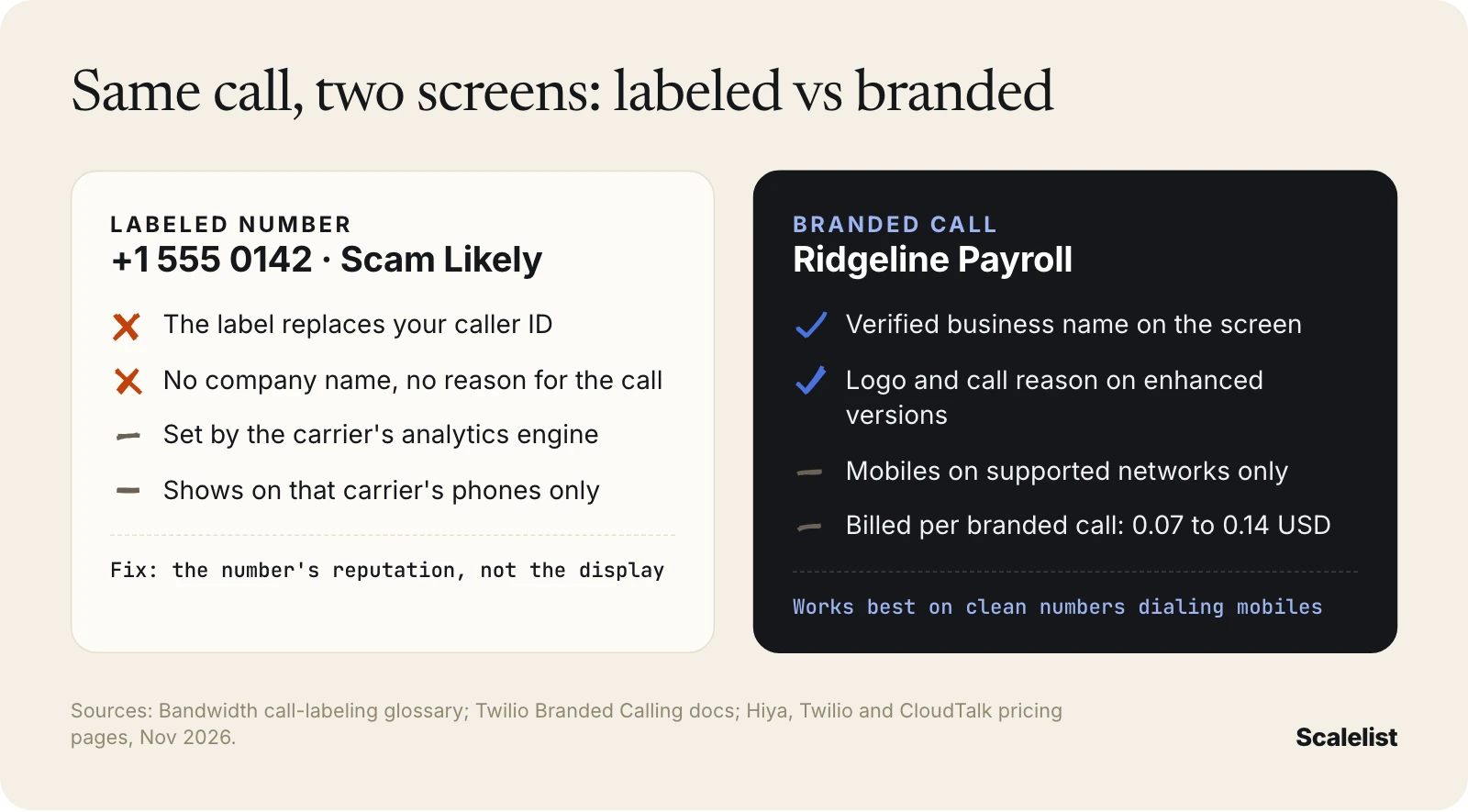
Here is what each option puts on screen and where it works:
| Option | What shows | Where it works | Published price |
|---|---|---|---|
| Plain number | Digits, maybe a city | Every phone | Included with your line |
| CNAM | Up to 15 characters, usually capitals | Landlines by default; mobiles only if the user opted in | Varies by provider |
| Branded calling | Verified business name; logo and call reason on enhanced versions | Mobiles on supported networks | 0.07 to 0.14 USD per branded call |
Coverage is the catch. Twilio lists its US branded calling on T-Mobile and Verizon networks, and says branding works on mobile phones while landlines need CNAM (Twilio docs). Hiya’s pricing page says it plainly: “Not every outbound will be branded. Branding depends on which operators and devices are supported” (Hiya).
The industry also runs a shared scheme. CTIA’s Branded Calling ID sends “name, logo, call reason” to smartphones through vetted partners, and calls are signed using the STIR/SHAKEN call-authentication framework (Branded Calling ID). For the rules that apply to caller ID on sales calls, read our B2B cold calling laws page.
Why do sales calls get labeled Spam Likely?
Sales calls get labeled because an analytics engine scores the calling number as risky and the prospect’s carrier shows that score as a label. The label “overwrites the default Caller ID”, per Bandwidth, a carrier that explains the process (Bandwidth).
Each major US carrier works with one engine: AT&T with Hiya, T-Mobile with First Orion, Verizon with TNS. That is why the same number can show “Scam Likely” on one network and look clean on another.
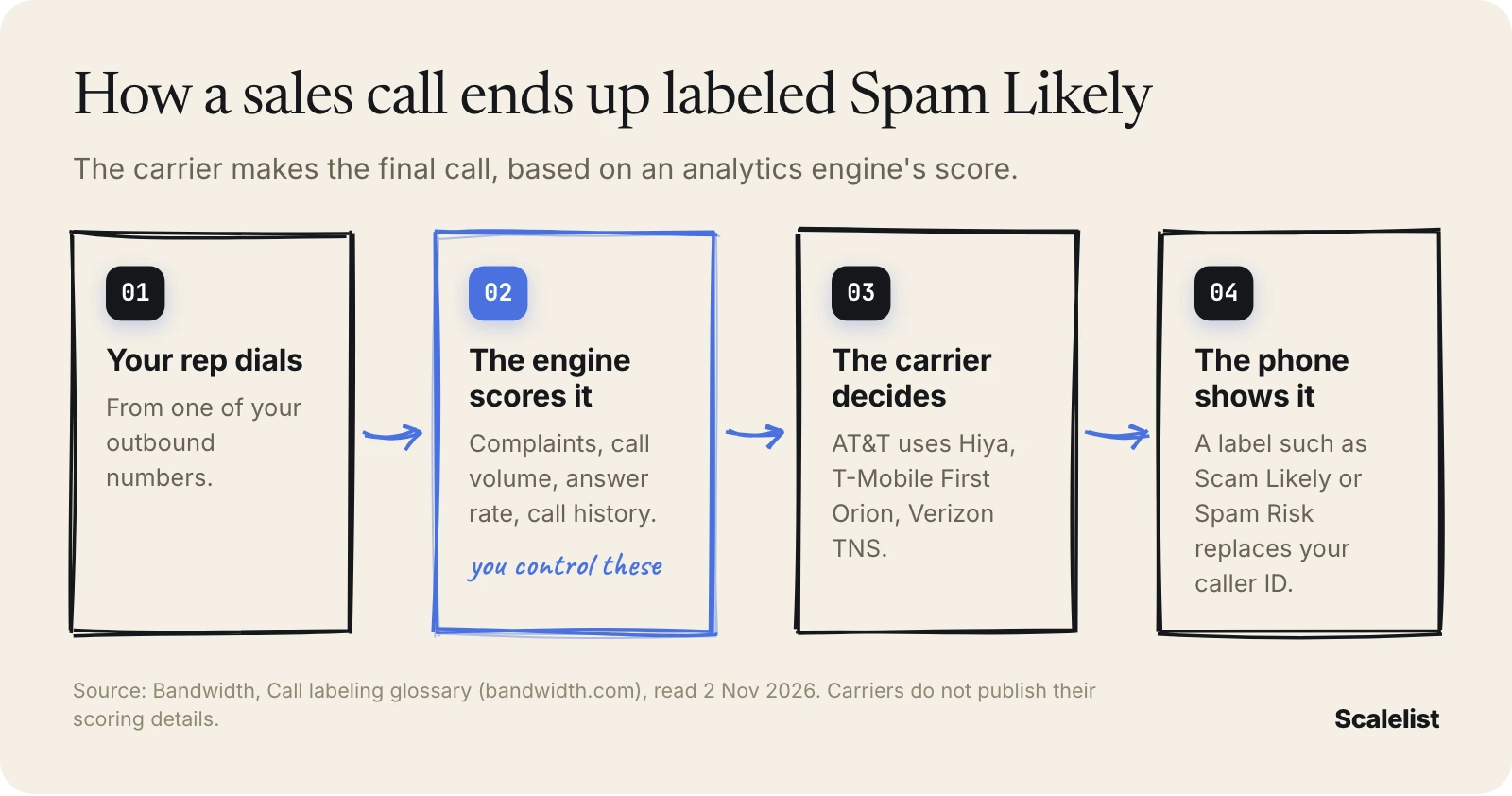
Bandwidth lists what the scores are “typically influenced by”: consumer complaints or feedback, call volume, answer rate and call history. It also notes carriers “have not released specific details”. Nobody can sell you a safe number of dials per day.
Here is a typical path to spam likely sales calls. A team buys a fresh block of numbers, each rep dials 150 times a day from one of them, most calls go unanswered, a few prospects tap “report spam”, and within weeks the number carries a label.
What your team can control
Your caller ID reputation is the sum of how your numbers behave, so you control most of it before any vendor gets involved. Work through these in order.
1. Register every outbound number
Register each number you call from with the analytics engines before you use it. The Free Caller Registry, brought to you by First Orion, Hiya and TNS, takes your business details, call purpose, monthly volume and your 10-digit US numbers, up to 20 typed in or more by file (Free Caller Registry).
It is a starting point, not a fix. The registry itself says registration “does not guarantee redress” and is not a replacement for reputation monitoring.
2. Spread volume across numbers, and give each one a history
Every number builds its own record. A brand-new number has no call history, and one number carrying a whole team’s dials piles volume and unanswered calls onto a single score.
Give each rep a small set of numbers, add new ones gradually, and keep a number in use long enough to earn a history. Most power dialers can assign and rotate numbers per rep.
3. Raise your answer rate with a better list
Answer rate is one of the scored signals, and the list decides it. Dialing switchboards, dead desk lines and people who left the company produces long runs of unanswered calls from the same number.
This is where caller ID and data quality meet. A list of direct mobile numbers gets picked up more often, which is good for the meeting count and for the number’s score.
4. Keep complaints near zero
Complaints are the signal you control most directly. Call people whose job matches your offer, at sensible local hours, say who you are in the first sentence, and remove anyone who asks you to stop on that call.
5. Watch each number every week
Check every outbound number at least weekly. Many dialers sell this: Nooks lists reputation monitoring and carrier registration, Orum lists number rotation and reputation monitoring, and PhoneBurner and CloudTalk sell spam remediation add-ons. A cheaper check is a test call from one phone on each of AT&T, T-Mobile and Verizon.
Track the answer rate per number too. A number whose pickups drop while the rest of the team’s hold steady is usually the one being labeled. Our guide to cold call connect rates by number type shows what normal looks like.
6. Pull a labeled number from rotation
When a number is labeled, stop dialing from it, ask for a review through the engine’s or carrier’s channel, and keep it for callbacks only. Do not swap in a batch of fresh numbers and repeat the same pattern: the new numbers start with no history and the same behavior.
Local presence dialing: pros, cons and the trust risk
Local presence dialing means calling each prospect from a number you own with an area code that matches theirs. Most sales dialers offer it: PhoneBurner (after approval), Kixie inside its ConnectionBoost add-on, and Dialpad from its Sell Advanced plan.
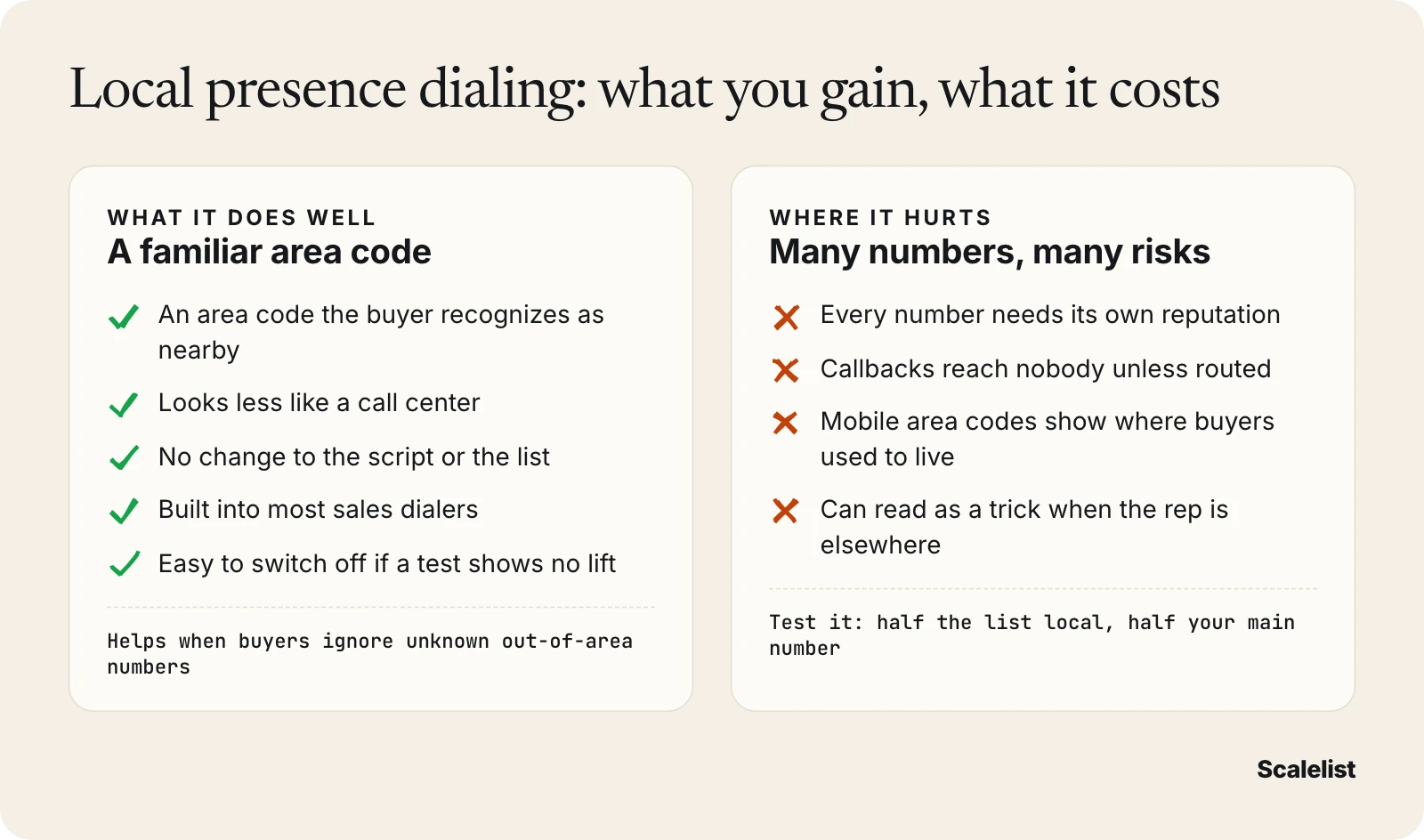
What it does well: – A local area code looks less like a call center, and US adults screen unknown numbers hard: eight in ten say they don’t generally answer their cellphone when an unknown number calls (Pew Research Center, 2020). – It requires no change to the script or the list.
Where it hurts: – More reputations. Twenty area codes means twenty numbers to register and watch. – Lost callbacks. The prospect calls back a 303 number and reaches nobody. – Old area codes. People keep their mobile number when they move. – A trust cost. A Columbus buyer who hears a rep in Austin on a 614 call may trust you less.
The honest test: run half of a list with local presence and half from your main number for two weeks, then compare connects and meetings per 100 dials, not pickups alone.
What branded caller ID costs
Branded calling is priced per branded call delivered, so the bill grows with your dial volume. These are the published prices we found, in USD, as of 2 November 2026:
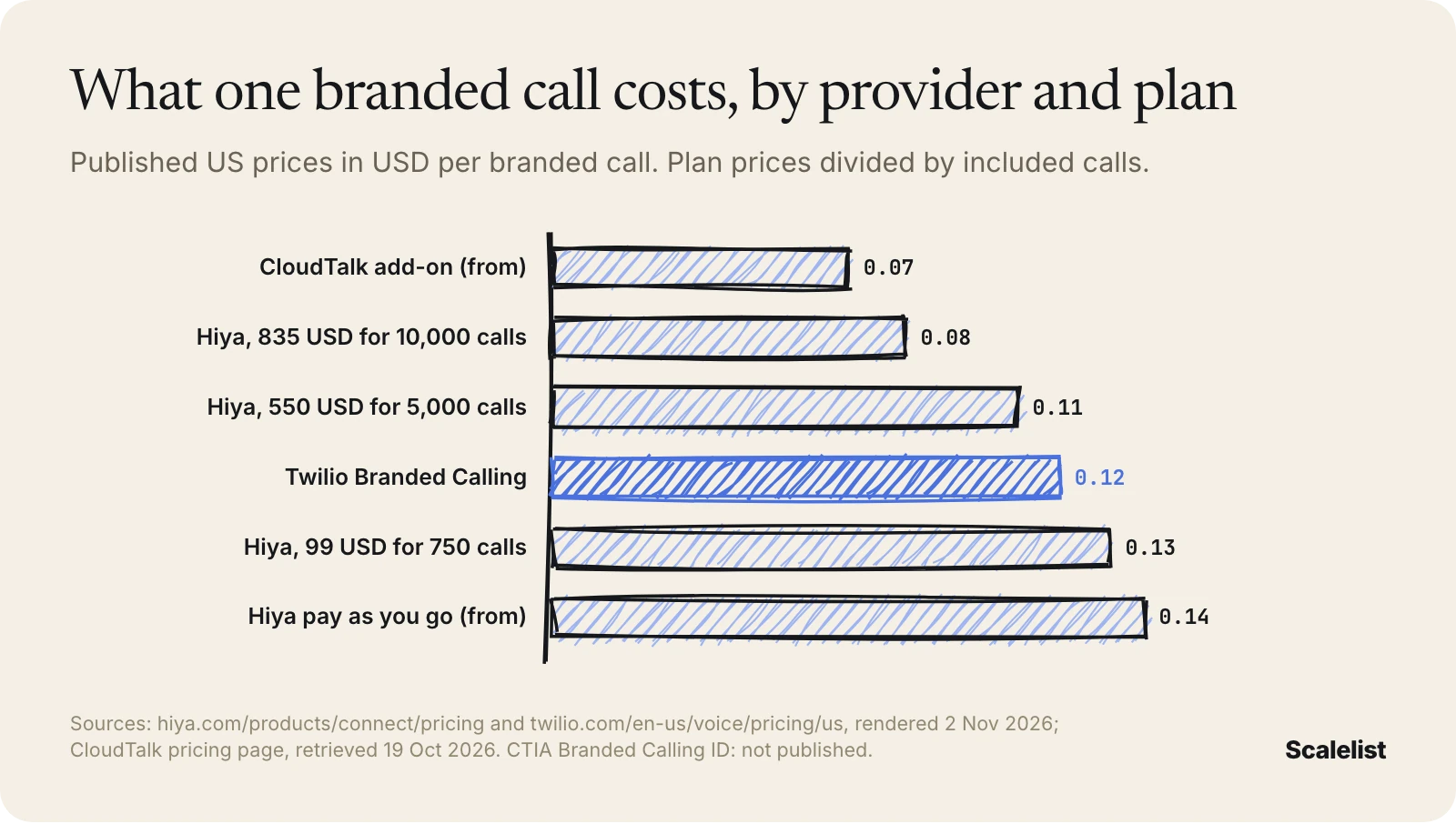
- Hiya Branded Call: 99 USD a month for 750 branded calls, 299 for 2,500, 550 for 5,000 and 835 for 10,000, or pay as you go “starting from $0.14 per branded call, with no minimum spend” (Hiya pricing).
- Twilio Branded Calling: 0.12 USD per call on its US voice pricing page (Twilio pricing).
- CloudTalk Branded Caller ID: an add-on from 0.07 USD per call for US and UK numbers (CloudTalk pricing).
- CTIA Branded Calling ID: prices not published. The site says enterprises pay only when delivery of their information is confirmed.
A worked example
Marcus Bell runs a four-person SDR team at Ridgeline Payroll in Denver. Each rep makes about 1,200 dials a month. Hiya’s calculator recommends its 99 USD plan (750 branded calls) for 1,200 outbound calls, because not every call can be branded.
That is about 400 USD a month for the team, or about 4,750 USD a year, to put “Ridgeline Payroll” on the screens of prospects whose carrier and phone support it. It is worth it only if the calls already reach the right people.
When is branded calling worth paying for?
Branded calling is worth paying for when your numbers are clean, your list is mostly mobiles, and your brand means something to the people you call. Otherwise fix the list and the numbers first.
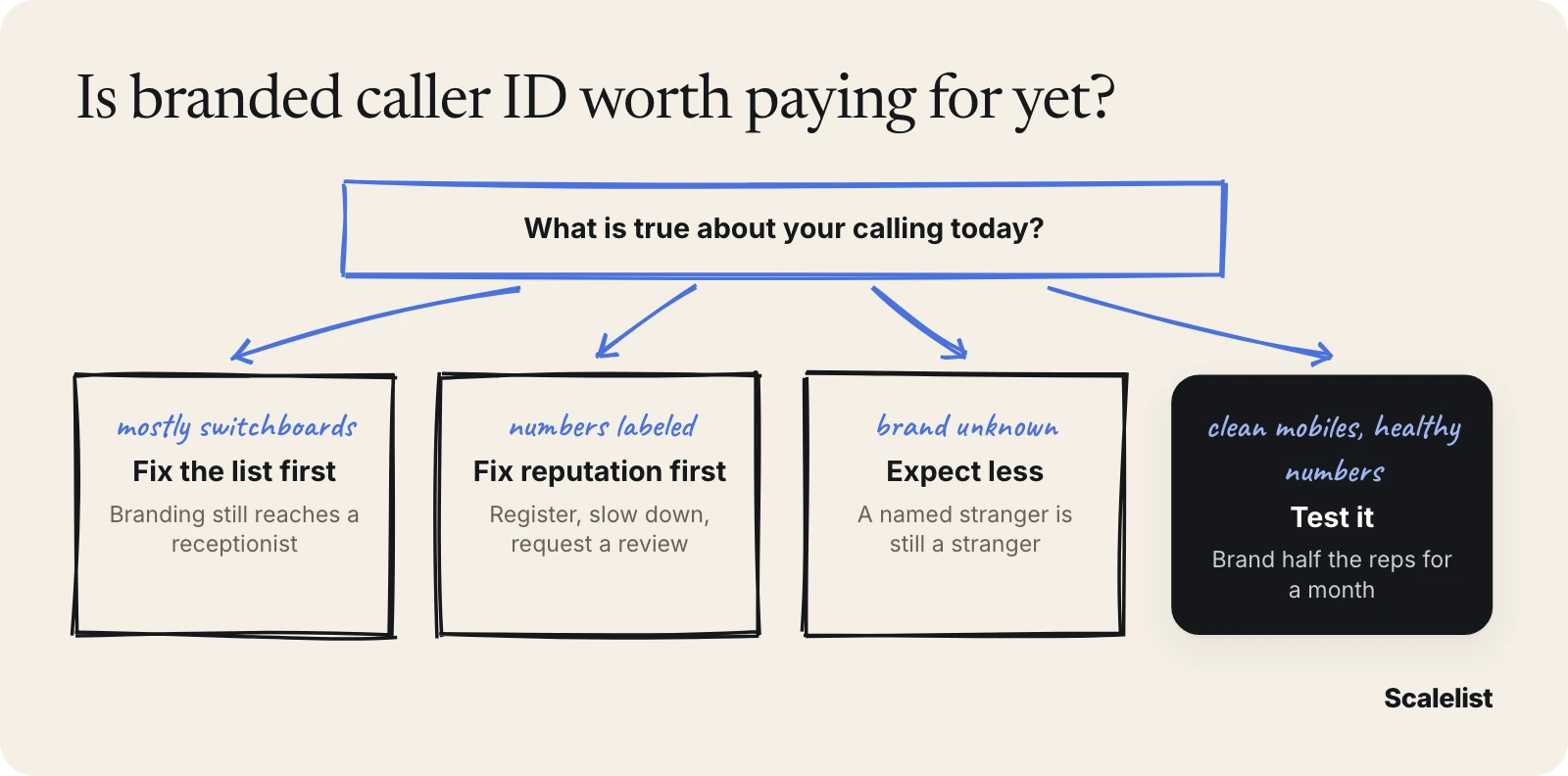
Your list is mostly switchboards
Fix the list first. A branded call to a main line still reaches a receptionist, and going through a gatekeeper cuts the chance of a successful call by 39% (Gong guide, 300M+ calls). See how to get past the gatekeeper for the calls you cannot avoid.
Your numbers are already labeled
Fix reputation first. Vendors sell branding and spam remediation as separate products, which tells you they are separate problems.
Your brand is unknown to the buyer
Expect less. “Ridgeline Payroll” on the screen of an HR director who has never heard of you is still a stranger, just a named one. Branding pays most when your name is recognizable to the buyer or when you call people who already asked for contact.
Your list is clean mobiles and your numbers are healthy
Test it. Brand half the reps for a month and compare connects and meetings per 100 dials against the other half.
The bigger lever: the number you dial
The number you dial changes your pickups more than the name on the screen. Across nearly 3 million dials, Nooks found “mobile numbers have a 45% higher connect rate than non-mobile numbers”, and those conversations became meetings 18% more often (Nooks, 2025).
My own dials point the same way: 894 dials across 8 recorded sessions from July to September 2026, mostly to direct mobiles, booked 18 meetings, about one per 50 dials. More detail by number type: direct dial vs mobile.
The cost comparison is stark. The 99 USD Hiya plan brands 750 calls for one month. On Scalelist’s 2,000-credit plan, 89 USD finds up to 200 mobile numbers, and you keep each one for every future dial.
Common caller ID problems and the fix
Most caller ID complaints from sales teams fall into three patterns, and each has a specific fix.
“Our calls show Spam Likely on some phones and not others”
Each carrier uses its own engine, so one number can be labeled on T-Mobile and clean on AT&T. Test from all three networks, then request a review with the engine behind the carrier that labels you.
“We pay for branding but prospects still see a number”
Branding needs a supported carrier and a supported phone. Twilio lists US branded calling on T-Mobile and Verizon only, and calls to landlines fall back to CNAM. Ask your vendor for the share of calls actually branded each month.
“Prospects call back and reach nobody”
Route every outbound number, local presence numbers included, to the rep who called or to a staffed line. Leave a voicemail that names your company and a number that rings a person.
Our sales voicemail scripts cover the rest of the callback flow.
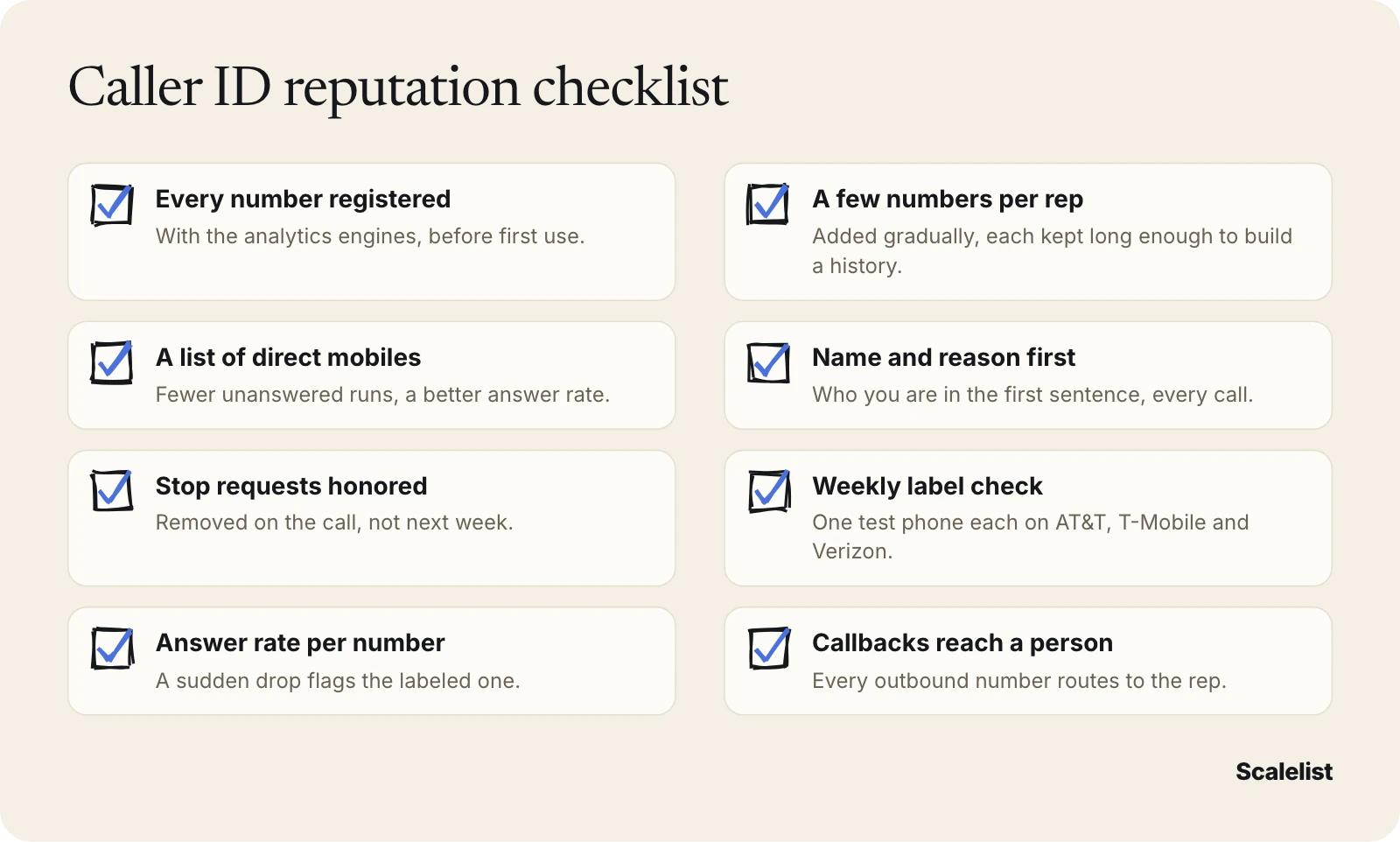
Caller ID best practices checklist
Run this checklist before any new calling block, and again whenever pickups drop.
What to look for in a dialer or caller ID tool
Ask these questions before you buy branded calling or a dialer that bundles it. Our comparison of cold calling software applies the same questions to nine tools.
- Branded share: what percentage of last month’s calls were actually branded, by carrier.
- Pricing unit: per branded call delivered, per call attempted, or per seat.
- Number health: per-number answer rate and label checks on AT&T, T-Mobile and Verizon.
- Registration: whether the vendor registers your numbers with the analytics engines for you.
- Callbacks: whether inbound calls to every outbound number reach the rep.
- Data: whether it supplies phone numbers at all. Most dialers do not, so the list still comes from you.
How Scalelist helps you call people who pick up
Scalelist, an AI Lead Finder, is where you get the mobile number, not just the email. It does not brand calls or manage caller ID; it gives your dialer better numbers to call.
- Describe the buyer in one sentence: “HR directors at US manufacturers with 200 to 1,000 employees”. Lead Finder shows what it understood and how many people match, and sizing the search costs nothing.
- Get the mobile: the Mobile Finder costs 10 credits per mobile found and 0 when nothing is found.
- Known cost: about 0.40 USD per mobile on the 5,000-credit plan (199 USD a month). New accounts get 100 free credits for 7 days.
- Load your dialer: export a CSV or push leads to HubSpot.
My own setup is simple: Scalelist AI lead finder pulls the list with direct mobiles, Claude preps every call, Flunter dials and logs everything. For the full method, start with our cold calling guide.
Find direct mobiles for your next calling block, 10 credits per mobile found and 0 for a miss.
Find your first 20 contactsFAQ
How does branded caller ID work?
Branded caller ID works by attaching your verified business name, and on enhanced versions a logo and call reason, to your outbound calls through the carrier network. The prospect’s carrier displays it on supported mobile phones. You register and verify your business and numbers with a provider first, and most providers charge per branded call delivered. Calls to unsupported carriers or landlines show a plain number or CNAM instead.
How much does branded calling cost?
Published prices run from about 0.07 to 0.14 USD per branded call as of November 2026. CloudTalk’s add-on starts at 0.07 USD per call, Twilio lists 0.12 USD per call, and Hiya charges 0.14 USD pay as you go or 99 USD a month for 750 branded calls. CTIA’s Branded Calling ID does not publish a price.
Does branded caller ID remove a Spam Likely label?
Do not count on it. Labels come from the analytics engine’s score of your number, based on complaints, call volume, answer rate and call history. Branding and spam remediation are sold as separate products. Register the number, fix how it is used, request a review, and add branding once the number is clean.
What is local presence dialing?
Local presence dialing is calling each prospect from a number whose area code matches theirs, picked automatically by the dialer. It can help with people who ignore unknown out-of-area numbers, but each number needs its own registration and monitoring, callbacks must reach a person, and a mobile’s area code often shows where the buyer used to live.
What is a TransUnion branded caller ID?
TransUnion is one of several companies that sell branded caller ID to businesses, alongside Hiya, First Orion, TNS, Numeracle and Twilio. We did not review its product or pricing for this page. Whichever vendor you consider, ask which carriers it reaches, what share of calls it brands, and whether you pay per call delivered.
Does using *67 still work?
Yes, for personal calls. On AT&T, dialing *67 before a number hides your caller ID for that one call, per AT&T’s support page. For sales calls it backfires: the prospect sees no number at all, and eight in ten US adults say they don’t generally answer unknown callers. Whether you may hide your number on a sales call is covered on our laws page.
Sources
- Twilio: Branded Calling overview
- Twilio: US Voice pricing
- Twilio: Brand your calls using CNAM
- Hiya: Branded Call pricing
- CTIA: Branded Calling ID
- Bandwidth: Call labeling
- Free Caller Registry
- Pew Research Center: Most Americans don’t answer cellphone calls from unknown numbers (2020)
- Nooks Insights: Here’s who picks up the most (2025)
- Gong: How to master cold calls, based on 300 million calls (2024)
- CloudTalk: Pricing
- AT&T: Block Caller ID